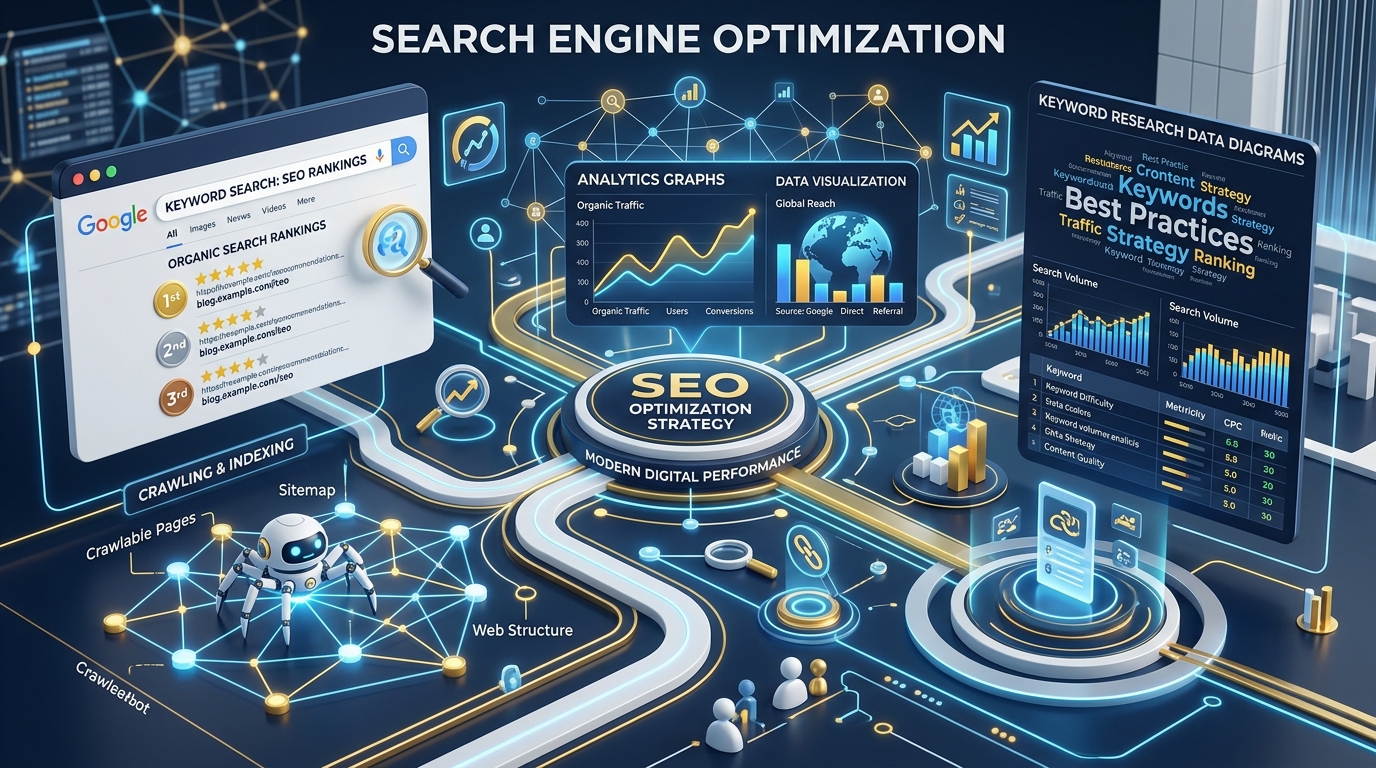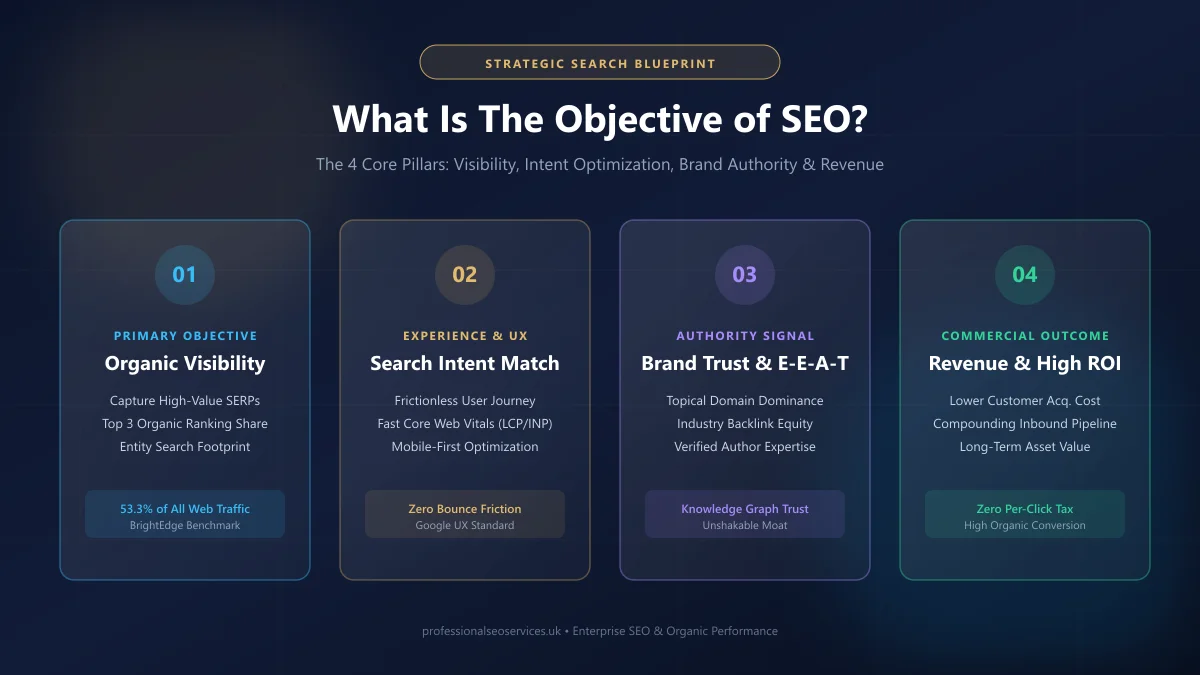
Executive Takeaway: What Is the Objective of SEO?
The fundamental objective of Search Engine Optimization (SEO) is not simply ranking for arbitrary keywords; it is to systematically align your digital web properties with commercial and informational search intent to capture qualified organic market share, build compounding brand authority, minimize Customer Acquisition Cost (CAC), and generate repeatable, high-margin revenue.
In modern digital commerce, search engines represent the primary gateway through which consumers discover solutions, evaluate competing alternatives, and finalize purchasing decisions. When executives ask, "What is the objective of SEO?", traditional marketers frequently offer a superficial answer: "to rank on page one of Google."
While securing premier positions on a Search Engine Results Page (SERP) is a crucial tactical milestone, viewing rankings as the ultimate objective fundamentally misunderstands the economic power of organic search. Rankings are an operational mechanism; commercial value creation and market leadership are the true objectives. To understand search optimization at an executive level, one must study how search algorithms evaluate information, how human search journeys unfold, and how sustainable organic visibility transforms balance sheets. Organizations seeking sustainable growth work with Professional SEO Services to turn complex search dynamics into defensible enterprise assets.
Defining the Primary Objective of SEO: Beyond Mere Rankings
To grasp the complete scope of search optimization, businesses must separate vanity metrics from commercial utility. An enterprise could theoretically achieve top positions for hundreds of obscure search terms, yet yield zero pipeline growth if those queries fail to align with qualified user intent.
The Core Mission: Aligning Brand Value with Searcher Intent
Every query typed or spoken into a search engine represents an unfulfilled user need. A research study conducted by Pew Research Center demonstrates that over 80% of adult consumers rely directly on search engines to initiate research prior to major commercial transactions.
Consequently, the core operational objective of SEO is search intent alignment. This process ensures that when prospective clients search for solutions to complex problems, your digital assets emerge as the most relevant, authoritative, and frictionless destination. Whether the query is informational ("how to diagnose website crawl leaks"), comparative ("custom enterprise CMS vs headless WordPress"), or strictly transactional ("hire dedicated technical SEO consultancy"), the objective is to capture the searcher at the exact second their intent forms.
The Revenue Engine: From Raw Traffic to Business Growth
According to extensive cross-industry research by BrightEdge Research, organic search drives 53.3% of all trackable website traffic across B2B and B2C verticals, surpassing paid search, social media, and direct channels combined.
Therefore, the commercial objective of SEO is to construct an evergreen revenue engine. Unlike paid advertising channels that cease generating leads the moment advertising budgets are exhausted, SEO builds persistent digital real estate. An optimized, high-authority domain continues to capture high-value inbound prospects month after month, delivering asymmetric returns on invested capital. To understand the deeper economic mechanics behind this compounding return, examine our comprehensive guide on whether SEO is worth the investment.
The 7 Strategic Objectives of Modern Search Engine Optimization
A mature enterprise SEO campaign operates across multiple interdependent dimensions. Below are the 7 primary strategic objectives that govern high-performance search marketing programs.
| Strategic Objective | Operational Focus | Primary Business Impact |
|---|---|---|
| 1. Maximize Qualified Visibility | Dominating top organic SERP positions and rich snippets | Massive capture of high-intent search traffic |
| 2. Build Brand Trust & E-E-A-T | Author expertise, knowledge graph entities, peer backlinks | Industry authority, elevated conversion velocity |
| 3. Dominate Full-Funnel Intent | Targeting TOFU, MOFU, and BOFU customer lifecycle stages | Nurturing buyers from discovery to contracted revenue |
| 4. Enhance UX & Core Web Vitals | Eliminating layout shifts, sub-second latency, mobile parity | Lower bounce rates, superior on-site engagement |
| 5. Lower Customer Acquisition Cost | Compounding organic channels vs escalating pay-per-click ads | Drastic reduction in blended CAC, higher profit margins |
| 6. Create Defensible Moats | Developing semantic topical depth & deep content clusters | Protection against algorithm updates and competitors |
| 7. Future-Proof for AI & GEO | Structuring entities for Google AI Overviews and LLM citations | Omnipresence across conversational and generative search |
1. Maximizing Qualified Organic Search Visibility
The first objective is ensuring your brand is prominently displayed when potential buyers search for services you provide. Prominence is not merely appearing somewhere on the first page; click-through rate (CTR) curves demonstrate that the top three organic results command over 54% of all search clicks.
Securing top visibility requires continuous mastery of search mechanics, indexing algorithms, and search features like featured snippets, People Also Ask (PAA) blocks, and video carousels. To explore how Google processes web architecture during indexation, review our deep dive on how Google SEO works behind the scenes.
2. Building Brand Authority, Trust, and E-E-A-T
Modern search engines are sophisticated semantic information retrieval engines. As outlined in Google Search Essentials, Google’s automated ranking systems explicitly reward documents demonstrating Experience, Expertise, Authoritativeness, and Trustworthiness (E-E-A-T).
When an organization consistently publishes verified, research-backed insights that solve customer queries, search engines recognize the domain as an authoritative node within their knowledge graphs. This recognition fosters immense buyer trust: consumers instinctively perceive websites ranking at the summit of search results as the undisputed leaders in their industry.
3. Dominating Full-Funnel Search Intent (TOFU to BOFU)
A common strategic failure is restricting SEO efforts exclusively to high-competition, bottom-of-the-funnel "money keywords." While commercial queries are vital, modern buying journeys are non-linear and involve dozens of digital touchpoints.
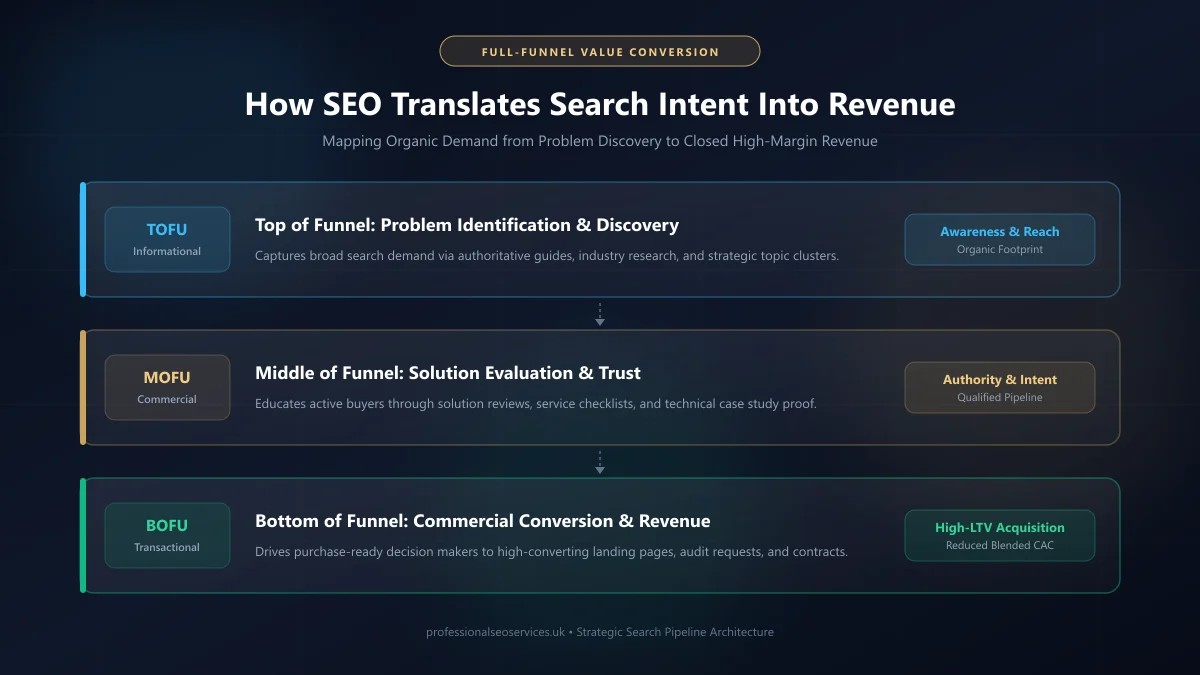
The strategic objective of SEO is to construct an integrated digital pipeline that captures users across all three lifecycle tiers:
- Top of Funnel (TOFU - Informational Intent): Prospects identify operational pain points or industry concepts. SEO captures them through in-depth architectural guides, research studies, and educational documentation (e.g., our foundational primer on what SEO is and how it functions).
- Middle of Funnel (MOFU - Commercial Intent): Prospects evaluate architectural options, methodologies, and service models. SEO addresses this via comparison matrixes, vendor checklists, and our proven organic search case studies.
- Bottom of Funnel (BOFU - Transactional Intent): Ready-to-buy decision-makers search with immediate intent. SEO captures this high-value demand through specialized landing pages such as our ecommerce SEO services and targeted local SEO campaigns.
4. Enhancing User Experience and Core Web Vitals
SEO has evolved past manipulative meta-tag tuning into a rigorous engineering discipline. Google’s Page Experience signals and Core Web Vitals (Largest Contentful Paint, Interaction to Next Paint, and Cumulative Layout Shift) mandate that a website must be exceptionally fast, technically stable, and responsive across all device viewports.
Rigorous UX research published by the Nielsen Norman Group proves that sub-second page rendering and clear semantic hierarchy drastically reduce user cognitive strain and abandonment rates. By aligning technical site architecture with search engine performance thresholds, SEO directly improves conversion rates across all web traffic sources.
5. Lowering Customer Acquisition Costs (CAC) and Maximizing ROI
In an era characterized by escalating digital advertising costs, platform privacy restrictions, and diminishing ad attribution accuracy, reliance on pay-per-click (PPC) advertising creates significant margin pressure.
The objective of SEO is to serve as an economic hedge that lowers blended Customer Acquisition Cost (CAC). While paid media requires a recurring fee for every click, organic traffic behaves like an appreciating capital asset. Once a comprehensive library of authoritative content ranks at the top of the SERP, it continues to deliver qualified leads without ongoing media costs. To understand how paid and organic channels work together, see our detailed guide on how SEO impacts PPC advertising performance.
6. Establishing Sustainable Competitive Moats via Topical Authority
One of the most valuable objectives of search engine optimization is the creation of a competitive moat that rival firms cannot easily replicate. In search architecture, this moat is known as Topical Authority.
Rather than producing disconnected articles, an advanced SEO program constructs comprehensive semantic clusters that answer every question, sub-topic, and adjacent problem within an industry niche. To master this content methodology, read our guide on building topical authority through strategic content clustering. When search algorithms confirm that your domain offers the most comprehensive, interlinked repository of answers in your vertical, your rankings become remarkably resilient to algorithm updates.
7. Future-Proofing for AI Search, GEO, and Answer Engines
The search landscape is undergoing its most radical transformation in two decades with the emergence of generative answer engines, including Google AI Overviews, Perplexity AI, and ChatGPT search features.
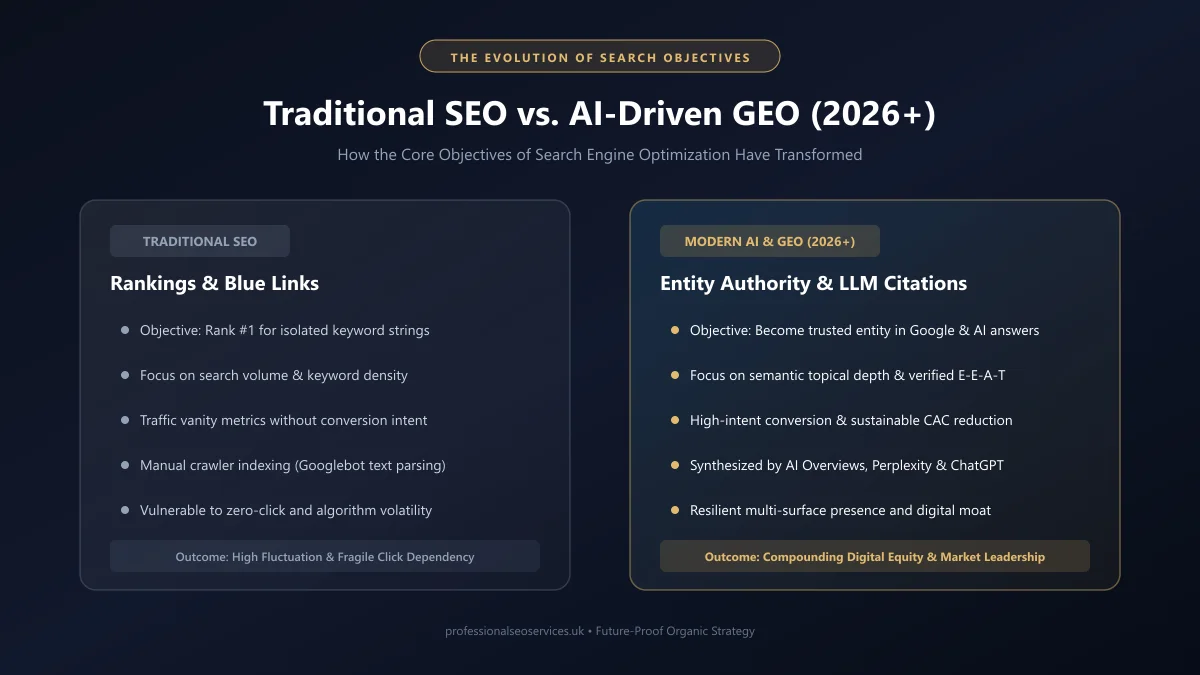
In this new paradigm, the objective of search optimization has expanded to include Generative Engine Optimization (GEO). The goal is to format, structure, and position your entity so that Large Language Models (LLMs) parse, digest, and cite your content as the authoritative source of truth. To safeguard your visibility in conversational search, explore our specialized GEO, LLM & AI SEO services.
How Different SEO Disciplines Drive Business Objectives
Achieving enterprise search objectives requires the harmonious execution of specialized sub-disciplines. Each branch of search optimization fulfills distinct operational functions:
Technical SEO: Laying the Foundation for Crawlability & Indexation
Technical SEO ensures that search spiders can crawl, parse, render, and index your digital pages without friction. Key objectives include optimizing crawl budget, structuring XML sitemaps, managing canonical tags to eliminate duplicate content leaks, and enforcing rigid schema markup hierarchies. Discover how we eliminate crawling roadblocks through our bespoke technical SEO services.
On-Page & Semantic SEO: Relevance & Content Architecture
On-page optimization aligns page copy, header hierarchy, internal linking networks, and metadata with user search intent and algorithmic natural language processing (NLP) models. Learn how we optimize web architecture for maximum engagement through our on-page SEO services.
Off-Page SEO: Digital PR, Brand Signals & Link Equity
Off-page optimization establishes your domain's credibility across the broader web. The objective is to earn contextual backlinks from trusted publications, secure digital PR mentions, and reinforce entity signals that validate your authority. Elevate your external reputation with our dedicated off-page SEO services.
Local SEO: Geotargeted Dominance & High-Intent Conversion
For businesses serving physical geographic markets, the objective of local search optimization is capturing the Google Map Pack and local localized organic rankings. This drives phone inquiries, foot traffic, and rapid regional conversions. Check our strategic framework in local search optimization services.
Measuring the Objective of SEO: Key Metrics, KPIs, and ROI Frameworks
To verify whether an SEO campaign is successfully fulfilling its strategic objectives, companies must implement a dual-tier measurement framework that separates operational diagnostics from executive business outcomes.
Tactical KPIs vs. Executive Revenue Metrics
Operational teams track technical health and ranking shifts, but board-level leadership evaluates commercial velocity. For a detailed guide on tracking performance, see our article on how to accurately measure SEO success.
| Diagnostic Metric (Tactical) | Executive Business Metric | Strategic Business Insight |
|---|---|---|
| Keyword Rankings & Position Gains | Organic Pipeline Revenue | Translates visibility directly into closed revenue contracts |
| Search Impressions in GSC | Market Share of Voice (SOV) | Measures relative industry dominance over direct competitors |
| Gross Organic Sessions | Qualified Lead Volume (MQLs/SQLs) | Separates irrelevant traffic from purchase-ready decision makers |
| Core Web Vitals Pass Rate | E-commerce Conversion Rate | Proves speed and usability drive checkout completions |
| Acquired Inbound Backlinks | Blended CAC Reduction | Demonstrates how organic equity slashes overall marketing spend |
Organic Search Attribution and Lifetime Value (LTV)
Sophisticated organizations measure SEO through multi-touch attribution models. Because organic search frequently serves as the critical touchpoint that introduces a buyer to a brand or re-engages them during consideration, attributing revenue solely to the final click undervalues organic search equity. When analyzing customer lifetime value (LTV), customers acquired via high-intent organic search typically exhibit higher retention rates and higher contract values than those acquired through disruptive advertising.
Frequently Asked Questions About the Objectives of SEO
What is the primary objective of SEO in simple terms?
The primary objective of SEO is to connect your business with active searchers who need your products or services, earning unpaid top placements on Google so you generate qualified website visitors, leads, and sales at a lower cost than paid ads.
Is the objective of SEO different for B2B vs. B2C businesses?
While the underlying technical mechanics are identical, the commercial objectives differ. B2C and ecommerce SEO prioritize high-volume transactional queries, immediate cart checkouts, and catalog visibility. B2B SEO focuses on long-tail informational and commercial intent, educating multiple enterprise stakeholders, and driving high-value sales meetings and demo inquiries.
How long does it take for SEO to achieve its objectives?
SEO is an asset-building strategy. Initial technical indexing and ranking gains typically materialize within 3 to 6 months, while transformative organic traffic growth, topical dominance, and compounded CAC reductions generally reach maturity between 6 to 12 months of consistent execution.
Can SEO completely replace paid search advertising?
While SEO can drastically reduce reliance on paid ads, the most effective marketing organizations use search optimization and PPC in synergy. SEO captures sustainable, high-margin evergreen traffic, while paid ads provide instantaneous promotional testing and protect branded search terms.
Will AI answer engines eliminate the objective of traditional SEO?
No. AI answer engines and Google AI Overviews do not generate facts out of thin air; they synthesize data from indexed, highly authoritative web documents. Therefore, the objective of SEO expands into Generative Engine Optimization (GEO): producing structured, original research that AI systems cite as the definitive authority.
Conclusion: Aligning Search Engine Optimization with Commercial Success
The objective of SEO is not an isolated technical exercise, nor is it a vanity pursuit of search rankings. When executed with precision, SEO is the strategic art and science of aligning your company’s unique value proposition with the real-time intent of prospective buyers.
By optimizing site crawlability, building comprehensive topical clusters, providing flawless user experience, and cultivating external domain authority, your website transforms from a static digital brochure into an appreciating commercial pipeline that compounds in enterprise value over time.
Whether you are looking to scale enterprise organic revenue, expand into new international markets via our international SEO services, or resolve complex architectural crawl leaks, partnering with seasoned practitioners accelerates your path to market leadership. Connect with the senior team at Professional SEO Services to request your custom strategy audit today.

Written by Rehan Saeed
Lead SEO Specialist & Technical Growth Architect
Rehan Saeed is the Lead SEO Specialist at Professional SEO Services, specializing in large-scale technical architecture, topical authority clustering, and algorithmic search recovery for enterprise brands across the UK and internationally. Connect on LinkedIn.