Google Search Engine Optimization (Google SEO) is the systematic engineering process of aligning website architecture, semantic content, and authority signals with Google's automated discovery, crawling, rendering, indexing, retrieval, and ranking algorithms. It operates by transforming raw source code into structured knowledge that Googlebot parses, understands, and delivers on the Search Engine Results Page (SERP) when searchers enter relevant queries.
The main benefits of understanding how Google SEO works center on securing durable first-page visibility, reducing customer acquisition costs, and generating high-intent commercial organic traffic. Websites that align with Google's algorithmic systems capture clicks from buyers searching for targeted solutions, building qualified revenue without recurring pay-per-click expenses.
The primary uses and applications of Google SEO include local service lead generation, ecommerce product revenue expansion, B2B pipeline growth, and enterprise brand authority building. Companies use search engine optimization to establish visibility across every stage of the user journey, answering informational questions and fulfilling transactional purchases.
The main parts and components of Google SEO comprise technical infrastructure, semantic on-page relevance, topical authority architecture, and off-page link graph validation. Coordinating these components enables search engines to parse pages rapidly and reward documents with top rankings. Organizations collaborate with Professional SEO Services to design bespoke technical roadmaps that maximize search visibility across competitive markets.
What Happens After You Publish a Webpage?
Publishing a webpage makes the document accessible on your web server, but Google remains completely unaware of its existence until discovery takes place. The server assigns the page an HTTP 200 status code, yet no search engine user can locate the page through organic search. Google does not automatically monitor your hosting server for newly published files.
Why Simply Having a Website Isn't Enough to Rank
Simply having a website is not enough to rank because search engines evaluate billions of competitive web documents to select only the most authoritative and relevant answers. Over 1.1 billion websites exist online, and Google processes more than 8.5 billion searches per day. If a webpage lacks indexation directives, clear topical entities, internal links, and external validation, search algorithms bypass the document entirely.
Google's Journey from Discovering a Page to Showing It in Search
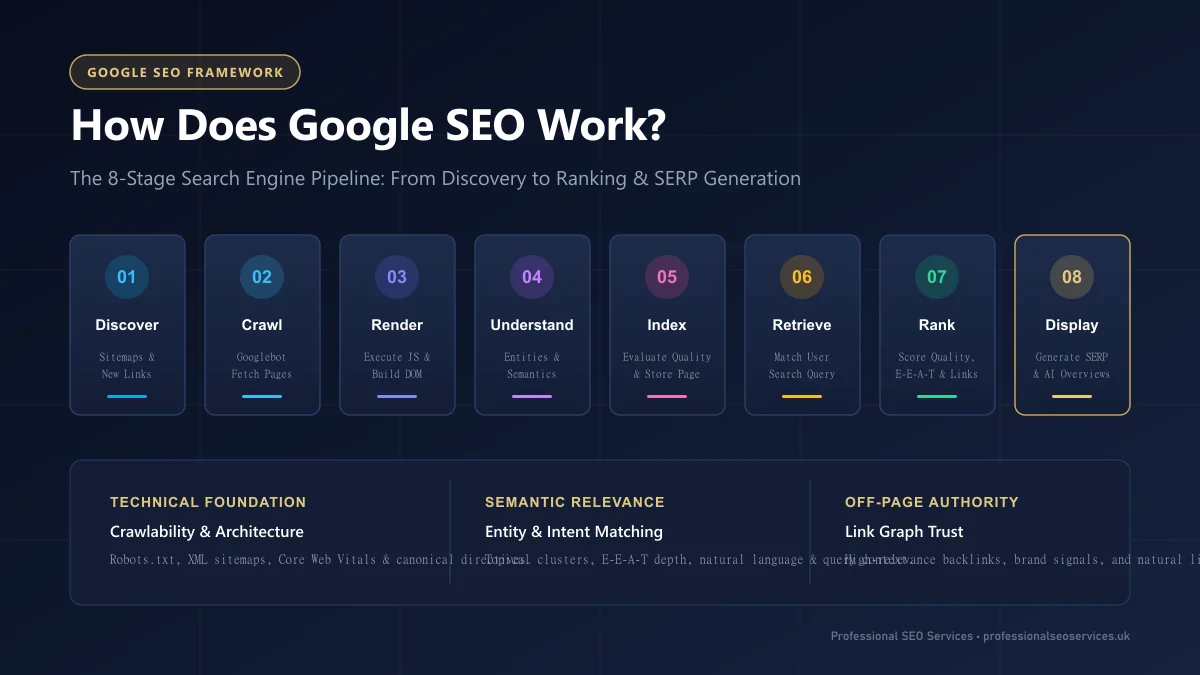
Google's journey from discovering a page to showing it in search follows an eight-stage automated pipeline: discovery, crawling, rendering, understanding, indexing, candidate retrieval, ranking scoring, and SERP display. Each phase acts as an algorithmic gatekeeper. A failure at any single point in the pipeline prevents a webpage from appearing in front of searchers.
Quick Overview of the Process
The complete Google search pipeline functions through sequential algorithmic operations:
- Google discovers your URL through sitemaps, internal links, or external backlinks.
- Googlebot fetches the server response headers and HTML markup.
- Web Rendering Service (WRS) compiles client-side JavaScript code.
- Natural language systems extract entities, concepts, and topical relevance.
- Indexing algorithms store eligible, non-duplicate content in the Search Index.
- Candidate retrieval systems pull potentially relevant pages when a user submits a query.
- Ranking algorithms score documents using hundreds of contextual signals.
- SERP generators display organic listings, Rich Results, and AI Overviews.
Google Search Pipeline Framework
Every webpage progresses through 8 sequential algorithmic stages before ranking. A failure at any single phase prevents search visibility.
Discover
Googlebot locates URLs via XML sitemaps, internal links, external backlinks, and Google Search Console submissions.
Crawl
Googlebot Smartphone makes HTTP GET requests, downloading source HTML and media while respecting crawl budget limits.
Render
Web Rendering Service (WRS) compiles client-side JavaScript, generates full DOM layout, and exposes dynamic elements.
Understand
BERT & MUM natural language models identify entities, resolve semantic relationships, and determine topical intent.
Index
Quality filters validate canonicals, filter duplicate text, and store qualified content in the massive Search Index.
Retrieve
When a user searches, retrieval algorithms extract matching candidate documents based on intent, location, and language.
Rank
Algorithms calculate ordering using E-E-A-T credentials, PageRank backlinks, Core Web Vitals, and anti-spam detection.
Display
SERP layout engine presents organic links, rich snippets, Local 3-Packs, and generative AI Overviews to the searcher.
The Cumulative Law of SEO: The 8 stages operate as strict prerequisites. If Googlebot is blocked in robots.txt (Stage 2), your page will never be rendered (Stage 3). If your JavaScript content fails to render (Stage 3), Google cannot understand your semantic entities (Stage 4), leaving the URL excluded from the Search Index (Stage 5).
How Does Google SEO Work?
Google SEO works by executing an eight-stage automated retrieval and ranking pipeline: discovering URLs, crawling web code, rendering JavaScript, analyzing semantic content, indexing quality pages, retrieving relevant candidate documents, evaluating ranking signals, and displaying the Search Engine Results Page (SERP).
To achieve organic search traffic, webmasters optimize their digital assets to satisfy each stage of Google's pipeline:
- Google discovers URLs: Googlebot collects unvisited links from XML sitemaps, internal links, external backlinks, and the Google Search Console (GSC) URL Inspection API.
- Google crawls pages: The crawler downloads the HTML document, stylesheet links, and server headers while adhering to host crawl budget limits.
- Google renders the page when necessary: Headless Chromium instances execute client-side JavaScript, parse Document Object Model (DOM) elements, and expose dynamic media.
- Google analyzes and understands the content: Natural Language Processing (NLP) models like BERT and MUM extract entities, evaluate semantic associations, and classify search intent.
- Google decides whether to index the page: Algorithms evaluate canonical tags, duplicate content thresholds, content depth, and quality metrics before admitting the document into the primary Search Index.
- Google retrieves potentially relevant pages for a query: When a user enters search terms, retrieval algorithms locate millions of candidate documents containing matching entities from the index within milliseconds.
- Ranking systems evaluate the candidates: Algorithmic systems assess Experience, Expertise, Authoritativeness, and Trustworthiness (E-E-A-T), backlink profiles, Core Web Vitals (CWV), and freshness signals to order results.
- Google generates the SERP: The layout engine constructs traditional organic blue links, featured snippets, knowledge panels, Local Packs, and AI Overviews tailored to user context.
Step 1: How Google Discovers Your Website
Google discovers your website by gathering Uniform Resource Locators (URLs) from seed lists, XML sitemaps, internal links, and external hyperlinks across the web. Before Googlebot can read a single word of your content, the crawler must first learn that your URL exists.
How Googlebot Finds New URLs
Googlebot finds new URLs by parsing hyperlinks found on existing, indexed web pages and reading registered sitemap feeds. The search crawler maintains an extensive database of known URLs called the crawl queue. When Googlebot visits an established page, the crawler extracts every valid hyperlink located in the page code and adds newly identified destinations to the queue for future processing.
Internal Links
Internal links are hyperlinks that connect two pages on the exact same domain. They provide Googlebot with navigable crawl pathways through your site architecture. Connecting newly published blog posts or service landing pages directly from high-authority parent pages allows Googlebot to locate your content within minutes of publication.
External Links
External links are hyperlinks originating from a third-party domain pointing toward your website. When an external website links to your content, Googlebot encounters your address while crawling that third-party page. Earning backlinks from established industry sites serves as a primary vehicle for rapid URL discovery on brand-new domains.
XML Sitemaps
An XML sitemap is a structured machine-readable file that lists all canonical URLs on a website alongside last modification timestamps. Submitting an XML sitemap through Google Search Console directly alerts Google to new, updated, and archived pages. Googlebot downloads the sitemap periodically to identify content revisions without needing to traverse every individual webpage link.
URL Discovery Through Other Sources
Google discovers URLs through 4 secondary sources: HTTP 301 redirect chains, domain registrar updates, Google Search Console URL submission tools, and Google Chrome user navigation data. Inspecting URL discovery paths confirms that creating multiple discoverable entry points accelerates crawler pickup.
Practical takeaway: How to make important pages discoverable:
- Add the target URL to your primary XML sitemap immediately upon publication.
- Create at least 3 to 5 contextual internal links from existing high-traffic pages on your website.
- Submit the link directly via the URL Inspection tool inside Google Search Console.
- Share the new webpage across verified brand social media profiles to trigger external link traversal.
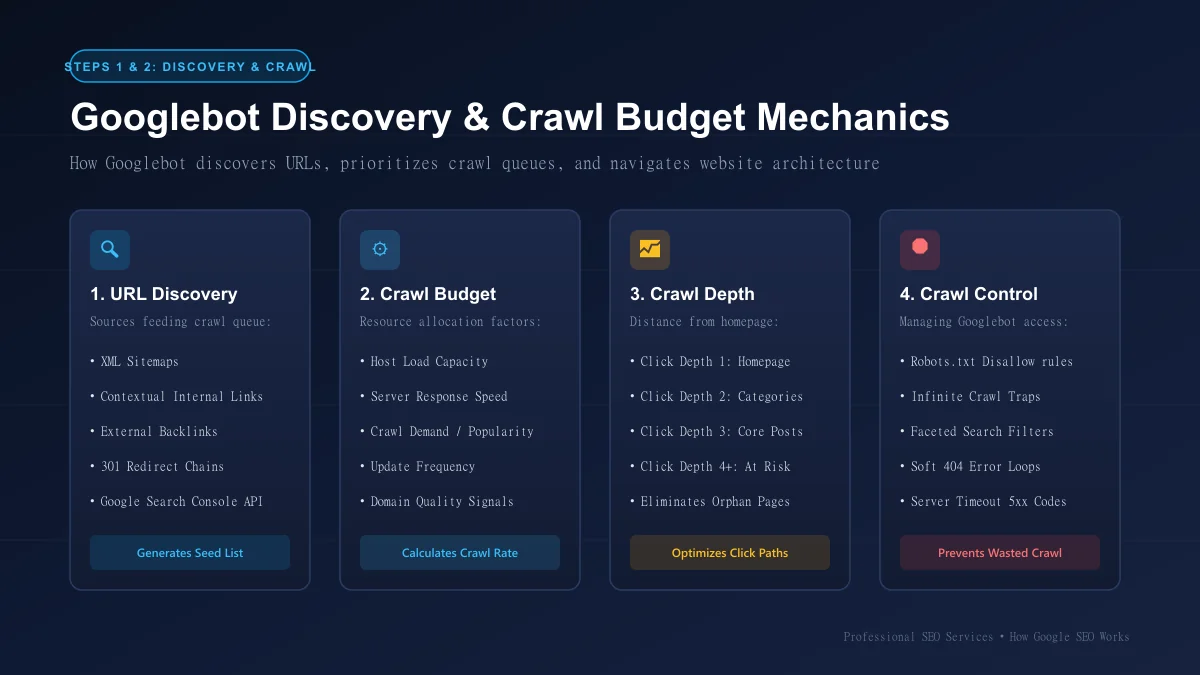
Figure 1: Googlebot URL discovery mechanisms, crawl budget allocation parameters, and click depth management.
Step 2: How Google Crawls Your Website
Google crawls your website by dispatching Googlebot to make HTTP/HTTPS GET requests to your web server, downloading the page's HTML markup, media assets, and structural code. Crawling represents the physical data-gathering phase of search engine optimization.
What Is Googlebot?
Googlebot is the generic brand name for Google's automated web crawling software. Googlebot operates under two primary user-agent personas: Googlebot Desktop (which emulates a desktop browser) and Googlebot Smartphone (which emulates a modern mobile device). Since Google transitioned fully to mobile-first indexing, Googlebot Smartphone conducts the vast majority of crawling requests across commercial websites.
How Google Decides What to Crawl
Google decides what to crawl by weighing 3 core criteria: crawl priority, URL update frequency, and domain popularity. Pages that update regularly (such as news feeds or active ecommerce stores) receive frequent crawl visits. Static informational pages that rarely change experience longer intervals between crawler requests.
Crawl Budget
Crawl budget is the total number of URLs Googlebot can and wants to crawl on a website within a specified timeframe. Crawl budget is determined by 2 distinct factors: crawl rate limit (how many simultaneous requests your web server can handle without slowing down) and crawl demand (how popular your URLs are and how frequently they change). Learn more about server resource management in our comprehensive technical SEO guide.
Crawl Depth
Crawl depth is the number of clicks required for a user or search crawler to navigate from the homepage to a target webpage. Web pages situated within 1 to 3 clicks of the homepage receive frequent crawling and higher internal PageRank transfer. Pages buried 4 or more clicks deep risk being crawled infrequently or overlooked completely by search bots.
Crawl Traps
A crawl trap is a website architecture flaw that produces an infinite number of unique URLs, consuming crawler budget without providing organic search value. Common crawl traps include infinite calendar links, unchecked faceted search filters, session identifier parameters, and recursive redirect loops.
Robots.txt and Crawling
Robots.txt is a plain text configuration file placed at the root directory of a web server to specify which pages search crawlers may or may not access. Directives like Disallow: /admin/ prevent Googlebot from making HTTP requests to administrative directories. Modify your robots.txt file, if server resources become strained by bot requests to non-public utility URLs.
Step 3: How Google Renders Your Webpage
Google renders your webpage by loading the downloaded HTML, CSS, and JavaScript files through a headless browser environment to generate the visual layout and complete Document Object Model (DOM). Rendering ensures search algorithms evaluate web pages exactly as real human users perceive them.
What Is Rendering?
Rendering is the technical execution of web code into a fully interactive visual document. Google utilizes its Web Rendering Service (WRS), which runs an up-to-date headless Chromium browser engine. The WRS executes scripts, parses layout coordinates, and discovers client-side links that do not exist in the initial static HTML response.
HTML vs JavaScript Content
HTML content is delivered immediately from the web server as plain text, whereas JavaScript content requires client-side code execution to construct the text on the page. Googlebot processes server-rendered static HTML during its initial crawl pass with minimal resource overhead. Content dependent upon client-side JavaScript execution enters a separate processing queue.
Why JavaScript Can Affect SEO
JavaScript can affect SEO by delaying indexing, masking critical links, and increasing server resource strain. Because executing scripts requires extensive computing power, Googlebot defers JavaScript rendering until computing resources become available. This delay can cause newly published content, dynamic pricing, or updated copy to remain unindexed for days or weeks.
Client-Side vs Server-Side Rendering
Client-Side Rendering (CSR) obligates the user's browser or Googlebot to assemble HTML using client scripts, whereas Server-Side Rendering (SSR) produces complete, pre-rendered HTML directly on the server before transmission. Implement Server-Side Rendering or Static Site Generation (SSG), if your website relies heavily on modern JavaScript frameworks like React, Angular, or Vue.
How to Check What Google Can See
To check what Google can see, use the URL Inspection tool inside Google Search Console and click "Test Live URL". Review the rendered screenshot, the generated HTML DOM code, and the HTTP response status. The test reveals whether external scripts, blocked CSS resources, or rendering timeouts prevent Googlebot from reading your primary content.
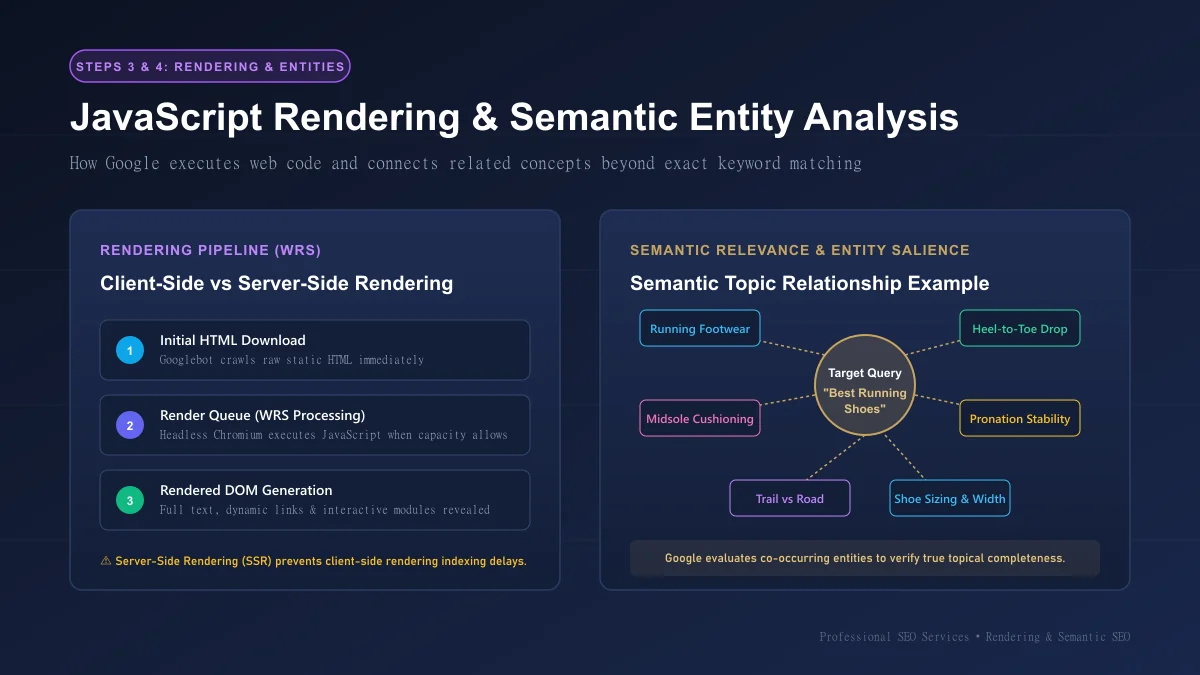
Figure 2: The Web Rendering Service (WRS) execution pipeline and semantic entity relationship graph.
Step 4: How Google Understands Your Content
Google understands your content by applying Natural Language Processing (NLP) models, Knowledge Graph entities, and semantic vector embeddings to decode topical relationships rather than matching strings of characters. This cognitive phase represents the most sophisticated technical milestone in modern search engine architecture.
How Google Interprets Words and Topics
Google interprets words and topics using machine learning systems like Bidirectional Encoder Representations from Transformers (BERT) and Multitask Unified Model (MUM). These transformer models analyze words in relation to all other words in a sentence, eliminating linguistic ambiguity and capturing nuanced search intent across complex search phrases.
Entities and Their Relationships
An entity is a singular, well-defined concept, person, place, organization, or thing that exists independently of the language used to describe it. Google stores billions of interconnected entities in its Knowledge Graph. Algorithms identify entities within your text, assess their salience, and map their mathematical proximity to established industry topics.
Semantic Relevance
Semantic relevance is the degree of topical alignment between the meaning of a search query and the conceptual coverage of a webpage. Google determines semantic relevance by evaluating whether a document incorporates the technical vocabulary, context, and related entities that genuine subject-matter experts naturally include.
Search Intent
Search intent is the fundamental objective or problem a user seeks to resolve when typing a phrase into the search box. Search intent is categorized into 4 primary classes: informational (seeking knowledge), navigational (locating a specific website), commercial investigation (comparing products or services), and transactional (ready to complete a purchase).
Context and Query Meaning
Context and query meaning determine how Google interprets polysemous words with multiple definitions based on surrounding terms and user history. For example, the term "Apple" refers to a fruit in recipes, but signifies a technology corporation when paired with terms like "iPhone", "operating system", or "stock price".
Main Topics vs Supporting Subtopics
Main topics define the primary subject of a webpage, while supporting subtopics provide the depth, context, and practical evidence necessary to satisfy user intent completely. Search algorithms reward pages that treat a subject thoroughly over documents that offer shallow, superficial coverage.
Example: Semantic Topic Disambiguation in Action:
When evaluating a search query for "best running shoes", Google does not merely hunt for pages that repeat the phrase "best running shoes". Google's semantic models look for documents rich in co-occurring topical entities:
- Running footwear classification
- Midsole cushioning foams
- Pronation stability support
- Heel-to-toe drop measurements (in millimeters)
- Trail running vs road running outsole traction
- Shoe sizing, toe box volume, and foot width considerations
A webpage that discusses heel drop, arch support, and cushioning foam proves its topical authenticity to search engines without needing to engage in repetitive keyword placement. Explore our guide on content strategy and topical authority to structure entity-driven content clusters that dominate search rankings.
Step 5: How Google Decides Whether to Index a Page
Google decides whether to index a page by evaluating the document against indexation rules, canonical declarations, duplicate content filters, and minimum quality thresholds. Crawling a webpage does not guarantee that the page will ever enter Google's Search Index.
What Is Google's Search Index?
Google's Search Index is a massive global database containing hundreds of billions of web pages organized by topics, entities, and keywords. When you perform a search, you are not searching the live internet; you are querying Google's pre-compiled index. Pages absent from this index cannot appear in search results under any circumstances.
Crawled vs Indexed
Crawled means Googlebot visited and fetched the webpage, whereas indexed means Google parsed, validated, and stored the document in its searchable database. In Google Search Console, the status "Crawled - currently not indexed" signals that Google inspected the URL but chose not to include it in the index due to perceived low quality or duplication.
Why Google May Not Index a Page
Google may decline to index a page for 5 primary reasons: explicit noindex directives, duplicate content, thin informational value, soft 404 status codes, or severe rendering failures. Rectify content quality issues, if URLs remain excluded from the search index.
noindex
A noindex tag is a robots meta directive placed in the HTML header (<meta name="robots" content="noindex">) instructing search engines not to add the page to their search index. Google respects this directive absolutely, dropping the page from organic listings while continuing to crawl the URL periodically to check for status updates.
Canonicalization
Canonicalization is the process of declaring the primary, authoritative URL when multiple pages feature identical or closely similar content. By implementing a <link rel="canonical" href="https://example.com/target-page/" /> tag, webmasters direct search engines to index a single master URL, consolidating ranking authority and preventing duplicate indexing.
Duplicate Content
Duplicate content refers to substantial blocks of text that match content on other pages on the same website or across external domains. Google algorithms identify duplicate text, select one version as canonical, and filter duplicate copies out of search results to ensure searchers see diverse answers.
Thin or Low-Value Pages
Thin pages are web documents that deliver minimal original text, uncurated syndicated copy, or superficial boilerplate content. Search engines actively avoid indexing thin pages to conserve database storage and preserve search quality.
Robots.txt vs Noindex
Robots.txt prevents crawling access, while a noindex tag prevents indexation storage. This distinction is crucial: if a page is blocked in robots.txt, Googlebot cannot crawl the page to read the noindex tag. As a result, the URL may still appear in search results as an empty link if external websites point toward it.
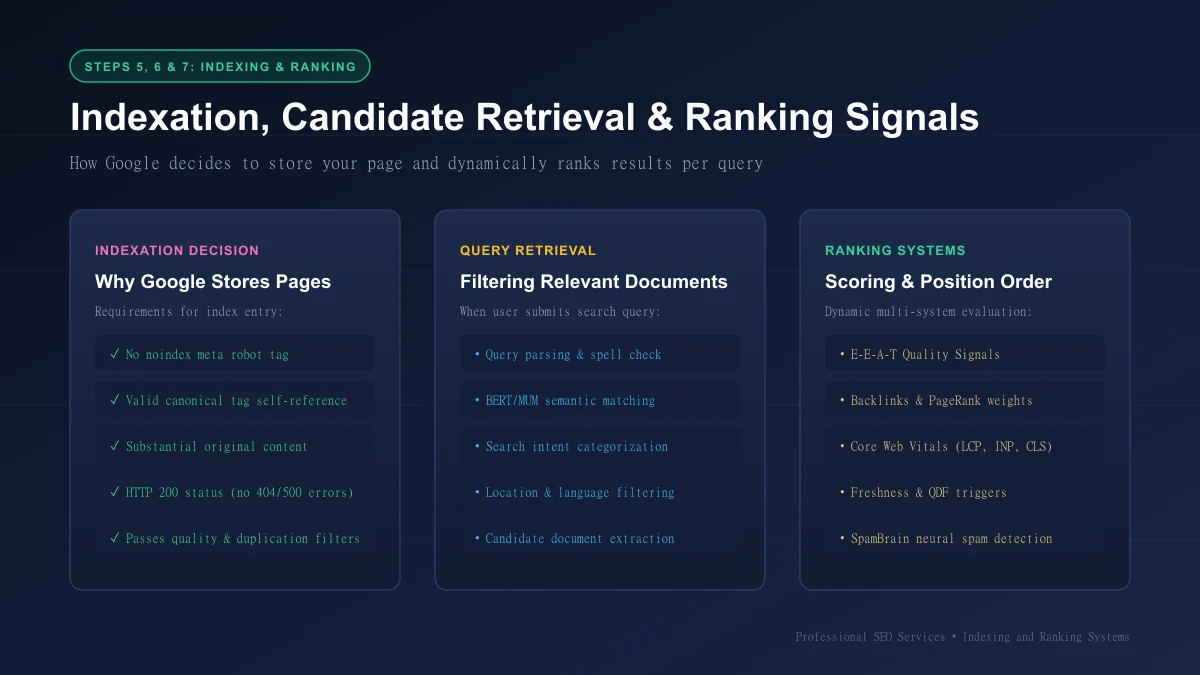
Figure 3: Multi-stage index validation, candidate retrieval filtering, and ranking evaluation signals.
Step 6: How Google Matches Pages to Search Queries
Google matches pages to search queries by interpreting the user's intent, filtering candidate documents from the Search Index, and applying contextual relevance models to extract the best matching results. This retrieval phase bridges the gap between stored index data and live search interactions.
Understanding the Search Query
Google understands search queries by correcting spelling errors, expanding synonyms, identifying entities, and interpreting grammatical relationships. Algorithms parse implicit requirements within the query, recognizing that a search for "emergency plumber" requires immediate service rather than historical plumbing advice.
Matching Search Intent
Matching search intent requires delivering the exact content format that users expect to find. If top-ranking results for a query consist of comparison lists and calculator tools, publishing an editorial opinion piece will fail to satisfy search algorithms regardless of word count.
Query Relevance
Query relevance measures how directly the factual information in a webpage satisfies the specific questions posed by a searcher. Google assesses term frequencies, heading structures, and semantic co-occurrences to score topical fit.
Freshness
Freshness is a temporal relevance factor evaluated by Google's Query Deserves Freshness (QDF) algorithm. Queries surrounding breaking news, current events, annual product releases, or fluctuating financial rates prioritize newly updated documents over historical archives.
Location and Language
Location and language factors tailor search results based on the geographic coordinates, country-code top-level domain (ccTLD), and language preferences of the user. A search for "tax accounting services" performed in London delivers UK-specific advisory firms rather than US providers.
User Context
User context incorporates device type, previous search sessions, and operating settings to refine candidate retrieval. Mobile users receive mobile-optimized interfaces, while searchers on desktop devices see richer analytical displays.
Step 7: How Google Ranks Search Results
Google ranks search results by scoring candidate web pages across multiple algorithmic systems, weighing content depth, domain authority, page experience, and anti-manipulation signals dynamically for every query. There is no single, monolithic "ranking factor"; Google deploys hundreds of interconnected systems.
Relevance
Relevance evaluates whether the text, headings, media, and structure of a page directly solve the user's inquiry. It serves as the baseline qualification: an authoritative page will never rank for an unrelated topic.
Content Quality
Content quality measures original reporting, analytical depth, factual accuracy, and editorial utility. Google penalizes automated regurgitation and elevates content that delivers distinct perspective and comprehensive insight.
Experience and Expertise
Experience and expertise reflect the author's first-hand exposure and technical mastery of the subject matter. Under Google's Search Quality Rater Guidelines, demonstrating genuine personal trial, original product testing, or professional accreditation creates high E-E-A-T scores.
Authority
Authority represents the industry-wide reputation and citation standing of the publishing domain. Authority is established when reputable external publications consistently reference your research, data, and editorial commentary.
Links
Links remain fundamental algorithmic signals of external endorsement and PageRank distribution. The quantity, topical relevance, and editorial integrity of referring domains validate the trustworthiness of a destination webpage.
Page Experience
Page experience measures the technical usability of a webpage during user browsing sessions. Google assesses Core Web Vitals (Largest Contentful Paint, Interaction to Next Paint, and Cumulative Layout Shift), mobile responsiveness, and HTTPS security.
Freshness
Freshness evaluates the velocity and recency of content updates. For dynamic commercial niches, keeping technical specifications and pricing updated signals continuous maintenance.
Spam and Manipulation Signals
Spam and manipulation signals are detected by Google's SpamBrain AI system to suppress deceptive tactics. Keyword stuffing, cloaking, private blog networks (PBNs), and scraped content trigger automatic demotions or manual penalties.
Important: Multiple Dynamic Ranking Systems:
Google does not rely on a fixed, static list of ranking factors. Google deploys multiple specialized ranking systems (including the Helpful Content system, PageRank, Passage Ranking, and MUM) whose relative weights adjust dynamically based on search category, query intent, and user context.
Why Some Pages Rank Higher Than Others
Some pages rank higher than others because search engines evaluate qualitative depth, technical health, entity completeness, and external trust rather than superficial keyword optimization alone. Targeting the exact same target keyword does not produce equal search rankings.
| Evaluation Dimension | Page A (Top 3 Ranking) | Page B (Page 4+ Obscurity) |
|---|---|---|
| Search Intent Matching | Answers search intent directly in first 100 words with clear data | Buries answer under 500 words of generic background fluff |
| Topical Entity Coverage | Covers primary entity and 15+ related semantic subtopics | Repeats target keyword unnaturally with zero entity depth |
| Internal Link Architecture | Supported by 8 contextual internal links within a topic cluster | Orphan page with zero supporting topical internal links |
| Backlink Authority Profile | Possesses 6 editorial links from industry-specific publications | Possesses zero backlinks or low-quality directory links |
| Page Experience (CWV) | LCP of 1.2s, zero layout shift, seamless mobile usability | LCP of 4.5s, intrusive pop-ups, disruptive layout shifts |
Even though Page A and Page B target the identical primary keyword, Google's algorithms reward Page A with top placement because it satisfies technical standards, entity completeness, and user trust.
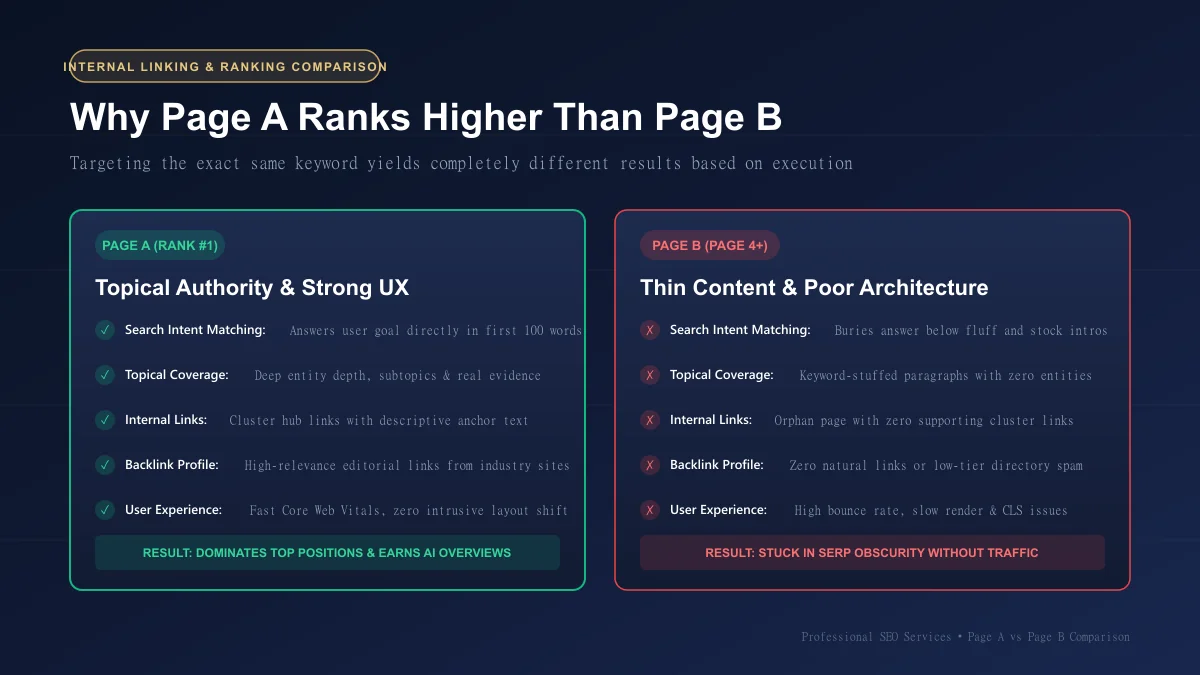
Figure 4: Side-by-side technical and architectural comparison: Page A (Top 3) versus Page B (Page 4+).
How Internal Linking Helps Google Understand Your Website
Internal linking helps Google understand your website by establishing navigational pathways, distributing PageRank equity, defining topical hierarchies, and signaling semantic relationships between related articles. It is one of the most powerful on-site levers for search visibility.
Contextual Internal Links
Contextual internal links are hyperlinks embedded naturally inside body copy surrounding related text. Unlike footer links or navigation menus, contextual links pass topical signals by showing Google the exact conceptual connection between the source paragraph and target page. For a foundational breakdown of search engine fundamentals, review our complete guide explaining what is SEO.
Anchor Text
Anchor text is the visible, clickable text within an HTML hyperlink. Descriptive anchor text tells search engines what the target page is about before Googlebot crawls it. Avoid generic anchors like "click here" or "learn more"; use specific, descriptive phrasing.
Topical Clusters
A topical cluster consists of a core pillar page that covers a broad subject broadly, connected to supporting cluster articles that explore subtopics in depth. Bidirectional internal links between pillar and cluster pages signal undeniable topical expertise to Google's ranking systems.
Crawl Paths
Crawl paths are the sequential chains of hyperlinks Googlebot follows to discover and re-index content across your domain. Clear crawl paths ensure search crawlers access freshly updated content within seconds of traversing your site.
Orphan Pages
An orphan page is a webpage that has zero internal links pointing to it from any other page on the same domain. Orphan pages are difficult for Googlebot to discover, receive zero PageRank transfer, and rarely achieve competitive organic rankings.
Click Depth
Click depth measures the minimum number of clicks required to navigate from the website's homepage to a target URL. Maintain a maximum click depth of 3 clicks for every commercially valuable page on your domain to ensure efficient crawl budget allocation.
Building a Logical Site Architecture
Building a logical site architecture requires organizing pages into intuitive hierarchical directories reflecting clear topic boundaries. A clean structure like domain.com/category/subcategory/page/ allows search algorithms and human visitors to understand parent-child relationships effortlessly.
How Content Quality Affects Google SEO
Content quality affects Google SEO by determining whether algorithms accept a page into the Search Index and reward the document with durable first-page visibility. Quality is assessed through rigorous algorithmic filters and human evaluation guidelines.
Search Intent Comes First
Search intent comes first because Google prioritizes content that solves the user's specific problem without unnecessary friction. If a searcher wants a direct definition, providing a 10-paragraph historical narrative produces immediate bounce-backs that signal dissatisfaction.
Originality and First-Hand Experience
Originality and first-hand experience prove that your content contributes new insights to the web rather than echoing existing search results. Google's Helpful Content systems look for unique data, original photography, real-world case studies, and proprietary research methodologies.
Topical Completeness
Topical completeness measures whether a document addresses every logical question and related subtopic a searcher might have. Complete articles reduce search bounce behavior by answering follow-up queries on the same page.
Accurate Information
Accurate information is vital for content in Your Money or Your Life (YMYL) categories like finance, law, and healthcare. Google matches factual assertions against verified consensus sources in the Knowledge Graph to weed out inaccuracies.
Clear Content Structure
Clear content structure utilizes sequential H1, H2, and H3 headings, concise paragraphs, bullet points, and data tables. Structured layouts help Google parse specific passages for snippet extraction and passage indexing.
Helpful Examples and Evidence
Helpful examples and evidence transform theoretical advice into actionable, verifiable guidance. Providing real numbers, software screenshots, code snippets, and quantifiable results builds trust with human users and algorithmic evaluators.
Updating Content When Information Changes
Updating content when information changes preserves organic search rankings through Google's freshness decay algorithms. Refresh outdated statistics, obsolete tools, and expired recommendations annually to maintain high ranking authority.
How Backlinks Affect Google SEO
Backlinks affect Google SEO by transferring PageRank equity, establishing domain trustworthiness, and acting as third-party endorsements of editorial value. External links remain among Google's most durable ranking signals.
What Is a Backlink?
A backlink is an incoming hyperlink from an external domain pointing toward a page on your website. When an independent website links to your resource, search engines interpret that link as a vote of confidence in your content.
Why Links Can Matter
Links matter because Google's original foundation, the PageRank algorithm, relies on web hyperlinks to measure the relative importance and authority of web documents. High-authority links signal to Google that other industry leaders trust your data.
Relevance vs Quantity
Relevance surpasses quantity in modern link evaluation systems. A single backlink from an established, topically aligned industry publication provides far greater algorithmic value than 50 links from unrelated blogs or generic directories.
Authority of Referring Pages
The authority of referring pages dictates how much PageRank equity flows through a hyperlink. A link originating from a trusted page that itself possesses high-quality backlinks transfers substantial ranking weight to the target document.
Natural Link Acquisition
Natural link acquisition occurs when third-party writers link to your content organically because it provides unique statistics, proprietary research, or insightful analysis. Earning links naturally shields your domain from algorithmic spam penalties.
Common Link-Building Mistakes
There are 5 common link-building mistakes to avoid:
- Purchasing bulk links from automated link vendors.
- Participating in reciprocal link exchanges ("link to me and I will link to you").
- Distributing low-quality guest posts across private blog networks (PBNs).
- Spamming blog comment sections and forums with keyword-stuffed anchor text.
- Over-optimizing exact-match commercial anchor text, which triggers SpamBrain filters.
How Technical SEO Supports Google Rankings
Technical SEO supports Google rankings by ensuring search crawlers can discover, access, render, and index your website without encountering infrastructure bottlenecks or security errors. Technical health provides the foundation upon which content and authority thrive.
Website Architecture
Website architecture is the structural blueprint of how pages, categories, and directories link together. A pyramid architecture ensures PageRank flows smoothly from the homepage down to granular articles.
HTTPS
HTTPS is a secure communications protocol that encrypts data between the user's browser and the web server. Google has maintained HTTPS as an official ranking signal since 2014, marking unencrypted HTTP websites as insecure.
Mobile SEO
Mobile SEO ensures your website displays and performs flawlessly across mobile devices, smartphones, and tablets. Because Google enforces 100% mobile-first indexing, desktop layouts have zero bearing on how pages are indexed and ranked.
Core Web Vitals
Core Web Vitals (CWV) are standardized metrics measuring real-world user experience: Largest Contentful Paint (LCP) for loading speed, Interaction to Next Paint (INP) for responsiveness, and Cumulative Layout Shift (CLS) for visual stability.
Canonical Tags
Canonical tags resolve duplicate content issues by telling Googlebot which URL represents the master version of a webpage. Self-referencing canonical tags prevent URL tracking parameters from fragmenting ranking authority.
XML Sitemaps
XML sitemaps provide a verified directory of all canonical pages that you want search engines to crawl and index. Update sitemaps dynamically, if new pages are published or old URLs are modified.
Robots.txt
Robots.txt manages crawl budget by restricting bot access to internal search results, cart checkout pages, and staging servers.
Structured Data
Structured data schema markup uses Schema.org vocabulary in JSON-LD format to clarify page context explicitly to search algorithms. Adding schema qualifies your URLs for Rich Results, including star ratings, FAQ accordions, and product prices.
Redirects and Status Codes
Redirects and HTTP status codes inform crawlers whether a document is accessible (200 OK), permanently moved (301 Moved Permanently), missing (404 Not Found), or broken (500 Internal Server Error). Resolve redirect chains to prevent crawl waste.
How Google Search Results Have Changed With AI
Google search results have changed with AI by integrating generative summaries, multi-step query expansion, and neural information synthesis directly into the SERP alongside traditional organic blue links. Leading search intelligence platforms like Semrush acknowledge that Google SEO now exists alongside AI-driven search experiences.
AI Overviews
AI Overviews are generative artificial intelligence summaries displayed at the top of Google search results that answer complex queries by synthesizing insights from multiple indexed web sources.
AI Mode
AI Mode represents conversational search interfaces where users interact iteratively with search engines to narrow down multi-variable queries without re-typing search terms.
Traditional Organic Results
Traditional organic results remain the foundational blue links situated beneath AI Overviews and sponsored ads. While AI features capture instant answers, organic links capture deep-funnel clicks from users seeking detailed guides, authoritative verification, and commercial transactions.
Query Fan-Out
Query fan-out is a mechanism where an AI system takes a single complex query and breaks it down into multiple sub-queries executed simultaneously across the index. Algorithms retrieve supporting documents from different angles, combining the facts into a coherent summary.
How AI Systems Discover Supporting Sources
AI systems discover supporting sources by seeking high-consensus entities, clear factual statements, and verifiable author expertise across the web. Pages that answer questions unambiguously and use clean semantic markup are selected as cited sources in AI Overviews.
SEO vs AI Search Visibility
SEO optimizes websites for organic SERP rankings, while AI Search Visibility (also called Generative Engine Optimization or GEO) optimizes content to be quoted, cited, and referenced inside generative AI models. Both disciplines share the same core foundation: topical authority, entity clarity, and technical accessibility.
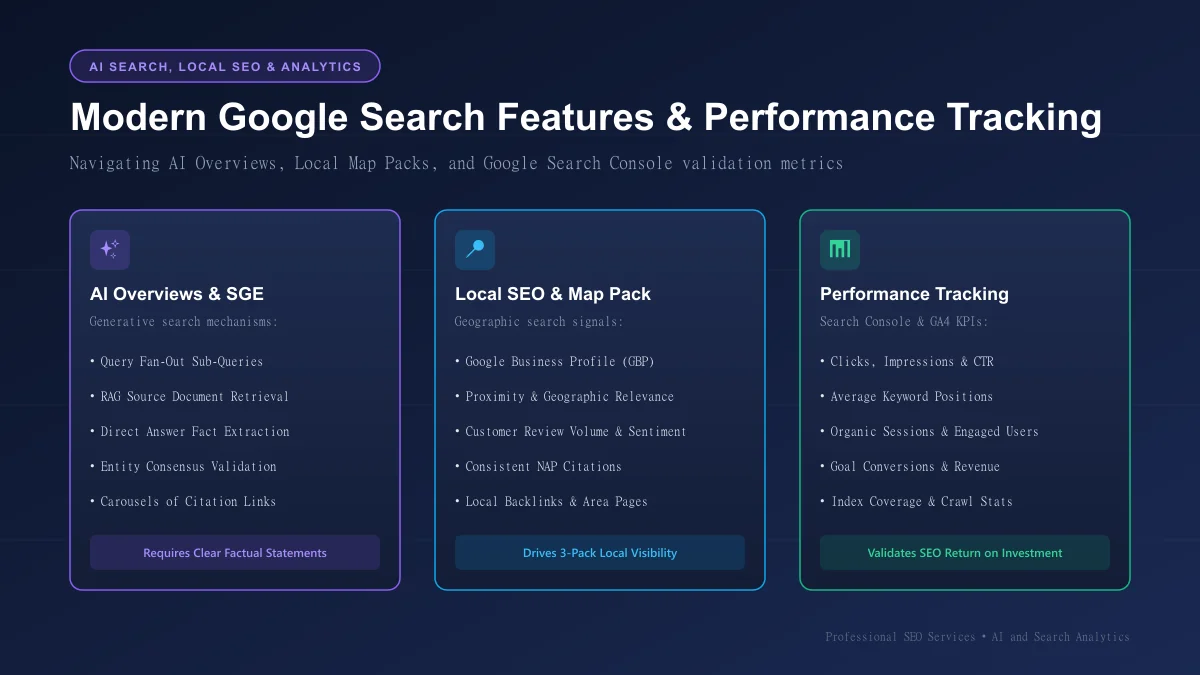
Figure 5: Modern search realities: AI Overviews synthesis, Local Map Pack signals, and Search Console analytics tracking.
How Local SEO Works in Google
Local SEO works in Google by evaluating geographic proximity, Google Business Profile (GBP) optimization, citation consistency, and localized relevance to connect searchers with nearby physical businesses.
Google Business Profile
Google Business Profile is a free listing tool provided by Google that allows local businesses to manage their presence across Google Search and Google Maps. Optimizing your categories, business hours, service areas, and visual media is essential for local visibility.
Local Relevance
Local relevance evaluates how closely a business listing matches the services requested in a localized query. Clear category selections and detailed service menus ensure algorithms match your listing to local searchers.
Reviews
Customer reviews provide user sentiment signals, rating averages, and localized keyword mentions that directly influence Local Pack rankings. Consistently collecting authentic customer feedback signals operational reliability to Google.
Citations
A citation is any online mention of a local business's Name, Address, and Phone number (NAP) across web directories, social platforms, and industry portals. Consistent NAP details across directories reinforce geographic validity.
Local Links
Local links are backlinks acquired from local chambers of commerce, regional newspapers, community sports sponsorships, and local suppliers. They confirm your real-world geographic footprint to local ranking algorithms.
Location Signals
Location signals include user GPS coordinates, Wi-Fi router IP locations, local phone area codes, and physical street addresses embedded in schema markup.
Organic Results vs Local Pack
The Local Pack is a map feature displaying 3 local business profiles above regular search results, while organic results are standard web page listings situated below. Local businesses must optimize for both to maximize regional search real estate.
How to Improve Your Google SEO Step by Step
To improve your Google SEO step by step, follow a structured 10-step optimization protocol that addresses crawlability, content relevance, technical site health, and domain authority in logical order:
1. Make Your Website Crawlable
Inspect your robots.txt file, eliminate server 5xx errors, and provide a clear internal linking structure so Googlebot navigates your pages without encountering crawl traps. Remove crawl barriers, if new URLs fail to appear in server logs.
2. Fix Indexing Problems
Review Google Search Console Page Indexing reports, remove accidental noindex meta tags, and configure self-referencing canonical tags on primary content URLs. Resolve soft 404 errors and redirect loops immediately.
3. Research Search Intent
Analyze top-ranking Search Engine Results Pages (SERPs) to classify query intent into informational, commercial, transactional, or navigational requirements before writing. Match the content format favored by current search results.
4. Build Topically Relevant Content
Create comprehensive articles covering core entities, related semantic subtopics, first-hand evidence, and unambiguous answers to primary user questions. Avoid keyword repetition; use natural industry terminology.
5. Improve Internal Linking
Connect related subtopic articles to central hub pages using descriptive, context-rich anchor text to distribute PageRank and clarify topical hierarchy. Eliminate orphan pages across your domain.
6. Optimize Technical SEO
Enforce HTTPS encryption, optimize Core Web Vitals (CWV) metrics, eliminate redirect chains, and validate structured data schema markup. Ensure mobile responsiveness across every page template.
7. Build Relevant Authority
Earn editorial backlinks from topically aligned industry publications through original research, data studies, and digital PR outreach. Focus on link relevance and publication trust rather than raw link counts.
8. Improve User Experience
Eliminate layout shifts, ensure rapid viewport rendering on mobile devices, and design intuitive navigation menus that minimize click depth. Provide fast, frictionless reading experiences.
9. Monitor Search Performance
Track organic impressions, clicks, click-through rate (CTR), and average keyword positions in Google Search Console alongside GA4 conversion data. Identify pages experiencing impressions without clicks to improve title tags.
10. Update and Improve Existing Pages
Refresh out-of-date factual figures, expand thin sections, and add newly emerging related entities when search queries or user expectations evolve. Schedule annual audits for top-ranking pages to prevent freshness decay.
How to Check Whether Your Google SEO Is Working
To check whether your Google SEO is working, evaluate quantitative performance metrics across Google Search Console, Google Analytics 4, and technical site audit crawlers.
Google Search Console
Google Search Console (GSC) is the primary diagnostic tool provided directly by Google to measure search visibility and technical health:
- Clicks: Total count of times users clicked your organic search listings to visit your site.
- Impressions: Number of times a searcher viewed your URL in search results.
- CTR (Click-Through Rate): Percentage of impressions that resulted in an organic click.
- Average Position: Mean numerical ranking of your URLs across searched queries.
- Queries: Exact search terms entered by users that triggered your listings.
- Pages: Specific landing page URLs that earned search impressions and clicks.
Google Analytics 4
Google Analytics 4 (GA4) tracks post-click user engagement and revenue performance:
- Organic Users: Count of unique individuals arriving through unpaid search.
- Engagement Rate: Percentage of sessions lasting over 10 seconds or converting.
- Conversions: Completion of high-value actions such as form submissions or sign-ups.
- Revenue: Monetary transactions attributed directly to organic search traffic.
Technical SEO Crawlers
Technical SEO crawlers like Screaming Frog and Sitebulb audit site health systematically:
- Crawlability: Verifying server response codes and robots.txt accessibility.
- Broken Links: Identifying internal and external 404 HTTP status errors.
- Indexability: Detecting conflicting canonical tags or rogue noindex directives.
- Internal Linking: Calculating internal PageRank flow and click depth.
- Canonicals: Validating that duplicate pages declare proper primary URLs.
How Long Does Google SEO Take to Work?
Google SEO takes 3 to 6 months to generate measurable ranking and traffic improvements for established websites, and 6 to 12 months for brand-new domains building topical authority from scratch. SEO is a compounding long-term growth asset, not an overnight switch.
What Determines SEO Speed?
There are 7 primary determinants of SEO speed:
- Competition: Market saturation and domain authority of rival incumbent sites.
- Website Authority: Historical domain reputation and age of existing backlink graph.
- Technical Condition: Presence of server bottlenecks, crawl traps, or rendering issues.
- Content Quality: Depth, originality, and intent alignment of published articles.
- Search Demand: Total search volume and seasonal fluctuations in your industry.
- Backlink Profile: Rate of incoming editorial link acquisition from trusted sources.
- Website History: Prior manual actions, spam flags, or algorithmic penalties.
What to Track During the First 3–6 Months
During the first 3 to 6 months of an SEO campaign, track leading indicators:
- Crawl frequency and total indexed pages in Google Search Console.
- Growth in total search impressions across target keyword topics.
- Keyword movements from position 50+ into positions 20 to 11.
- First organic clicks arriving on newly optimized pillar content.
- Steady increases in non-branded organic keyword visibility.
Common Google SEO Mistakes
There are 10 common Google SEO mistakes that undermine search performance:
- Keyword stuffing: Forcing repetitive search phrases unnaturally into headings and body text, triggering spam penalties.
- Creating content without understanding intent: Writing informational articles when users want transactional purchase comparisons.
- Publishing thin content: Releasing shallow 300-word summaries that fail to answer user questions completely.
- Ignoring technical SEO: Overlooking Core Web Vitals, slow server response times, and broken links.
- Blocking important pages: Inadvertently disallowing high-value URLs in the robots.txt file.
- Poor internal linking: Leaving orphan articles without contextual connections to topic cluster hubs.
- Buying spammy backlinks: Purchasing low-tier links from PBNs that trigger manual penalties in SpamBrain.
- Creating duplicate pages: Generating multiple identical URLs for localized or faceted variations.
- Ignoring existing content: Abandoning published articles and allowing factual decay to erode rankings.
- Optimizing only for rankings instead of conversions: Driving keyword traffic that fails to guide visitors toward business actions.
Google SEO FAQs
Mastering the Google Search Pipeline for Sustainable Growth
Google Search Engine Optimization (Google SEO) functions as an integrated pipeline encompassing URL discovery, Googlebot crawling, JavaScript rendering, semantic indexing, candidate retrieval, ranking scoring, and SERP display. Aligning your digital properties with each phase ensures search algorithms recognize your pages as authoritative answers.
The enduring benefits of search engine optimization center on acquiring predictable, high-intent organic search traffic that converts into commercial revenue without perpetual ad spend. By mastering entity relevance, technical site architecture, and natural backlink acquisition, organizations scale durable visibility across both traditional organic search results and emerging AI Overviews.