

Measuring Search Engine Optimization (SEO) is the systematic practice of evaluating website crawlability, search visibility, user engagement, and organic revenue to determine marketing performance on search engines. It works by collecting quantitative search data from Search Engine Results Pages (SERPs) and on-site web analytics tools to verify that optimization tasks produce commercial returns.
The main benefits of measuring search engine optimization center on protecting marketing budgets, identifying high-performing content assets, eliminating technical crawl errors, and calculating exact Return on Investment (ROI). Tracking quantitative data prevents teams from relying on guesswork when allocating resources across onsite and offsite campaigns.
The primary uses and applications of SEO measurement span enterprise performance reporting, ecommerce revenue attribution, B2B pipeline forecasting, client retainers in an agency setting, and AI search visibility benchmarking. Search practitioners evaluate performance data to refine content strategy and align landing pages with customer search intent.
The core components of measuring SEO include technical health tracking, keyword ranking analysis, click-through rate evaluation, organic conversion attribution, and pipeline revenue calculations. You can explore foundational ranking concepts in our comprehensive SEO Guide.
How Do You Measure SEO?
You measure SEO by tracking leading indicators, user behavior metrics, and commercial business Key Performance Indicators (KPIs) through a sequential analytics funnel. Measuring SEO effectiveness requires connecting technical site health to search visibility, organic traffic, user interactions, and final financial outcomes.
Define Your SEO Goals First
To measure SEO performance, define your SEO goals around specific business outcomes before modifying website code or publishing new content. Search engine optimization supports different commercial objectives depending on your organization structure:
- Lead generation objectives: Acquire contact enquiries, consultation bookings, newsletter sign-ups, and demo requests from qualified business buyers.
- Ecommerce revenue objectives: Increase product sales, average order value (AOV), and customer repeat transactions from organic search.
- Publisher audience objectives: Maximize page views, return visitor rates, newsletter subscribers, and ad impression inventory.
- Local brand objectives: Drive phone calls, driving direction requests on Google Maps, and physical store foot traffic.
Establish an SEO Baseline Before Making Changes
To assess SEO impact, record an SEO benchmark across rankings, traffic, crawl health, and conversions during the preceding 90 days before deploying website updates. A documented baseline allows you to isolate whether traffic shifts stem from algorithm changes, seasonality, or deliberate onsite optimizations.
Capture your benchmark data in a spreadsheet or business intelligence tool by recording 4 primary datasets:
- Organic search clicks and impressions: Export 3 months of query data from Google Search Console (GSC).
- Baseline organic sessions and conversions: Document monthly session counts, engagement rates, and goal completions in Google Analytics 4 (GA4).
- Keyword rankings and visibility: Log current ranking positions for your top 50 revenue-driving search terms.
- Technical audit health score: Record total crawl errors, broken links, and Core Web Vitals pass rates. You can inspect architectural requirements in our Technical SEO Guide.
Measure SEO as a Funnel
Measuring SEO as a 4-stage funnel connects search engine crawl signals directly to bottom-line revenue. When you evaluate search performance across sequential layers, you can locate exact bottlenecks where potential customers drop off.
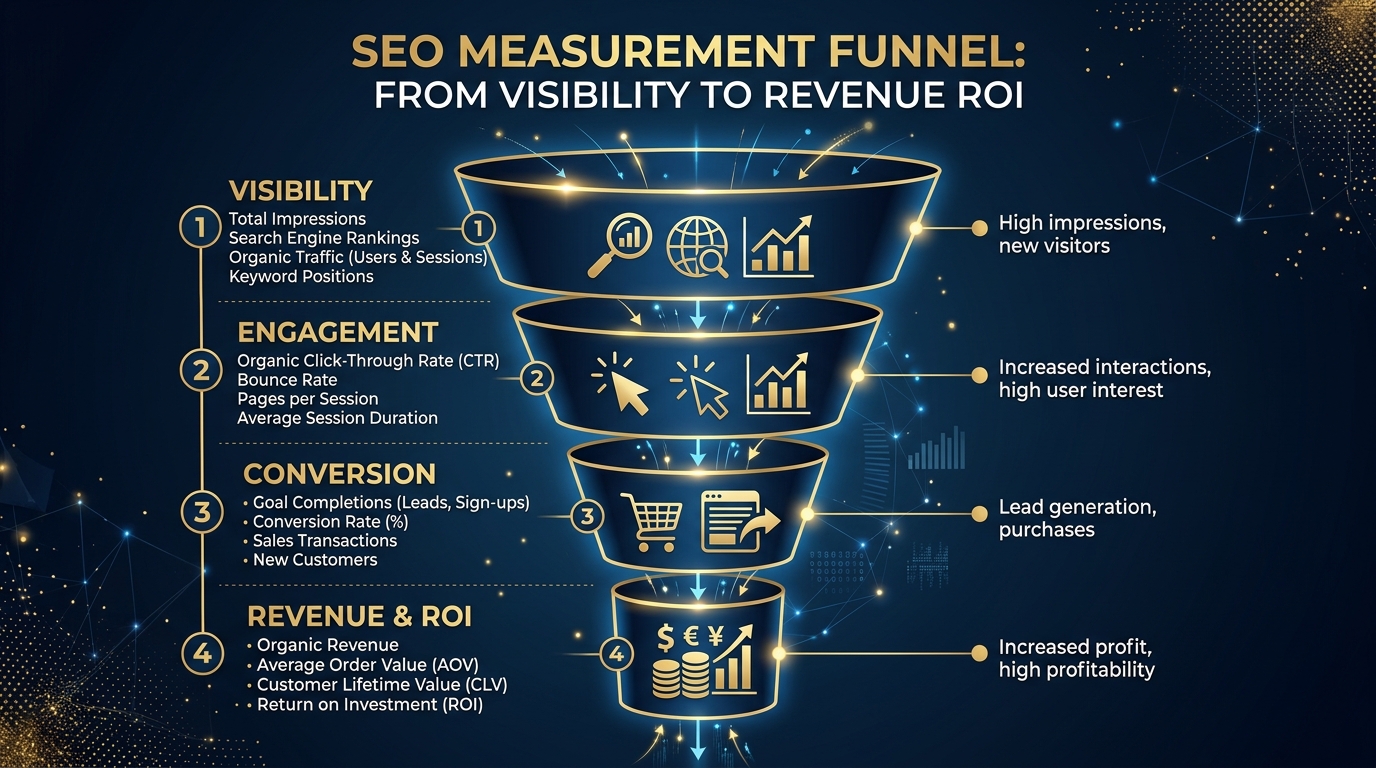
The 4 distinct stages of the SEO measurement funnel encompass:
- Stage 1: Visibility (Search Engine Results Pages): Search crawlers index your pages, leading to keyword ranking positions and SERP impressions.
- Stage 2: Engagement (User Traffic & Interaction): Users click your listings in search results, generating organic search traffic, time on page, and page views.
- Stage 3: Conversion (Lead & Action Capture): Engaged visitors submit enquiries, sign up for trials, or complete purchases on your landing pages.
- Stage 4: Revenue & SEO ROI (Commercial Growth): Conversions generate gross margin, customer lifetime value (CLV), and measurable financial return.
15 Key SEO Metrics You Should Track
Tracking 15 specific SEO metrics provides a complete view of technical health, search visibility, user experience, and revenue generation. Evaluating multiple metrics side-by-side prevents misleading conclusions caused by monitoring a single vanity number.
1. Organic Search Traffic
Organic search traffic represents the total volume of unpaid website sessions and visitors arriving from search engines like Google, Bing, and Yahoo. It serves as a primary volume indicator for search marketing performance.
Monitor both organic sessions and unique active users in GA4. Break down organic traffic by landing page category to verify that traffic growth occurs on commercially valuable URLs rather than exclusively on general blog posts.
2. Organic Search Impressions
Organic search impressions measure the number of times a search engine user saw a URL from your website displayed on Search Engine Results Pages (SERPs). A user does not need to click your link for an impression to be recorded.
Impression increases represent the earliest leading indicator of SEO success. When you optimize page titles, header tags, and body content, Google begins ranking your pages for a wider range of queries, causing impressions to rise weeks before organic clicks increase.
3. Click-Through Rate (CTR)
Click-Through Rate (CTR) is the percentage of total search impressions that result in a click through to your website. Calculate CTR by dividing total organic clicks by total impressions, then multiplying by 100.
A listing receiving 1,000 impressions and 50 clicks yields a 5.0% CTR. Improving your meta titles, meta descriptions, and rich snippet schema markups increases CTR, driving additional visitors to your top product pages without requiring higher ranking positions.
4. Keyword Rankings
Keyword rankings indicate the specific numerical position where your web page appears in search results for a designated query. Position 1 earns approximately 27.6% of all organic clicks, while positions on page 2 receive fewer than 1.5% of clicks.
Track rankings for high-intent commercial keywords that drive business inquiries. Monitor ranking stability across desktop and mobile devices to ensure your site maintains visibility during algorithm updates.
5. Number of Ranking Keywords
The number of ranking keywords measures the total count of distinct search queries for which your domain appears within the top 100 search results. This metric reflects your topical authority across your target industry landscape.
Track keyword growth across 3 ranking tiers: positions 1–3, positions 4–10, and positions 11–50. An expanding keyword footprint indicates that search engines recognize your site as an authoritative source on core subject areas.
6. Keyword Visibility and Share of Search
Keyword visibility and Share of Search quantify your brand's market presence across target keywords compared to direct search competitors. Search software calculates this score by weighting ranking positions against monthly search volume.
A rising share of search confirms that your brand captures search demand from category rivals. Compare your visibility score against top 5 industry competitors monthly to identify market share gains.
7. Organic Engagement Rate
Organic engagement rate is the percentage of organic search sessions that lasted longer than 10 seconds, included a conversion event, or recorded 2 or more page views in GA4. This metric replaced legacy bounce rate as Google's official measure of visit quality.
An engagement rate above 60% indicates that your content satisfies user search intent and provides relevant answers. An engagement rate below 40% signals slow loading speeds, confusing layout structures, or irrelevant search targeting.
8. Average Engagement Time
Average engagement time measures the length of time in minutes and seconds that a web page spent in the user's active browser viewport. GA4 tracks user activity through scroll events, mouse movement, and screen interactions.
Longer engagement times (such as 2 minutes to 4 minutes on technical articles) demonstrate that visitors consume your content thoroughly. For transactional checkout pages, shorter engagement times with high conversion completion rates represent optimal user flow.
9. Organic Conversions
Organic conversions represent valuable user actions completed by visitors who arrived on your website via unpaid search results. Conversions prove whether organic traffic generates business value.
What Counts as an SEO Conversion?
An SEO conversion is any predetermined action that contributes directly to business growth or pipeline revenue. Primary SEO conversion examples include:
- Lead generation conversions: Contact form submissions, quotation requests, phone calls, and webinar registrations.
- Ecommerce conversions: Completed product checkouts, added items to cart, and recurring subscription sign-ups.
- Soft micro-conversions: PDF whitepaper downloads, email newsletter sign-ups, and interactive calculator usage.
How to Track Organic Conversions in GA4
To track organic conversions in GA4, configure custom key events in Google Tag Manager (GTM) and mark them as conversion events in your GA4 property settings. Follow these 4 steps:
- Create trigger events in GTM for form submissions, purchases, or phone link clicks.
- Navigate to Admin > Data Display > Events inside GA4.
- Toggle the switch next to each business action under Mark as key event.
- Open the Traffic Acquisition report and filter by Session Default Channel Group = Organic Search to review conversion totals by channel.
How to Calculate Organic Conversion Rate
To calculate organic conversion rate, divide total organic conversions by total organic sessions, then multiply the result by 100.
For example, if your website receives 20,000 organic sessions in a month and records 600 completed form enquiries:
Organic Conversion Rate = (600 / 20,000) × 100 = 3.0%
10. Leads and Sales Generated From Organic Search
Leads and sales generated from organic search quantify the exact commercial output produced by search traffic inside your Customer Relationship Management (CRM) platform. Connecting web analytics to CRM systems like Salesforce or HubSpot validates lead quality.
Track 3 specific sales pipeline stages for organic visitors:
- Marketing Qualified Leads (MQLs): Prospects who match your target customer profile and requested product resources.
- Sales Qualified Leads (SQLs): High-intent buyers who booked discovery calls with your sales representatives.
- Closed Deals: Paying clients and customers who signed service contracts or completed commercial orders.
11. Organic Revenue and SEO ROI
Organic revenue and SEO Return on Investment (ROI) measure the financial profit generated from organic search relative to the financial costs incurred to execute search marketing campaigns. This metric confirms commercial profitability for business executives.
How to Measure SEO Revenue
To measure SEO revenue, attribute transactional income and closed CRM contract values to organic search source tags using multi-touch attribution modeling. In ecommerce stores, GA4 Ecommerce Tracking records transactional revenue automatically. For B2B organizations, import CRM closed-won deal amounts filtered by original lead source equal to organic search.
How to Calculate SEO ROI
To calculate SEO ROI, subtract total SEO expenses from total organic search revenue, divide by total SEO expenses, and multiply by 100.
For example, if an enterprise generates £150,000 ($190,000) in organic revenue over 6 months with £30,000 ($38,000) spent on agency retainers, tools, and content production:
SEO ROI = [(£150,000 - £30,000) / £30,000] × 100 = 400%
Measuring these commercial returns helps leadership evaluate whether is SEO worth the investment for long-term customer acquisition.
12. Indexed Pages and Indexation Health
Indexed pages and indexation health represent the total count of valid website URLs stored in search engine databases available to be returned for search queries. A web page cannot rank or receive traffic if Google bots fail to index the page.
Inspect the Pages report inside GSC monthly. Verify that valid canonical URLs status displays as Indexed, and inspect non-indexed URLs to resolve errors such as Crawled - currently not indexed or Discovered - currently not indexed.
13. Technical SEO Health
Technical SEO health measures website architecture stability, page rendering efficiency, crawl error rates, and Core Web Vitals performance. Search engines reward technically sound websites that deliver fast user experiences.
Audit 4 critical technical parameters:
- Core Web Vitals scores: Maintain Largest Contentful Paint (LCP) under 2.5 seconds, Interaction to Next Paint (INP) under 200 milliseconds (ms), and Cumulative Layout Shift (CLS) under 0.1.
- HTTPS encryption: Verify valid SSL certificates across all subdomains and protocol redirects.
- Crawl errors: Eliminate 404 broken links, 500 server errors, and redirect loops.
- Schema markup validation: Test structured data using Google's Rich Results Test tool.
Should You Use an SEO Score to Measure SEO?
No, you should not rely on a single composite SEO score from automated software tools as your primary measurement of SEO success. Third-party proprietary scores (such as Site Health percentages or Digital Certainty Indexes) evaluate technical rule adherence rather than ranking success, organic traffic growth, or revenue generation. Use audit scores solely as diagnostic checklists for developers.
14. Backlinks and Referring Domains
Backlinks and referring domains measure the quantity and authority of external websites that hyperlink to your domain. Backlinks serve as third-party endorsements that build domain authority and trust with search engines.
Evaluate link profile growth using 3 specific criteria:
- Unique referring domains: Earning 50 links from 50 distinct authoritative websites provides greater ranking power than 500 links from a single domain.
- Link topical relevance: Prioritize links from websites operating within your industry vertical over generic web directories.
- Authority metrics: Monitor Domain Rating (DR) from Ahrefs, Domain Authority (DA) from MOZ, or Trust Flow and Citation Flow from Majestic.
15. Branded vs. Non-Branded Organic Traffic
Branded vs. non-branded organic traffic separates search visitors searching your company name from prospects searching generic industry keywords. This distinction indicates whether SEO expands your customer reach or captures existing brand recognition.
How to Measure Branded vs. Non-Branded Performance
To measure branded vs. non-branded performance, apply regex query filters inside Google Search Console Performance reports. In GSC, set a query filter selecting Queries containing your brand variations for branded traffic, and set Queries not containing brand terms to isolate pure non-branded organic search traffic.
Why Non-Branded Traffic Matters for SEO Growth
Non-branded traffic matters for SEO growth because non-branded searches capture new prospective customers who do not yet know your company name. Growth in non-branded queries confirms that your content strategy and keyword targeting expand your total addressable market.
How to Measure SEO Using SEO Tools
Measuring SEO using specialized tools provides verified search performance data, competitor benchmarks, and technical crawl diagnostics. Combining first-party Google tools with third-party software gives you full visibility across the search landscape.
Google Search Console
Google Search Console (GSC) is Google's official free webmaster platform that provides first-party data on search impressions, clicks, keyword rankings, and indexation coverage. It delivers accurate visibility data directly from Google's search algorithms without third-party estimations.
Google Analytics 4
Google Analytics 4 (GA4) is Google's event-based web analytics platform that tracks user behavior, session engagement, conversion events, and transactional revenue generated from organic traffic. GA4 connects search visits to on-site actions.
Semrush
Semrush is a comprehensive search intelligence platform used to track daily keyword rankings, estimate competitor search traffic, and analyze domain visibility scores across international markets. It offers competitive intelligence across organic search and paid advertising.
Ahrefs
Ahrefs is a premier search analytics tool renowned for backlink index depth, referring domain monitoring, keyword difficulty calculation, and content gap analysis. Practitioners use Ahrefs to evaluate link equity and competitor content strategies.
Screaming Frog
Screaming Frog SEO Spider is an industry-standard desktop website crawler that diagnoses on-page issues, broken redirects, missing metadata, duplicate content, and XML sitemap errors. It crawls large websites locally to locate technical defects.
SEO Audit Tools
SEO audit tools (including Siteimprove, Deepcrawl, and Google Lighthouse) automate continuous site monitoring to detect accessibility errors resolved, speed bottlenecks, and structural markup issues. These platforms alert development teams to regressions before rankings drop.
How to Measure SEO With Google Search Console
To measure SEO with Google Search Console, navigate to the Performance report to evaluate impressions, clicks, average positions, and query-level opportunities. GSC serves as the single source of truth for organic search visibility.
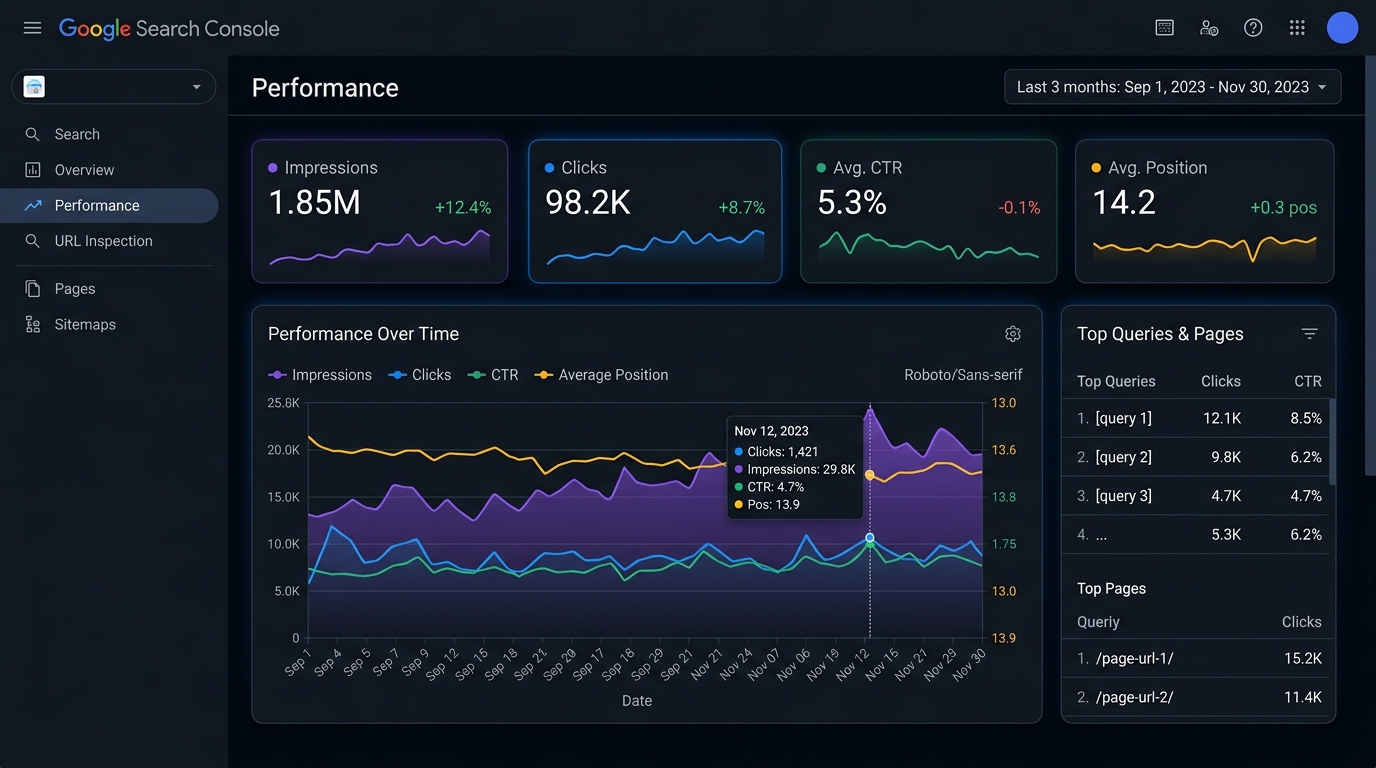
Measure Impressions, Clicks, CTR and Average Position
To measure core search metrics in GSC, activate all 4 metric checkboxes across the top of the Performance report: Total Clicks, Total Impressions, Average CTR, and Average Position. Compare the last 3 months to the previous period to identify positive or negative performance trends across your entire website.
Analyze Queries Driving Organic Visibility
To analyze queries driving organic visibility, scroll to the Queries tab beneath the performance chart and sort rows by total impressions or clicks. Identify high-volume search queries that bring users to your domain, and verify that the query intent matches your landing page content.
Analyze Top-Performing Pages
To analyze top-performing pages, select the Pages tab to evaluate which URLs generate the largest proportion of organic clicks. Check your top 20 pages monthly to monitor traffic distribution and identify URLs experiencing ranking drops.
Find Pages With High Impressions but Low CTR
To find high-opportunity pages in GSC, filter the Pages report for URLs with over 1,000 impressions and an Average CTR below 2.0%. These pages appear frequently in search results but fail to attract clicks. Rewrite the title tags and meta descriptions on these URLs with compelling copy and clear benefits to increase CTR immediately.
Find Pages Ranking in Positions 4–20
To locate striking-distance keywords, filter Queries by Position with values greater than 3.9 and less than 20.1. These queries rank on the bottom of page 1 or on page 2 of Google. Adding comprehensive content sections, improving internal links, and refreshing outdated data on these pages can push rankings into top 3 positions.
Monitor Indexing and Page Experience
To monitor indexing and user experience, review the Indexing > Pages section and the Experience > Core Web Vitals tab weekly. Verify that valid URLs are indexed without errors, and resolve any URLs flagged as poor in mobile usability or loading speed.
How to Measure SEO With GA4
To measure SEO with GA4, inspect Traffic Acquisition reports to evaluate organic sessions, user engagement rates, key conversion events, and revenue generation. GA4 tracks how search engine visitors behave after clicking your search listings.
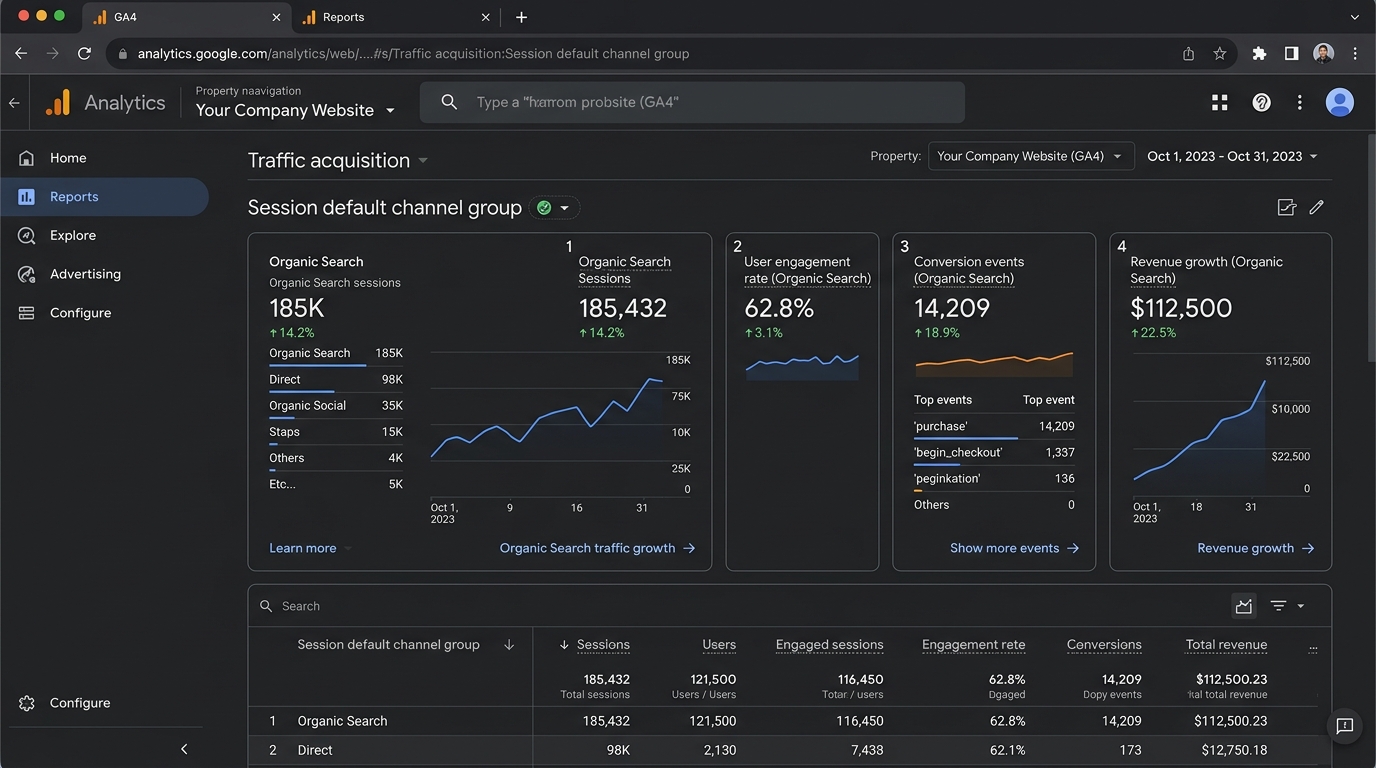
Find Organic Search Traffic
To find organic search traffic in GA4, navigate to Reports > Acquisition > Traffic Acquisition, and set the primary dimension to Session default channel group. Locate the row labeled Organic Search to review total sessions, engaged sessions, and active users over your selected date range.
Analyze Organic Landing Pages
To analyze organic landing pages, open Reports > Engagement > Landing Page, and apply a filter for Session default channel group exactly matches Organic Search. Review which specific blog posts, service pages, and category templates serve as entry points for new visitors.
Measure Engagement
To measure search visitor engagement, evaluate Engagement Rate, Average Engagement Time, and Engaged Sessions per User within your organic landing page report. High engagement confirms that your content delivers on the search intent promised in your metadata.
Track Organic Conversions
To track organic conversions, customize the Key Events column in your Traffic Acquisition table to view specific goal completions attributed to organic search. Compare monthly conversion volume to identify whether organic traffic gains generate real customer inquiries.
Measure Revenue From Organic Search
To measure organic revenue in GA4, review the Total Revenue and Purchase Revenue columns in the Traffic Acquisition report for ecommerce properties. Evaluate average purchase value and transaction counts originating from organic search sessions.
Compare Organic Search With Other Channels
To benchmark marketing channels, compare Organic Search performance directly against Paid Search, Direct, Organic Social, and Referral traffic within the Traffic Acquisition overview. Evaluate organic search in terms of customer acquisition cost efficiency and long-term retention.
How to Measure SEO Visibility in AI Search
Measuring SEO visibility in AI search requires tracking brand citations, source references, and linked mentions inside generative AI engines such as Google AI Overviews, ChatGPT Search, Perplexity AI, and Claude. Generative Engine Optimization (GEO) expands traditional search measurement into AI-generated answers.

What Is AI Search Visibility?
AI search visibility is the frequency and prominence with which a brand or website is cited, recommended, and linked within AI-synthesized search responses. Unlike standard 10-blue-link SERPs, AI engines answer queries directly by synthesizing verified online sources.
Track Brand Mentions in AI-Generated Answers
To track brand mentions in AI answers, test target commercial prompts across leading Large Language Model (LLM) search engines monthly and record whether your brand appears in the recommended summary. Use automated AI visibility tracking tools to monitor sentiment and mention frequency across product categories.
Monitor Citations and Linked Sources
To monitor citations and linked sources, track which specific domain URLs are hyperlinked within Google AI Overviews and Perplexity answer cards. Structuring content with clear factual statistics, author credentials, and Experience, Expertise, Authoritativeness, and Trustworthiness (EEAT) signals increases AI citation frequency.
Track Visibility Across AI Search Platforms
To track visibility across AI platforms, benchmark brand performance across 4 primary generative engines: Google AI Overviews, Microsoft Copilot, Perplexity AI, and OpenAI ChatGPT Search. Record citation consistency across each engine to ensure broad generative search coverage.
Compare Traditional Search Visibility With AI Visibility
To evaluate search channel shifts, compare keyword ranking positions in standard Google search against brand citation rates in AI Overviews. Tracking both search formats reveals whether zero-click AI summaries reduce organic clicks or drive highly qualified referral visits.
How to Measure SEO Performance for Different Types of Websites
Measuring SEO performance depends on your website business model, requiring distinct KPIs tailored to ecommerce, lead generation, local services, or digital publishing. Aligning your metrics with business operations ensures accurate ROI reporting.
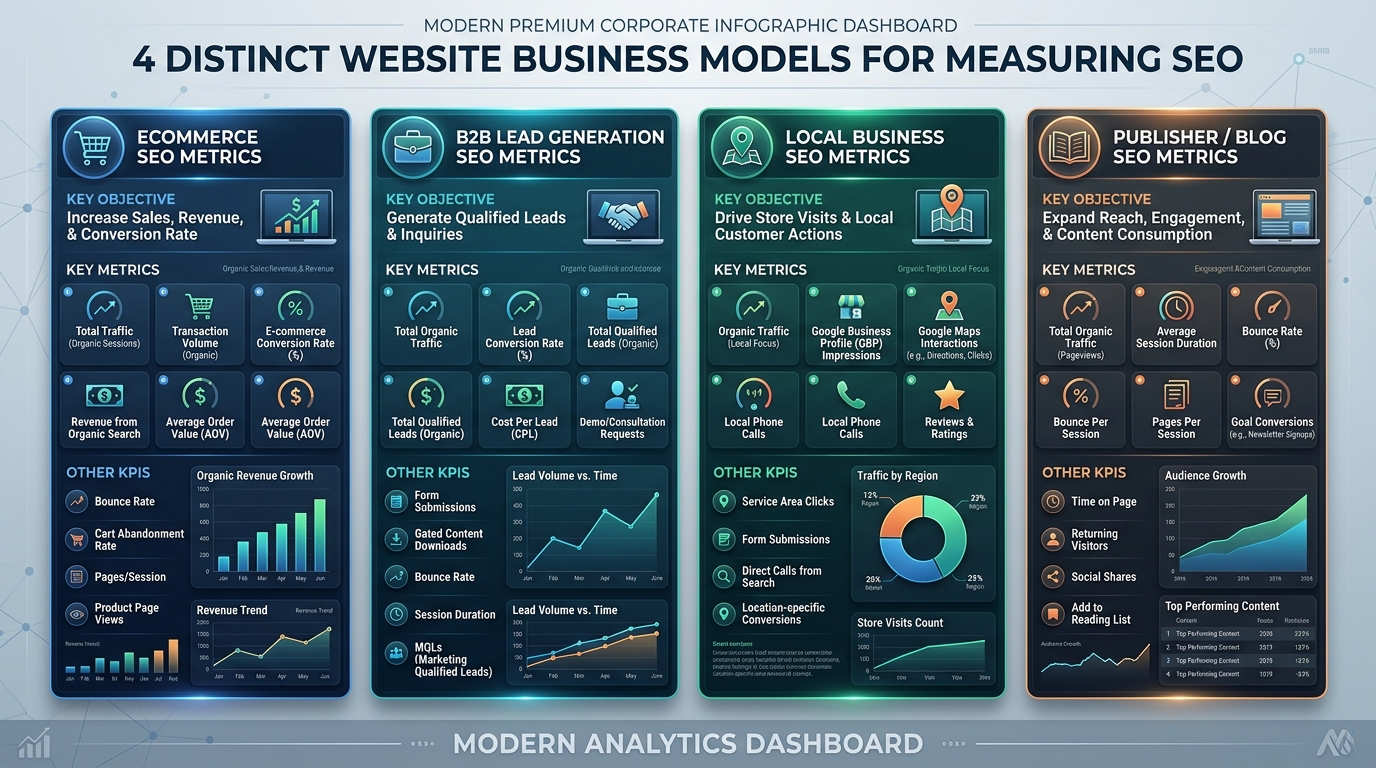
Measuring SEO for an Ecommerce Website
To measure ecommerce SEO, prioritize organic product revenue, ecommerce conversion rate, Average Order Value (AOV), and category page rankings. Monitor non-branded search traffic landing on product and category URLs to verify that search optimization drives commercial transactions.
Measuring SEO for a Lead Generation Website
To measure B2B lead generation SEO, track organic enquiry form submissions, phone calls, cost per qualified lead, and CRM pipeline progression. Focus on high-intent commercial keywords that attract decision-makers rather than generic educational traffic.
Measuring SEO for a Local Business
To measure local SEO, track Google Business Profile (GBP) interactions, local map pack rankings, driving directions, phone call clicks, and localized landing page visits. Review monthly GBP performance metrics to assess physical customer footfall.
Measuring SEO for a Blog or Publisher
To measure publisher SEO, focus on total organic page views, average engagement time, return reader frequency, newsletter subscribers, and ad impression earnings. Target broad topic clusters to maximize content reach across diverse search queries.
How Long Does It Take to Measure SEO Results?
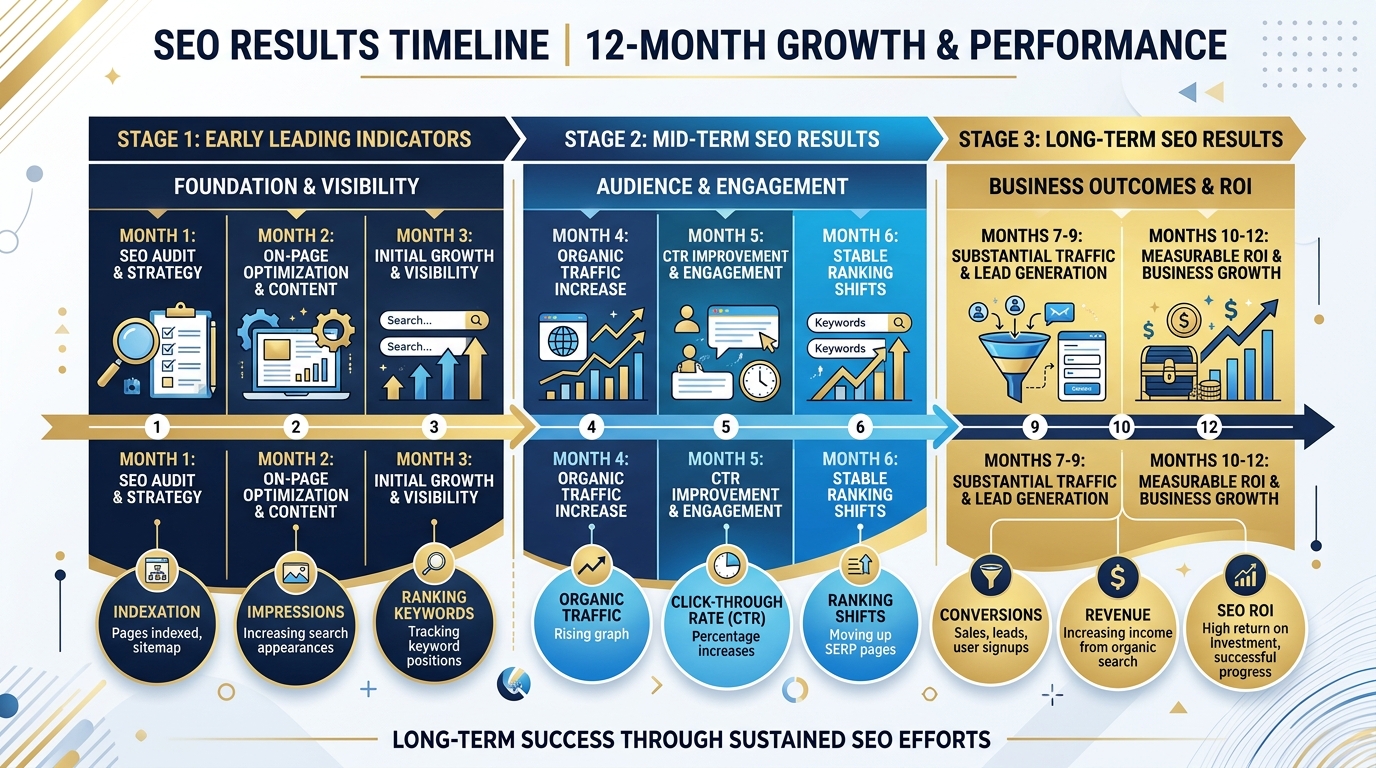
It takes 3 to 6 months to measure initial SEO traffic improvements and 6 to 12 months to measure substantial revenue growth. SEO compounds over time as search engines crawl site updates, recalculate topical authority, and reward high-quality content.
Early SEO Indicators
Early SEO leading indicators appear within Months 1 to 3 following initial technical fixes and content updates. Primary early indicators include:
- Improved indexation coverage and crawl error reductions in GSC.
- Rising total SERP impressions across target keyword categories.
- An increase in the total number of ranking keywords in positions 20–100.
Mid-Term SEO Results
Mid-term SEO results emerge in Months 4 to 6 as search engines recognize content authority. Primary mid-term results include:
- Keyword movements from page 2 into top 10 first-page positions.
- Measurable growth in total non-branded organic search traffic.
- Higher organic click-through rates and improved user engagement time.
Long-Term SEO Results
Long-term SEO results materialize in Months 7 to 12 as sustained organic visibility translates into business KPIs. Primary long-term results include:
- Dominant top 3 rankings for high-intent commercial queries.
- Substantial increases in organic lead volume, sales transactions, and revenue.
- A proven, positive SEO ROI that lowers overall customer acquisition costs.
How to Know if Your SEO Strategy Is Working
You know your SEO strategy is working when you observe simultaneous upward trends in non-branded impressions, first-page keyword rankings, organic search traffic, and qualified business conversions over a 90-day period. If traffic rises while conversions remain stagnant, your keyword targeting requires refinement toward higher buyer intent.
SEO Metrics You Shouldn't Rely on Alone
You should not rely on vanity metrics in isolation because single data points fail to reflect actual business profitability. Assessing metrics without broader context leads to incorrect strategic decisions.
Domain Authority
Domain Authority (DA) is a third-party logarithmic score created by MOZ to predict ranking probability, not an official Google ranking factor. A high DA score does not guarantee revenue, and websites with lower DA scores frequently outrank high-DA competitors by delivering superior, relevant content.
Total Backlinks
Total backlink count measures raw link volume without accounting for link quality, topical relevance, or anchor text diversity. Earning 20 links from authoritative, industry-relevant domains outperforms acquiring 20,000 low-quality links from spam directories.
Number of Ranking Keywords
Ranking for thousands of irrelevant search terms generates vanity numbers without delivering business value. Focus on ranking for commercial search queries that attract qualified prospects ready to enquire or buy.
Average Keyword Position
Average keyword position can be skewed by new keywords entering the index at position 80, artificially dragging down your overall average position metric. Evaluate position changes on individual target keyword clusters rather than relying on site-wide averages.
Total Organic Traffic
Total organic traffic volume is misleading if visitors land exclusively on informational articles and leave without engaging. Measure traffic in tandem with engagement rates, lead conversions, and sales revenue.
SEO Audit Score
Automated SEO audit scores assess technical formatting rules rather than search intent alignment or market demand. Use audit tools to fix broken links and speed bottlenecks, but measure ultimate success through business KPIs.
Conclusion
Measuring Search Engine Optimization (SEO) effectively requires tracking technical health, search visibility, user engagement, and organic revenue across a unified analytics funnel. By utilizing Google Search Console for search visibility, GA4 for user engagement and conversions, and CRM systems for revenue attribution, marketing leaders gain clear proof of SEO ROI.
Avoid relying on isolated vanity metrics like Domain Authority or total organic traffic alone. Establish a quantitative baseline, track leading indicators during early months, and evaluate commercial revenue growth to build a scalable, data-driven organic search strategy.
Frequently Asked Questions

Rehan Saeed
Lead SEO Specialist & Organic Search Strategist with over 10 years of experience executing technical SEO, enterprise data analytics, and search revenue growth for global brands.
Connect on LinkedIn