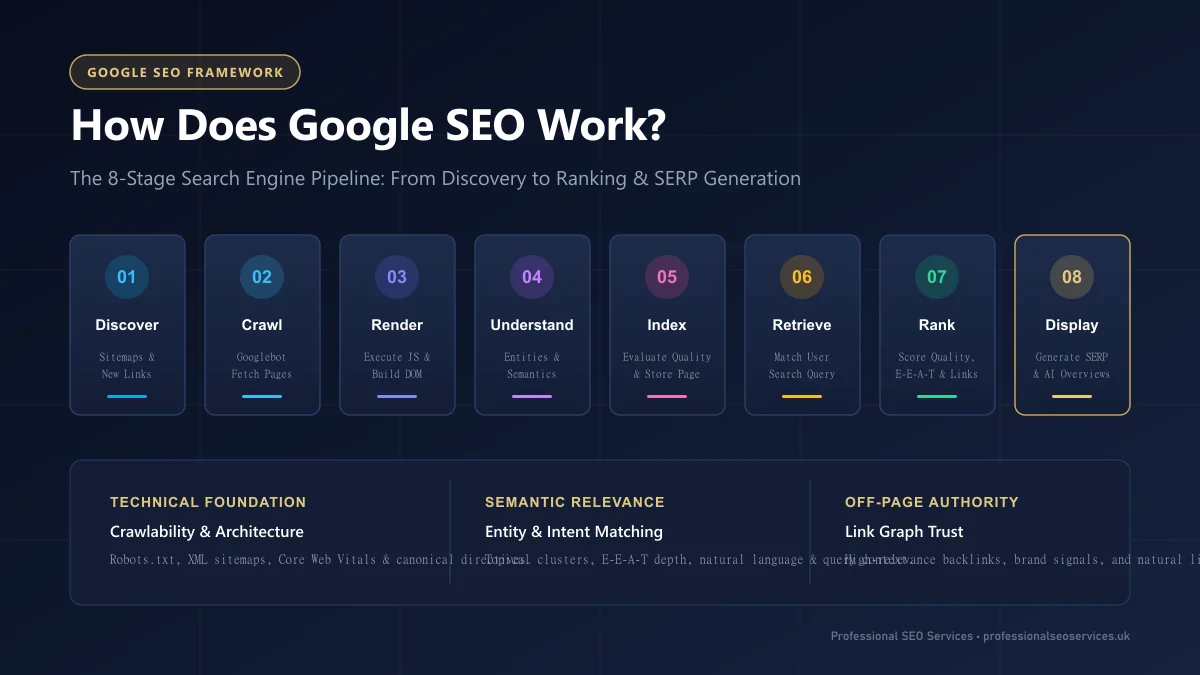
Search Engine Optimization (SEO) is the process of improving website structure, technical health, and content relevance to earn top positions in unpaid organic search results. Pay-Per-Click (PPC) advertising is an online marketing auction model where advertisers pay a designated fee each time a user clicks their ad on a Search Engine Results Page (SERP).
Businesses often manage Search Engine Optimization (SEO) and Pay-Per-Click (PPC) as separate marketing channels. Internal marketing teams maintain siloed budgets, separate performance goals, and isolated software tools. Many managers ask the central question: how does SEO affect PPC?
Clarify an important distinction: Search Engine Optimization (SEO) does not directly control Google Ads rankings or Pay-Per-Click (PPC) auctions. The organic algorithm and the ad auction engine operate on distinct computational systems. Search Engine Optimization (SEO) influences the quality of pages, keyword strategy, search visibility, brand presence, and conversion ecosystem surrounding Pay-Per-Click (PPC).
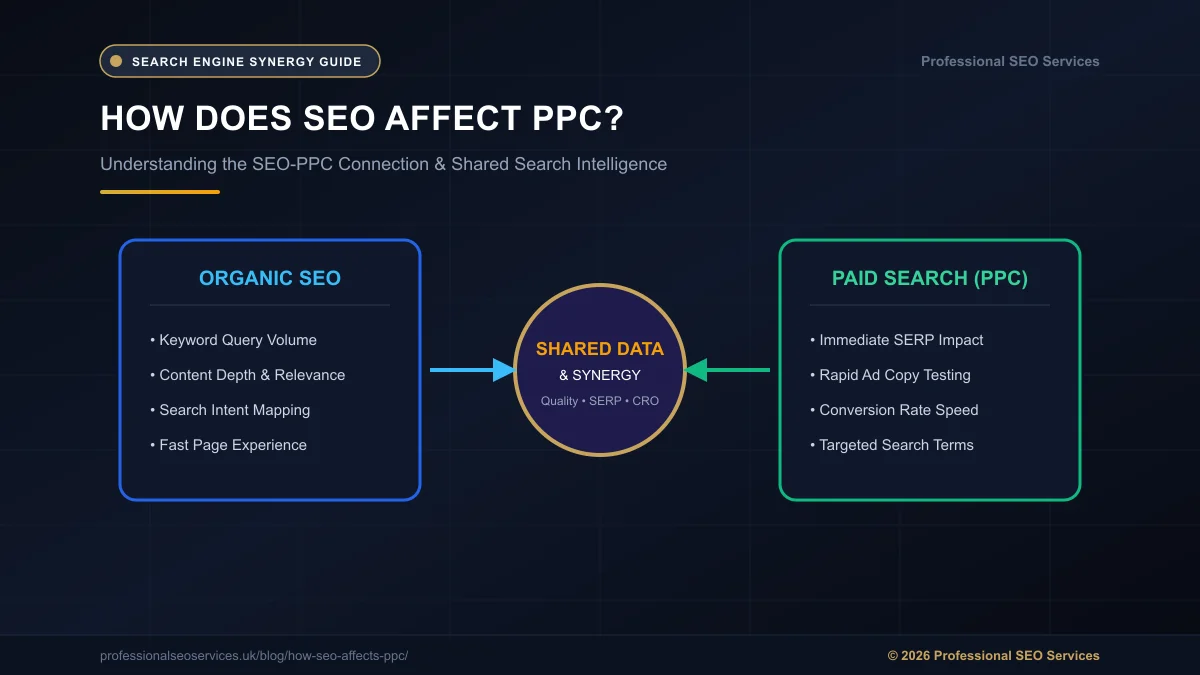
Pay-Per-Click (PPC) advertising provides valuable data that improves Search Engine Optimization (SEO). Paid search queries validate high-converting keywords, test headline copy, and reveal real-time user intent. An integrated Search Engine Optimization (SEO) and Pay-Per-Click (PPC) strategy improves overall search performance by eliminating budget waste, capturing total SERP real estate, and lowering blended customer acquisition costs. Leading brands collaborate with Professional SEO Services to unify organic growth with paid campaign execution.
How Does SEO Affect PPC?
SEO affects PPC by improving landing-page quality, supplying high-intent organic keyword data, reducing bidding waste, and expanding brand dominance across the Search Engine Results Page (SERP). Search Engine Optimization (SEO) refines website infrastructure and page relevance, which directly supports the metrics that determine Google Ads auction efficiency.
SEO Does Not Directly Improve Your Google Ads Rankings
Organic rankings and paid ad rankings are separate systems. Search Engine Optimization (SEO) does not automatically make an ad appear higher in paid ad auctions. Pay-Per-Click (PPC) spending does not buy better organic rankings. Google engineering teams build an explicit algorithmic firewall between organic search indexing systems and Google Ads advertising networks.
Businesses should not confuse SEO and PPC ranking factors. Google Ads calculates Ad Rank by multiplying maximum Cost Per Click (CPC) bids by Quality Score (QS) and ad asset impact. The Google organic ranking algorithm scores documents using topical relevance, crawlability, internal linking, and verified external authority signals.
SEO Can Indirectly Improve PPC Performance
Search Engine Optimization (SEO) can indirectly improve Pay-Per-Click (PPC) performance across 8 primary digital dimensions. These dimensions include:
- Landing-page quality: Faster loading speeds improve Google Ads landing page experience ratings.
- Search intent alignment: Targeted page copy answers commercial queries immediately.
- Content relevance: Comprehensive body text matches targeted ad group themes.
- Keyword research: Organic search queries reveal long-tail phrases for paid campaigns.
- User experience: Clear navigation reduces bounce rates from paid traffic.
- Conversion optimization: Structured layouts increase action completion rates.
- Brand visibility: Frequent appearances build consumer trust.
- Organic and paid SERP coverage: Multiple listings increase overall click volume.
SEO Can Give PPC Campaigns More Search Intelligence
Search Engine Optimization (SEO) gives Pay-Per-Click (PPC) campaigns search intelligence through organic keyword data, Google Search Console (GSC) queries, and existing high-performing pages. Organic search queries reveal exact phrasing that prospects submit when researching solutions.
Marketing teams analyze organic search intelligence to identify content gaps and evaluate commercial vs informational queries. When evaluating how does SEO affect PPC, how does PPC impact SEO, and how do Google Ads affect SEO, search intelligence acts as the unifying bridge.
How Do SEO and PPC Work Together?
SEO and PPC work together by combining short-term paid speed with long-term organic authority to capture maximum search demand. Reviewing what is seo clarifies why organic search builds lasting assets, while paid advertising provides immediate targeting control.
SEO Builds Long-Term Organic Visibility
Search Engine Optimization (SEO) builds long-term organic visibility by establishing topical authority and earning sustainable non-paid clicks. Once a comprehensive article or service page ranks in top organic positions, that page collects continuous traffic without incurring a Cost Per Click (CPC) fee.
Discovering how does google seo work highlights how search crawlers evaluate topical depth over months. Organic visibility creates an enduring brand footprint that lowers blended customer acquisition costs over annual operating cycles.
PPC Provides Immediate Paid Visibility
Pay-Per-Click (PPC) provides immediate paid visibility by placing brand ads at the top of the Search Engine Results Page (SERP) within minutes of campaign launch. Advertisers configure precise keyword targeting, geographic radius borders, and demographic audience segments.
PPC enables faster campaign testing. Marketing teams test new value propositions, seasonal sales discounts, and conversion offers in 48 hours without waiting for search engine crawlers to re-index site content.
Together They Cover More of the SERP
Displaying both a paid listing and an organic listing captures dominant Search Engine Results Page (SERP) real estate. Searchers encounter the brand in top sponsored ads and again in primary organic positions.
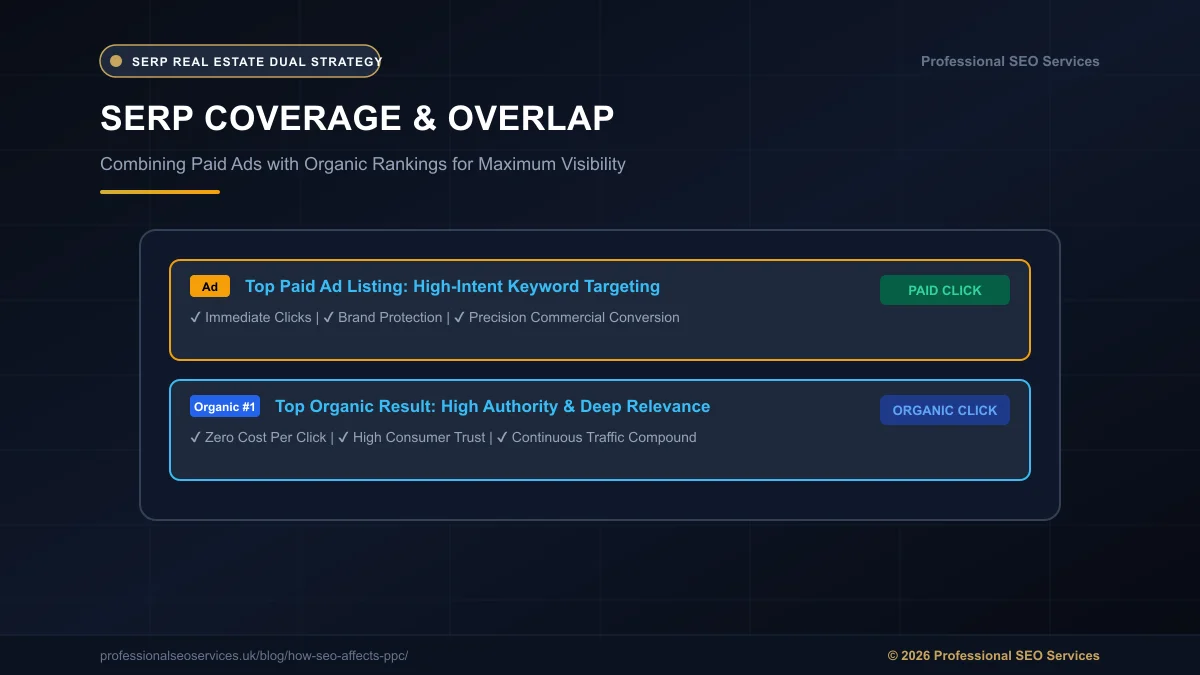
This dual visibility creates 3 primary commercial outcomes:
- Increased brand exposure: Repetition reinforces brand authority in the buyer's mind.
- More opportunities for clicks: Dual listings prevent competitors from monopolizing above-the-fold space.
- Greater visibility for competitive searches: Difficult keyword auctions become profitable when supported by organic rankings.
Knowing how SEO and PPC work together helps marketing teams capture maximum market share. Studying how do SEO and PPC work together reveals how search ads and organic content reinforce each other. Evaluating how can SEO and PPC work together allows media buyers to reallocate spending to high-margin queries. Examining how SEO and paid search work together confirms that total search market share surpasses single-channel operations.
8 Ways SEO Can Improve PPC Performance
There are 8 distinct ways SEO can improve PPC performance across auction costs, landing pages, keyword targeting, and conversion rates. Coordinating organic technical optimization with paid ad strategy produces measurable efficiency gains in Google Ads and Bing Ads accounts.
1. SEO Can Improve PPC Landing Pages
Search Engine Optimization (SEO) improves Pay-Per-Click (PPC) landing pages by establishing strict technical standards for page speed, mobile experience, and content structure. Google Ads calculates Quality Score (QS) on a scale from 1 to 10. Landing Page Experience represents 1 of 3 core pillars in this calculation.
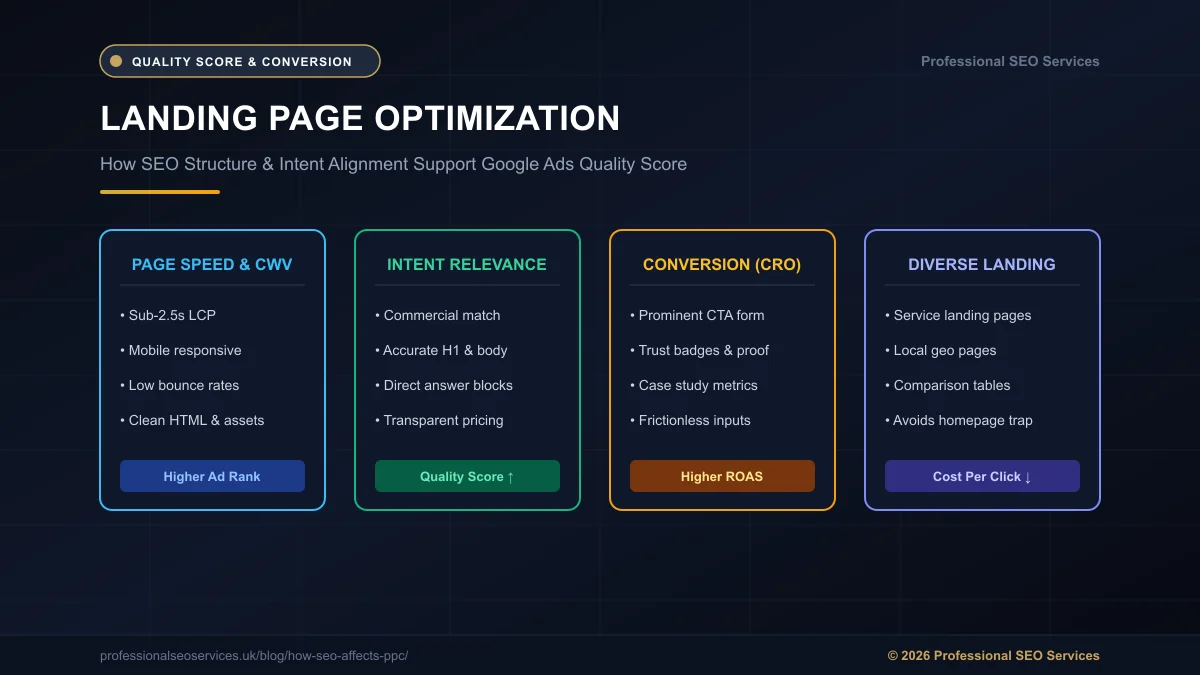
Technical SEO focuses on Core Web Vitals (CWV), keeping Largest Contentful Paint (LCP) under 2.5 seconds. Faster load speeds reduce mobile bounce rates, leading to higher Quality Score ratings in Google Ads. Keep the distinction clear between SEO optimization and Google Ads landing-page requirements: SEO focuses on comprehensive depth and crawlability, whereas Google Ads rewards direct relevance, rapid loading, and clear calls to action (CTAs).
2. SEO Keyword Research Can Strengthen PPC Targeting
SEO keyword research strengthens PPC targeting by supplying extensive lists of verified search terms, search intent classifications, and keyword clusters. Organic research analyzes primary keywords, long-tail phrases, commercial keywords, transactional searches, and location-based queries using tools like SEMrush, Ahrefs, Moz, and Google Keyword Planner.
Existing SEO research provides a stronger starting point for PPC campaigns. Paid ad specialists eliminate guesswork by building ad groups around keyword clusters that already demonstrate active search volume and commercial viability in organic tracking.
3. Organic Search Data Can Help Prioritize PPC Keywords
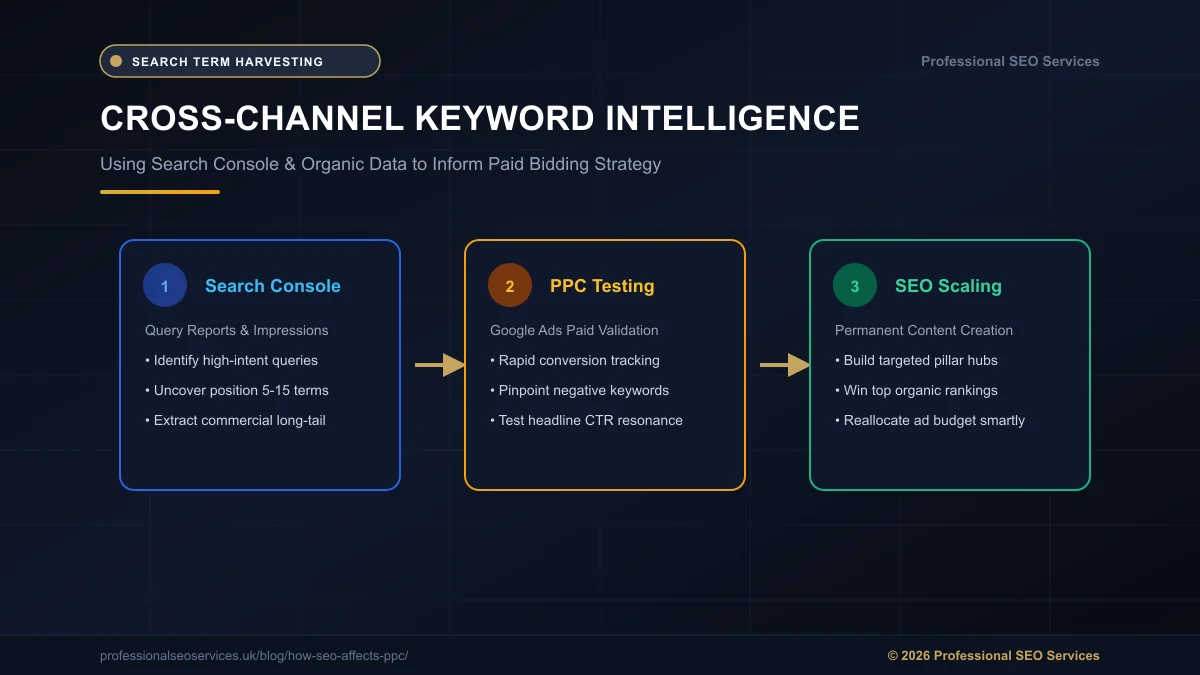
Organic search data helps prioritize PPC keywords by revealing exactly which search terms generate qualified impressions and conversions. Google Search Console (GSC) records queries that bring searchers to the website.
Media buyers prioritize budget allocation across 4 specific query segments:
- High-converting organic queries: Allocate paid budget to ensure top placement on revenue-generating terms.
- High-impression queries: Bid on high-volume terms where organic rankings sit on page 2.
- Keywords with weak organic rankings: Buy paid placements to maintain visibility during content development.
- Keywords where competitors dominate: Deploy paid ads to defend brand market share against rival campaigns.
4. Strong Organic Visibility Can Increase Overall SERP Presence
Appearing in both paid and organic results increases overall Search Engine Results Page (SERP) real estate and builds consumer familiarity. Users who see a brand in the top sponsored ad slot and in position #1 in organic listings perceive that business as an industry leader.
Appearing twice does not guarantee double clicks. Studies show that holding both positions yields a 20 percent to 35 percent lift in total net clicks compared to running either listing alone.
5. SEO Content Can Give PPC Campaigns More Landing-Page Options
A mature SEO content library gives PPC campaigns targeted destination pages for specific ad groups. Instead of routing all ad traffic to a generic homepage, PPC managers route ad clicks to dedicated service pages, product catalogs, location landing pages, and comparison articles.
Sending every PPC visitor to the homepage is a weak strategy. Broad messaging on homepages lowers conversion rates. Directing searchers to a specific SEO service landing page matches the precise problem stated in their search query.
6. SEO Can Help PPC Align With Search Intent
SEO methodology categorizes search behavior into 4 core search intent types: informational, commercial investigation, transactional, and navigational intent.
- Informational intent: Searchers seeking answers, definitions, or procedural guides.
- Commercial investigation intent: Buyers comparing solutions, pricing models, or customer reviews.
- Transactional intent: Prospects ready to purchase, book a consultation, or request an audit.
- Navigational intent: Users looking for a specific website login or brand page.
Aligning the PPC landing page with user intent improves the customer journey. Route commercial investigation queries to product comparison pages, and route transactional queries to direct lead forms to increase conversion rates.
7. SEO and PPC Can Strengthen Brand Visibility
SEO and PPC strengthen brand visibility by establishing multiple touchpoints across the search landscape. Buyers rarely convert on their first search interaction. A user may click an informational blog post during initial research, notice an ad during a commercial comparison search, and click a branded PPC ad to complete their purchase.
Coordinated search presence builds trust signals across organic rankings, paid ads, and Google Business Profile local map packs. Multiple touchpoints reassure potential buyers of company credibility.
8. SEO and PPC Together Can Improve Conversion Insights
Combining SEO and PPC conversion data reveals deep insights into search behavior, landing page performance, and keyword profitability. Google Analytics 4 (GA4) attribution models connect multi-channel conversion paths.
Marketing leaders track keyword-level performance across both channels. If a keyword converts at 8 percent in Google Ads, the SEO team builds dedicated long-form content to capture organic rankings for that exact query.
How Does PPC Affect SEO?
PPC affects SEO by validating high-converting keywords in real time, testing marketing messages rapidly, and discovering search query patterns that guide content production. While PPC does not change search engine ranking algorithms, paid campaign data provides verified market intelligence for organic optimization.
Does PPC Directly Improve Organic Rankings?
No, PPC does not directly improve organic rankings. PPC spending is not an organic ranking factor. Paying for Google Ads does not purchase higher organic positions or protect a site from organic algorithm updates.
Google enforces strict separation between advertising clients and organic search indexing algorithms. Distinguish correlation from causation: while paid traffic increases brand searches and indirect mentions, PPC clicks do not alter Google's core organic ranking calculations.
How PPC Can Indirectly Support SEO
PPC indirectly supports SEO by functioning as a fast testing laboratory for organic marketing initiatives. Paid campaigns test metadata headlines, identify high-converting commercial intent, and bridge search visibility while new organic content earns backlink authority.
Running Google Ads exposes new content to target audiences immediately. This exposure generates initial engagement, social shares, and industry citations, without acting as an algorithmic ranking mechanism.
How PPC Data Can Improve Your SEO Strategy
PPC data improves your SEO strategy by providing immediate numerical feedback on keyword conversion rates, Click-Through Rates (CTR), and search trends. Marketers use these insights to refine editorial calendars and on-page optimization.
Use Search-Term Data to Discover New SEO Keywords
Extract new SEO keywords from the Google Ads Search Terms Report. This report displays the exact queries users entered before clicking an advertisement. SEO writers identify emerging conversational phrases and long-tail questions to integrate into existing articles.
Identify High-Converting Keywords
Identify high-converting keywords by reviewing cost-per-acquisition (CPA) and conversion rates in paid search reports. Prioritize SEO resources on keywords that prove they generate paying customers in PPC, rather than targeting keywords based solely on search volume.
Find Keywords With High Commercial Intent
Discover high commercial intent keywords by analyzing Cost Per Click (CPC) data. High CPC values indicate intense competition among advertisers. When competitors pay $25 (£20) per click for a term, that term possesses strong commercial intent and warrants dedicated organic content assets.
Discover Emerging Search Trends
Spot emerging search trends in PPC impression volume before organic keyword tools update their monthly averages. Rapid spikes in paid impression share alert the SEO team to write timely guides and capture early organic rankings.
Identify Negative Keywords and Irrelevant Queries
Identify negative keywords from PPC campaigns to prune irrelevant organic keyword targets. If PPC search term logs show that queries containing "free", "template", or "cheap" produce zero sales, exclude those terms from organic content targeting.
Find Keywords Where Organic Rankings Are Weak
Pinpoint keywords where your domain ranks outside the top 5 organic positions and maintain paid coverage. PPC ads ensure your business retains top-of-page visibility while the SEO team optimizes content, internal links, and technical architecture.
Test Messaging Before Creating SEO Content
Test messaging and headlines in PPC ad copy before writing 3,000-word organic pillar guides. Deploy responsive search ads with 4 headline variations. Use the winning headline with the highest Click-Through Rate (CTR) as your organic H1 title and meta title tag.
How SEO Can Help Reduce PPC Waste
SEO helps reduce PPC waste by providing high-ranking organic pages that capture clicks without per-click ad costs, allowing businesses to reallocate paid budgets efficiently. Coordinating organic and paid marketing budgets prevents unnecessary ad spending on uncompetitive search queries.
Avoid Paying for Every Search Where You Already Rank Strongly
Evaluate ad spend on non-competitive queries where your website holds position #1 in organic rankings. Test reducing PPC bids on non-brand terms with zero competitor ads, if organic listings capture 90 percent of clicks.
Use Organic Rankings to Inform Bid Strategy
Adjust PPC bid levels based on organic ranking positions. Lower paid bids on terms where your organic listing ranks in position 1, and raise paid bids on commercial terms where your organic ranking sits on page 2 or page 3.
Shift PPC Budget Toward High-Value Keyword Gaps
Shift paid media budgets directly into high-value keyword gaps. Reallocate funds saved from strong organic positions into high-margin commercial keywords where organic competition is steep.
Use SEO Content to Capture Informational Searches
Use organic SEO content to capture informational queries rather than paying expensive PPC fees. Answering top-of-funnel questions through comprehensive blog articles preserves PPC budgets for bottom-of-funnel transactional queries.
Improve Landing-Page Relevance
Improve landing-page relevance by applying SEO on-page optimization methods to paid destination URLs. Aligning heading tags, semantic keywords, and fast server response times improves Quality Score, which lowers actual Cost Per Click (CPC) in Google Ads auctions.
Should You Run PPC for Keywords You Already Rank For?
Deciding whether to run PPC for keywords where you already rank organically depends on competitor activity, commercial intent, and incremental conversion lift. Running both channels delivers strategic advantages on commercial searches, but selective budget adjustments reduce waste on low-threat queries.
When Running Both SEO and PPC Makes Sense
Run both SEO and PPC simultaneously when search terms display high commercial value and competitive threat. Specific conditions include:
- High-converting keywords: Maximize lead volume across every available SERP slot.
- Brand terms: Protect branded real estate against aggressive competitor conquesting.
- Competitive SERPs: Defend market share when multiple competitors run Google Ads above organic results.
- High-value commercial queries: Ensure conversion capture on transactional terms.
- Important product/service searches: Establish authority for high-margin offerings.
When Reducing PPC Spend May Make Sense
Reduce PPC spend when data demonstrates limited incremental conversion gain from paid ads. Specific situations include:
- Strong organic visibility with zero competitor ads on the SERP.
- Low incremental paid conversions: Users click paid ads simply when ads appear in top positions.
- High Cost Per Click (CPC) that erodes profit margins.
- Limited monthly marketing budget: Allocate capital toward unranked growth keywords.
- Poor PPC profitability compared to organic lead channels.
Why You Should Test Before Pausing Ads
Test search queries before pausing paid campaigns to measure true incremental conversions. Pausing ads can cause a net drop in overall sales.
Execute a 30-day geographic split test or bid reduction test. Monitor total conversions across paid and organic channels to verify whether organic listings absorb the lost paid volume.
SEO vs PPC: How Does Paid Search Compare to SEO?
Paid search compares to SEO across 7 operational variables: cost structure, delivery speed, sustainability, keyword control, conversion data immediacy, scalability, and SERP visibility. Evaluating how does paid search compare to SEO, how does PPC differ from SEO, and how is SEO different from SEM clarifies which channel to deploy for specific business targets.
SEO vs PPC Cost
SEO involves upfront investment in content production and technical health, while PPC incurs continuous per-click fees. SEO costs remain stable as traffic scales, driving down the effective cost per visitor over time. PPC costs scale linearly with traffic volume.
SEO vs PPC Speed
PPC delivers immediate traffic within 60 minutes of campaign activation, while SEO requires 3 to 6 months to establish ranking authority. Businesses needing immediate quarterly sales launch PPC, while investing in SEO for long-term dominance.
SEO vs PPC Sustainability
SEO provides compounding sustainability, while PPC traffic stops the moment media budgets cease. A well-optimized guide can generate qualified organic traffic for 3 to 5 years.
SEO vs PPC Keyword Control
PPC provides total control over keyword match types, negative keywords, and exact landing-page URLs. SEO offers less precision as Google algorithms select which indexed URL best satisfies the user query.
SEO vs PPC Conversion Data
PPC delivers precise conversion data tied directly to search queries and ad copy variations. SEO data is partially obscured by Google Search Console privacy thresholds and aggregated query metrics.
SEO vs PPC Scalability
PPC scales instantly by increasing daily ad spend, while SEO scales gradually by expanding content libraries and earning domain authority.
SEO vs PPC Search Visibility
SEO captures organic listings, featured snippets, and local map packs, while PPC commands top sponsored ad placements above organic results.
Which Is Better: SEO or PPC?
Neither channel is universally better; the right choice depends on goals, competition, budget, timeline, and search intent. Early-stage startups use PPC to validate messaging and generate immediate revenue. Established businesses use SEO to build sustainable market share and reduce reliance on paid media.
SEO vs SEM vs PPC: What's the Difference?
The difference between SEO, SEM, and PPC centers on channel scope and billing mechanics. Search Engine Marketing (SEM) serves as the umbrella category covering both unpaid organic optimization (SEO) and paid search advertising (PPC).
What Is SEO?
SEO is the discipline of optimizing web pages to rank in unpaid organic search engine results. Practitioners optimize content relevance, technical crawlability, and backlink authority.
What Is PPC?
PPC is a paid digital advertising auction model where advertisers pay a fee each time a searcher clicks their ad. Advertisers bid on keywords in Google Ads and Bing Ads.
What Is SEM?
SEM is the broad discipline of growing search engine visibility through both paid advertising and organic search optimization.
How Do SEO and SEM Differ?
SEO differs from SEM in scope; SEO represents one specific component of SEM. SEM encompasses all search marketing strategies, including Google Ads, Bing Ads, and organic SEO.
How Does PPC Fit Into SEM?
PPC fits into SEM as the paid advertising component of search engine marketing. SEM campaigns combine PPC auction targeting with SEO content assets.
How Do SEO and SEM Work Together?
SEO and SEM work together by balancing paid ad agility with organic authority to capture the entire customer conversion journey. Exploring how do SEO and SEM work together, how SEO and SEM work together, how does SEO and SEM work, how does SEM differ from SEO, and how does PPC differ from SEO ensures marketing teams allocate media spend with clarity.
How SEO and Google Ads Work Together
SEO and Google Ads work together by sharing keyword intelligence, aligning ad headlines with page content, and balancing paid bids against organic positions. Google Ads serves as the practical proving ground for search engine marketing strategies.
Use SEO Data to Build Google Ads Campaigns
Use organic keyword data from Google Search Console to structure Google Ads ad groups. High-impression organic queries provide ready-made keyword targets for targeted ad groups.
Use Google Ads Search Terms to Improve SEO
Use the Google Ads Search Terms report to discover conversational search queries and FAQs. Add these long-tail queries into organic landing pages to improve topical authority.
Align SEO Content With Ad Messaging
Align SEO content with Google Ads copy to reinforce brand value propositions across the SERP. Consistent headlines build trust and increase conversion rates.
Coordinate Organic Rankings and Paid Bids
Coordinate paid bid levels with organic ranking movements. Lower bids when organic rankings reach position #1, and raise bids when organic rankings experience temporary volatility.
Use Google Ads to Support Weak Organic Rankings
Use Google Ads to capture visibility on competitive commercial queries where your organic ranking is outside the top 5. Paid ads secure leads while the SEO team strengthens organic content depth.
Measure Paid and Organic Performance Together
Measure paid and organic performance in unified dashboards to understand total search market share. Evaluating how SEO and Adwords work together and how SEO and Google Ads work together reveals true blended acquisition efficiency.
How to Build an Integrated SEO and PPC Strategy
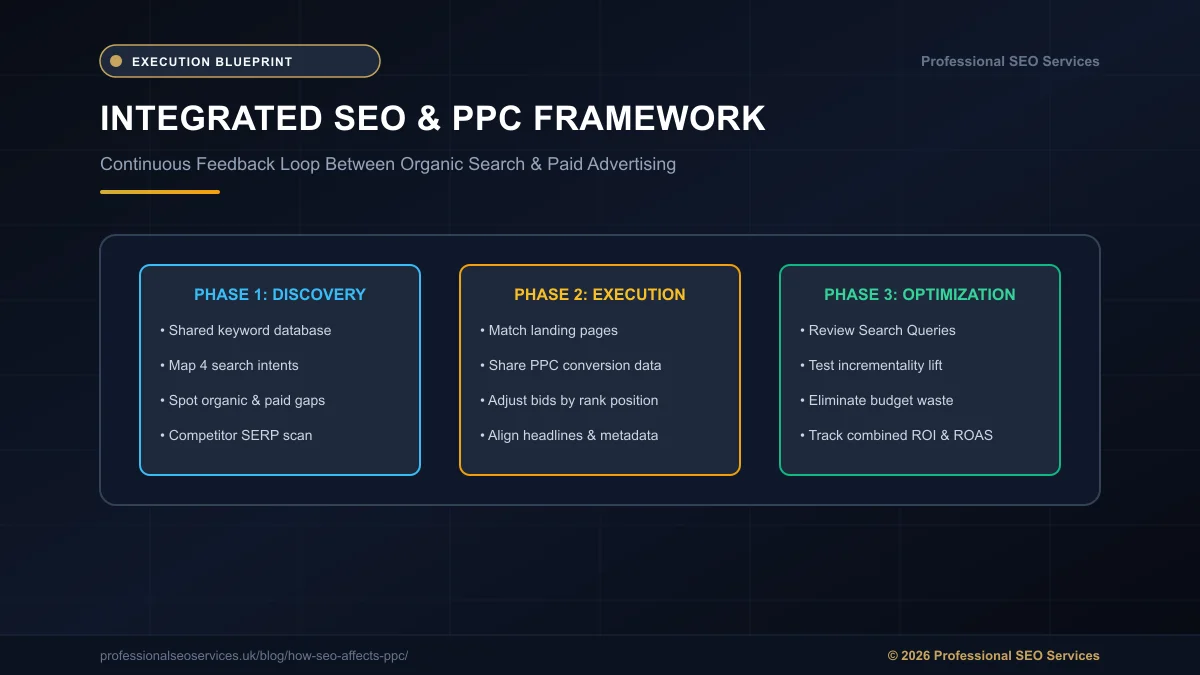
Build an integrated SEO and PPC strategy by following a 9-step cross-channel framework that unifies keyword data, search intent mapping, and budget management.
Step 1: Build a Shared Keyword Database
Consolidate organic keywords and paid search queries into a single database. Track organic rank, Cost Per Click (CPC), impression share, and conversion rate for every core query.
Step 2: Map Keywords to Search Intent
Map every keyword to 1 of 4 search intent categories: informational, commercial, transactional, or navigational.
Step 3: Identify Organic and Paid Keyword Gaps
Identify keywords with high search volume where your brand lacks both paid ads and organic rankings. Assign high-intent gaps to PPC for rapid coverage, and assign informational terms to SEO.
Step 4: Match Landing Pages to Intent
Match paid and organic traffic to destination pages designed for specific user needs. Direct transactional visitors to conversion-focused landing pages with frictionless forms.
Step 5: Share PPC Conversion Data With SEO
Export high-converting search queries from Google Ads and provide them to content writers. Writers incorporate proven commercial phrases into title tags, headers, and meta descriptions.
Step 6: Use Organic Rankings to Inform PPC Bids
Automate bid rules in Google Ads based on organic positions. Lower paid bid targets on queries where your organic URL maintains top organic ranking.
Step 7: Coordinate Ad Copy and SEO Messaging
Align promotional offers, guarantees, and calls to action across organic snippets and responsive search ads.
Step 8: Review Search-Term and Query Data Regularly
Review PPC Search Terms and Google Search Console performance reports every 14 days. Add non-performing search queries to negative keyword lists, and expand high-performing organic queries into new articles.
Step 9: Test, Measure, and Reallocate Budget
Reallocate media budget toward keyword clusters that generate maximum blended Return on Ad Spend (ROAS).
How Can SEO and PPC Work Together for a Law Firm?
SEO and PPC work together for a law firm by capturing high-intent emergency searches through PPC ads while building local authority and practice-area dominance through SEO. Legal keywords represent some of the most expensive terms in Google Ads, often exceeding $150 (£120) per click.
Target High-Intent Legal Keywords With PPC
Target immediate transactional searches using Google Ads. Queries such as "car accident attorney near me" require rapid legal assistance. PPC places the law firm at the top of the mobile screen when prospective clients need immediate representation.
Build Organic Practice-Area Content
Build comprehensive organic practice-area pages addressing statutes of limitations, accident liability, and settlement processes. This content captures prospects researching claims and builds long-term domain authority.
Use PPC Data to Discover Legal Search Intent
Analyze PPC search term logs to identify specific legal scenarios prospects describe. Use these scenarios to write case study guides and FAQ content that attract organic searchers.
Combine Local SEO With Local PPC
Combine Google Local Services Ads (LSAs) and standard PPC with Google Business Profile local SEO. A law firm dominating local ads, the local 3-pack, and position #1 in organic search captures the vast majority of regional case inquiries.
Dominate SERPs for High-Value Legal Searches
Dominate legal search results by displaying sponsored ad extensions, local map placements, and organic links on the same page. Competitors struggle to gain visibility when your firm controls 3 distinct SERP positions.
Use Separate Landing Pages for Different Legal Services
Deploy dedicated landing pages for specific case types. For example, route "personal injury lawyer" queries to a specialized PPC landing page with immediate consultation forms, while maintaining an organic practice-area pillar page that educates searchers on injury compensation law.
How Should PPC and SEO Work Together to Gain Visibility?
PPC and SEO should work together by aligning channel tactics to specific search situations across the SERP. Apply the following operational visibility framework:
| Search Situation | SEO Strategy | PPC Strategy |
|---|---|---|
| Strong organic ranking | Maintain ranking | Test incremental value |
| Weak organic ranking | Build content | Bid on valuable terms |
| New product/service | Create optimized page | Drive immediate traffic |
| High CPC keyword | Assess organic opportunity | Focus on profitable searches |
| Brand keyword | Protect organic presence | Consider brand protection |
| Competitive keyword | Build authority | Use paid visibility |
| Informational query | Create helpful content | Test paid opportunities |
How to Measure the Combined Impact of SEO and PPC
Measure the combined impact of SEO and PPC by tracking 10 core performance metrics across customer journeys. Measuring channels separately hides assisted conversions and obscures blended customer acquisition costs.
Organic Clicks and Impressions
Track total organic clicks and search impressions in Google Search Console. Growth in impressions confirms expanding topical footprint.
Paid Clicks and Impressions
Track paid clicks and auction impression share in Google Ads. Measuring impression share reveals what percentage of total available searches your ads capture.
Organic Conversion Rate
Calculate organic conversion rate by dividing completed actions by total organic sessions. Compare rates across service pages and informational guides.
PPC Conversion Rate
Calculate PPC conversion rate by dividing ad conversions by total ad clicks. Compare conversion rates against organic landing pages targeting the same topic.
Cost Per Acquisition
Calculate Cost Per Acquisition (CPA) by dividing total marketing spend by the number of acquired leads or sales. Track paid CPA, organic CPA, and combined blended CPA.
Return on Ad Spend
Calculate Return on Ad Spend (ROAS) by dividing total revenue generated from paid ads by total ad spend. Target a minimum 4x ROAS on direct-response campaigns.
Total Search Conversions
Sum organic conversions and paid conversions to determine total search conversions. This unified metric reveals true growth in market demand.
Assisted Conversions
Analyze assisted conversions in Google Analytics 4 (GA4). Track how often an organic blog visit assists a final PPC purchase, and vice versa.
SERP Visibility
Measure total SERP visibility share across primary commercial keywords. Calculate the percentage of target terms where your brand holds both paid and organic placements.
Paid + Organic Incrementality
Measure incrementality lift by testing total conversions when paid ads run alongside top organic rankings. Incrementality testing proves whether running ads on top organic terms generates net additional revenue or duplicates existing demand.
Common SEO and PPC Mistakes to Avoid
Avoid 9 common SEO and PPC mistakes that drain marketing budgets and stifle organic growth.
Treating SEO and PPC as Completely Separate Channels
Siloing SEO and PPC teams creates duplicate effort and misses cross-channel data insights. Establish weekly data-sharing sessions between organic strategists and paid media buyers.
Assuming PPC Improves Organic Rankings
Assuming that increasing Google Ads spend will improve organic rankings is factually incorrect. Invest in technical infrastructure and content relevance to earn organic positions.
Assuming SEO Automatically Lowers CPC
Publishing organic content does not automatically lower Cost Per Click (CPC) in Google Ads. CPC declines only when the specific PPC landing page earns high Quality Score ratings for relevance and page speed.
Stopping PPC Because You Rank Organically
Abruptly pausing PPC ads on terms where you rank #1 organically often reduces total lead volume by 20 percent to 40 percent. Test conversion incrementality before pausing ads.
Ignoring Search Intent
Bidding on informational queries with sales-pitch landing pages produces high bounce rates and wasted spend. Match transactional intent with lead forms and informational intent with content.
Sending Every Ad to the Homepage
Routing ad clicks to generic homepages diminishes conversion rates. Route ad traffic to dedicated service pages or product landing pages matching the exact search query.
Not Sharing Keyword and Conversion Data
Failing to share PPC search-term reports with SEO teams slows organic topic discovery. Share negative keyword lists and high-converting queries monthly.
Measuring Traffic Instead of Revenue
Tracking vanity click metrics instead of customer revenue obscures channel profitability. Align SEO and PPC tracking with qualified pipeline value and closed sales.
Failing to Test Paid and Organic Together
Evaluating channel performance in isolation hides true customer conversion journeys. Measure combined search impact using multi-touch attribution models.
Frequently Asked Questions About SEO and PPC
Review direct answers to the 12 most frequent questions regarding how SEO affects PPC and search marketing integration.
How does SEO affect PPC?
SEO affects PPC by improving landing page speed and relevance, supplying proven keyword queries from Search Console, and strengthening brand credibility across the SERP. SEO provides the technical foundations and content assets that make paid campaigns more cost-effective.
Does PPC affect SEO rankings?
No, PPC does not directly affect SEO rankings. Google maintains an absolute algorithmic separation between paid advertising spend and organic search ranking calculations.
Does Google Ads affect SEO?
No, Google Ads does not directly affect SEO rankings. Purchasing ad space on Google Ads delivers paid traffic while campaigns remain funded, but organic rankings require technical health, content quality, and external authority.
How does PPC help SEO?
PPC helps SEO by discovering high-converting keyword queries, testing title copy for Click-Through Rate (CTR) resonance, and driving immediate user engagement to new service offerings.
How does PPC impact SEO?
PPC impacts SEO by supplying real-time conversion metrics, uncovering negative keywords to avoid in organic content, and highlighting competitive gaps across search results.
How do SEO and PPC work together?
SEO and PPC work together by sharing keyword intelligence, coordinating landing-page conversion rate optimization, dominating SERP real estate, and maximizing total conversions across both channels.
How can SEO and PPC work together?
SEO and PPC can work together through a shared keyword database, coordinated bid management against organic ranking positions, unified landing-page CRO, and cross-channel attribution tracking.
How does SEO and SEM work together?
SEO and SEM work together by balancing short-term paid traffic acquisition with long-term compound organic traffic growth to achieve minimum blended cost per acquisition.
How is SEO different from SEM?
SEO focuses strictly on earning unpaid organic rankings through content relevance and technical health, whereas SEM encompasses both paid advertising (PPC) and organic search marketing.
How does PPC differ from SEO?
PPC provides immediate, paid search visibility that ceases when media budgets run dry, whereas SEO takes weeks or months to build durable rankings that deliver compounding clicks without per-click fees.
Should I use SEO and PPC at the same time?
Yes, using SEO and PPC at the same time captures maximum SERP market share, protects branded keywords against competitors, and provides two rich streams of search behavior analytics.
Is SEO better than PPC?
Neither channel is universally better; the right choice depends on goals, competition, budget, timeline, and search intent. Combining both channels creates an agile, resilient search marketing strategy.
Final Takeaway: SEO and PPC Are Stronger Together
Search Engine Optimization (SEO) and Pay-Per-Click (PPC) advertising have different mechanisms and goals. Neither channel directly controls the other channel's rankings. Search Engine Optimization (SEO) strengthens the ecosystem around Pay-Per-Click (PPC) through high-speed landing pages, search intent mapping, and organic search intelligence. Pay-Per-Click (PPC) provides valuable keyword and conversion data for Search Engine Optimization (SEO).
The strongest digital marketing strategy is not SEO vs PPC, but coordinated search marketing. Businesses that coordinate organic rankings with paid search campaigns achieve higher brand presence, lower customer acquisition costs, and greater market share across competitive Search Engine Results Pages (SERPs).
Measure total search visibility, combined conversions, revenue, and Return on Ad Spend (ROAS). Partner with Professional SEO Services to design an integrated search architecture that transforms search into your most profitable revenue engine.