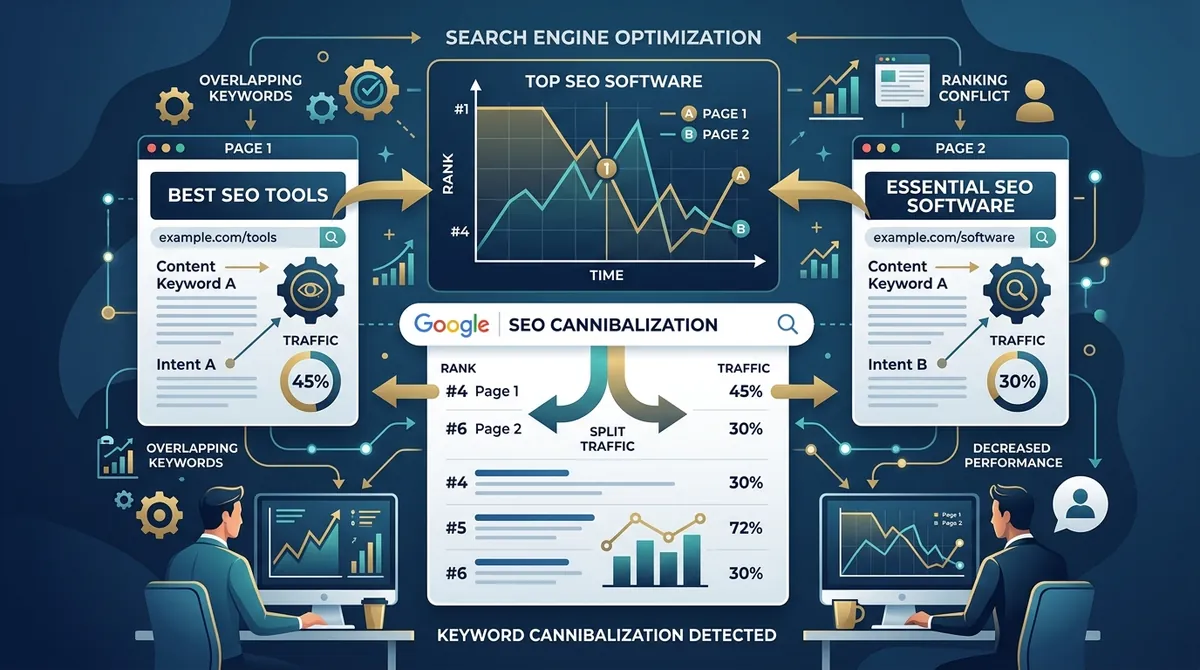
SEO cannibalization occurs when multiple pages on the same website inadvertently compete against each other for the same or closely related search queries, satisfying substantially similar search intent. Rather than helping a domain secure multiple top positions on Google, this internal competition dilutes page authority, splinters inbound organic links, fractures click-through rates, and creates profound confusion for search engine algorithms attempting to choose the single most relevant page for searchers.
When search engines encounter multiple URLs on your domain with overlapping topical focus and identical user intent, they struggle to determine which document best deserves index priority and rank placement. Consequently, search engines may alternate between ranking different URLs from day to day, depress overall rankings for all competing pages, or elevate an irrelevant, low-converting blog post above your high-priority commercial service landing page.
However, it is crucial to establish an important distinction early: ranking multiple pages for the same keyword is not automatically cannibalization. When two pages satisfy distinct user needs—such as an informational guide serving top-of-funnel discovery and a commercial transaction page serving bottom-of-funnel buyers—multiple rankings represent legitimate topical domination. Cannibalization exists only when multiple URLs collide around the intersection of search intent + topical overlap + competing internal signals.
In this comprehensive masterclass, our senior search strategists examine every operational aspect of SEO cannibalization. You will discover the root causes of cannibalization, practical diagnostic signs to spot inside Google Search Console, comparative distinctions separating cannibalization from duplicate content and thin pages, forensic detection workflows across enterprise toolsets, actionable solutions ranging from 301 consolidation to intent restructuring, preventative governance frameworks, vertical considerations for ecommerce and local businesses, and how cannibalization impacts modern generative AI engines like ChatGPT and Google AI Overviews. For ambitious enterprises seeking bulletproof structural architecture, our agency specialists at Professional SEO Services conduct full-spectrum audits to resolve structural friction and maximize organic revenue.
What Is SEO Cannibalization?
To understand the operational mechanics of SEO cannibalization, search professionals must look beyond raw keywords and evaluate how modern search algorithms index entities, map intent vectors, and distribute algorithmic trust across complex domain ecosystems.
SEO cannibalization definition
SEO cannibalization occurs when multiple pages on the same website compete for the same or closely related search queries and satisfy substantially similar search intent. When this structural flaw arises, your website actively works against itself, dividing algorithmic signals across fragmented URLs instead of concentrating topical authority into a single, dominant organic asset.
At its core, SEO cannibalization encompasses seven defining technical characteristics:
- Multiple URLs: Two or more distinct web pages published under the same root domain or subdomains target identical topic clusters.
- Same or overlapping keywords: Competing pages optimize for identical primary search terms, secondary synonyms, and long-tail variants.
- Similar search intent: Both URLs satisfy the same informational, commercial, navigational, or transactional goal of the searcher.
- Overlapping content: The topical coverage, on-page entities, headers, and media across the pages duplicate value propositions without distinct value differentiation.
- Search engines choosing between URLs: Algorithmic scoring models must evaluate which page to serve, frequently oscillating between competing candidate documents.
- Potentially unstable rankings: SERP positions experience rapid volatility, erratic fluctuations, and sudden drops as Google repeatedly shifts preferences.
- Dilution of internal signals and links: Internal link equity, external backlinks, PageRank, and user engagement metrics are divided across multiple assets rather than compounding on a primary champion page.
What is keyword cannibalization?
While digital marketers frequently use the terms interchangeably, examining the semantic distinctions between these concepts clarifies the exact technical challenge:
- SEO Cannibalization: The overarching technical and strategic umbrella describing any scenario where internal website pages compete against each other for organic search visibility, traffic, and rankings.
- Keyword Cannibalization: The specific lexical occurrence where multiple URLs optimize for and compete over the same target keyword strings in title tags, H1 headers, meta descriptions, and on-page body copy.
- Content Cannibalization: The structural overlap of subject matter, where multiple blog posts, resource guides, or category pages deliver near-identical informational value, explanations, or media assets.
- Search-Intent Cannibalization: The deepest and most damaging form of competition, where multiple URLs fulfill the exact same user search task, forcing Google to choose one URL at the direct expense of the other.
In modern search architecture, keyword cannibalization is simply a visible symptom, while search-intent cannibalization represents the underlying root problem. To master modern keyword targeting, explore our comprehensive guide on how to do keyword research.
Is ranking multiple pages for the same keyword always cannibalization?
No, ranking multiple pages for the same keyword is not automatically cannibalization. In fact, authoritative search analytics platforms including Semrush explicitly warn that observing multiple ranking URLs for a query does not necessarily indicate a structural malfunction.
Google frequently serves multiple pages from a single authoritative domain when those pages serve genuinely complementary functions or satisfy distinct nuances of a multi-faceted search query:
- Different search intents: A user searching for a broad query like "enterprise CRM software" might benefit from seeing both an informational comparison guide and a direct software demo landing page.
- Parent category + subcategory: An ecommerce site ranking both its top-level category
/laptops/and a specialized subcategory/laptops/gaming/on page one of Google for specific hybrid queries. - Informational article + commercial landing page: An educational post explaining "what is technical SEO" coexisting on SERPs alongside your agency's core commercial Technical SEO services page.
- Brand + product pages: A branded query returning the company homepage alongside specific flagship product offerings or customer portal logins.
- Different geographic intent: Multi-location enterprises ranking distinct regional landing pages for localized variations of a national brand query.
- Different stages of the buyer journey: Top-of-funnel discovery articles ranking in tandem with mid-funnel case studies and bottom-of-funnel quotation calculators.
True cannibalization occurs only when the presence of multiple URLs harms your overall performance—causing rankings to oscillate, clicks to plummet, or lower-converting URLs to cannibalize high-converting assets.
How Does SEO Cannibalization Work?
Understanding the mechanical progression of SEO cannibalization illuminates why it degrades organic performance so quietly and insidiously over time.
The cannibalization cycle unfolds across seven sequential stages:
- Website publishes multiple related pages: Over months or years of content creation, marketing teams produce numerous articles, service pages, or category variations addressing the same overarching topic.
- Pages target overlapping queries: Authors, copywriters, or SEO teams unintentionally assign identical focus keywords, synonyms, and secondary phrases across these distinct URLs.
- Content and intent become similar: Because the pages address identical user problems without distinct transactional or educational boundaries, their semantic entities and intent profiles converge.
- Search engines evaluate multiple URLs: Googlebot crawls and parses both URLs, identifying comparable relevance scores, topical entities, and semantic keywords.
- Different URLs rank at different times: Because Google cannot decisively determine which page is the definitive authority, algorithmic ranking systems test URL A in position #5 one week, then switch to URL B in position #8 the next week.
- The site's preferred URL fails to appear consistently: The high-converting landing page you engineered to generate business leads drops out of the top results, replaced sporadically by an outdated informational article.
- Organic visibility becomes fragmented: User clicks, impressions, external backlinks, and social shares are split across multiple URLs, depriving your domain of the consolidated link equity required to break into competitive top-three SERP positions.
How Google chooses between competing URLs
When Google encounters two or more URLs on a single domain vying for the same query, its multi-stage information retrieval algorithms evaluate candidate documents across complex comparative heuristics:
- Relevance and entity coverage: Which URL provides the most complete, logically structured coverage of the query's underlying semantic entities? Review our technical guide on on-page SEO optimization for deep entity structuring techniques.
- Search intent alignment: Which page best matches what Google's machine learning models (such as RankBrain and RankEmbed) have determined searchers want to accomplish?
- Content quality and freshness: Which document demonstrates superior depth, original data, verified author credentials, and up-to-date analysis?
- Internal link signals: Which page receives more internal links, and what anchor text is used to describe it? Google relies heavily on internal site architecture to discern a webmaster's preferred canonical resource.
- External backlinks and PageRank: Which URL commands a stronger off-page citation profile with high-authority referring domains? Discover our approach to enterprise authority building with our Off-Page SEO services.
- Page authority and user experience: Which page achieves faster Core Web Vitals performance, cleaner mobile rendering, and lower bounce-back rates?
- Context and topical hierarchy: Where does each URL sit within the domain's logical URL folder structure and parent-child hierarchy?
- Historical search performance: How consistently has each URL satisfied historical searchers based on aggregate dwell time and task completion signals?
- Site architecture and canonical directives: Has the webmaster provided clear technical indicators, such as breadcrumb navigation and canonical tags, pointing toward one authoritative asset?
Note: Search practitioners must avoid claiming that Google literally "splits ranking power" as a rigid, universal mathematical formula. Google evaluates pages individually; however, dividing link equity, topical relevance, and engagement across multiple assets prevents any single URL from reaching its maximum ranking potential.
What Causes SEO Cannibalization?
SEO cannibalization rarely happens intentionally. Instead, it emerges as an organic byproduct of website expansion, decentralized editorial teams, legacy migrations, and uncoordinated optimization campaigns.
Creating multiple pages targeting the same keyword
The most common cause of cannibalization is intentionally creating multiple distinct URLs targeting identical keyword variations. For example, a digital agency might publish:
https://example.com/seo-services/https://example.com/seo-company/https://example.com/seo-agency/
If all three pages serve essentially the same commercial intent—convincing a prospective client to hire the firm for search engine optimization—they will directly cannibalize each other. Google's semantic indexing recognizes that "services," "company," and "agency" in this context represent identical user goals, forcing the algorithm to divide impressions among all three.
Publishing similar blog posts over time
Content teams publishing frequently across multiple years often cover overlapping subject matter without auditing historical archives. Consider a site that has published:
- "What is SEO?" (published in 2021)
- "How Does SEO Work?" (published in 2023)
- "SEO Explained: A Beginner Guide" (published in 2024)
- "SEO Basics for Beginners" (published in 2026)
These articles legitimately coexist only if each adopts a distinctly unique angle (e.g., beginner fundamentals vs. an advanced technical breakdown vs. an interactive glossary). When all four articles provide introductory definitions and basic optimization advice, they compete head-to-head for identical introductory queries.
Targeting the same search intent with different pages
Many marketing teams focus excessively on exact-match keyword strings while ignoring underlying search intent. For instance, creating separate pages for "how to track keyword rankings" and "best tools to monitor search rankings" often results in intent collision. If Google's SERP displays software tool roundups for both queries, Google treats both queries as demanding the same commercial-investigative format.
Poor keyword mapping
Without an authoritative, centralized keyword-to-URL mapping document, multiple copywriters and product managers inevitably assign the same high-volume search terms to new landing pages, product releases, and blog articles, sowing the seeds for systemic cannibalization.
Duplicate or near-duplicate content
When distinct URLs display identical or nearly identical blocks of body copy, product descriptions, or boilerplate paragraphs, search crawlers struggle to discern semantic differences. While duplicate content is primarily an indexation hygiene issue, it actively triggers cannibalization whenever multiple near-duplicate URLs compete for organic ranking slots.
Weak site architecture
Deficiencies in website taxonomy—such as ambiguous category-to-subcategory relationships, inconsistent parent-child breadcrumb hierarchies, missing topic cluster links, and isolated orphan pages—deprive Google of structural signals. When search bots cannot determine the primary hub page in a topic cluster, they distribute ranking weight unpredictably across peripheral assets.
Ecommerce category and product overlap
Ecommerce websites are particularly susceptible to severe cannibalization. For example:
/laptops/(Broad Parent Category)/gaming-laptops/(Specialized Subcategory)/gaming-laptops/dell/(Brand + Attribute Filter Page)/dell-alienware-m18-gaming-laptop/(Individual Product Page)
If the individual product page, the brand filter page, and the subcategory page all optimize heavily for "Dell gaming laptops," Google will fluctuate between listing the product page and the category pages, suppressing conversion rates. Master retail optimization with our specialized Ecommerce SEO services.
Faceted navigation and URL variations
Faceted navigation systems generate thousands of dynamic parameter URLs for filtering by color, size, price, and brand (e.g., /shoes?color=black&size=10&brand=nike). If these parameterized URLs are crawlable and indexable without canonicalization or noindex directives, they flood the search index with near-identical URL variations competing with primary category pages.
Programmatic SEO
Programmatic SEO campaigns that automatically generate thousands of landing pages based on database attributes can quickly backfire. If localized or template variations (e.g., "Accounting Software for Dentists in Chicago" vs. "Dental Accounting Software Chicago") fail to deliver unique local value or distinct entity data, search engines flag them as cannibalistic programmatic spam.
Local SEO location-page overlap
Service businesses operating in regional markets frequently create overlapping landing pages such as:
/seo-agency-lahore//seo-services-lahore//seo-company-lahore/
Unless these pages serve genuinely separate regional districts or completely different service disciplines, they cannibalize each other's local authority. Learn how to manage regional expansion without cannibalization in our guide on multi-location local SEO or discover our dedicated Local SEO services.
International SEO overlap
Global domains targeting English-speaking audiences across multiple countries (such as the US, UK, Canada, and Australia) often suffer international cannibalization if hreflang annotations are misconfigured. When Google cannot verify geographic targeting signals, the UK landing page may rank in US search results, or the generic global version may suppress localized regional offerings. Review our global frameworks via our International SEO services.
What Are the Signs of SEO Cannibalization?
To safeguard your search equity, use this practical diagnostic checklist to identify whether your domain is suffering from active cannibalization:
1. Multiple URLs rank for the same query
When inspecting keyword performance in ranking tracking tools, you observe two or three URLs from your domain fluctuating between positions #12, #18, and #24 for the same keyword instead of one page holding a top-five position.
2. Google repeatedly switches the ranking URL (URL volatility)
In Google Search Console or rank tracking charts, the ranking URL changes frequently—URL A ranks on Monday, URL B takes over on Wednesday, and URL A reappears by Saturday. This URL volatility (or "URL hopping") is a hallmark indicator that Google cannot determine your definitive master page.
3. Rankings fluctuate between closely related pages
Whenever URL A moves up, URL B moves down, and vice versa. The two pages trade positions in a seesaw pattern rather than both rising together in organic prominence.
4. Important pages lose visibility unexpectedly
Your primary commercial landing page—which historically produced high conversion rates—inexplicably drops from top search positions shortly after you publish a new, topical blog post or resource guide.
5. Several pages receive impressions but weak clicks
Google Search Console reveals that three different URLs each accumulate tens of thousands of impressions for a target query, but none achieve a click-through rate (CTR) above 1% because all three are stranded on lower SERP tiers.
6. One page ranks for another page's target keywords
An informational blog post ranks for high-intent commercial keywords intended for your service page, while your service page fails to register in search results at all.
7. Similar pages have overlapping title tags and H1s
A site crawl reveals multiple URLs with virtually identical title tags, H1 headers, and meta descriptions, confusing search crawlers before they even parse on-page body copy.
8. Internal links point to different pages for the same topic
Different blog posts and navigation menus link to different URLs using the exact same anchor text, sending conflicting signals to Googlebot regarding which URL represents the authoritative pillar page.
9. Search results show the wrong page
When prospective buyers search for your high-value commercial services, Google displays an obsolete top-of-funnel informational guide rather than your conversion-optimized service page, drastically suppressing lead acquisition.
10. Organic traffic is fragmented across similar URLs
Web analytics data shows modest, stagnant traffic trickling across five different articles rather than a compounding torrent of qualified visits converging on an authoritative topic hub.
SEO Cannibalization vs Similar SEO Problems
Because search performance declines can stem from multiple structural deficiencies, distinguishing SEO cannibalization from other technical search challenges is essential for applying the correct remediation.
SEO cannibalization vs duplicate content
Duplicate content involves identical or near-identical text blocks existing across multiple URLs (e.g., HTTP vs. HTTPS versions, printer-friendly URLs, or syndicated articles). In contrast, SEO cannibalization can occur between two pages with completely unique wording if both pages target the same search query and fulfill the same user intent.
SEO cannibalization vs keyword stuffing
Keyword stuffing is an on-page spam tactic where repetitive keyword phrases are unnaturally crammed into page text or hidden in code. Cannibalization is an architectural, multi-page problem where legitimate, well-written pages compete against each other across the domain.
SEO cannibalization vs thin content
Thin content refers to low-value pages that fail to provide substantial, helpful information to searchers (often penalized under Google spam updates; read our breakdown on what is a Google penalty in SEO). Cannibalizing pages, however, may both be deeply researched, high-quality documents that simply fail to establish unique search intent boundaries.
SEO cannibalization vs content decay
Content decay describes the gradual erosion of organic traffic and rankings as information becomes outdated and competitors publish fresher resources. Cannibalization, by contrast, is an active internal conflict caused by newly introduced or competing internal URLs.
SEO cannibalization vs search intent mismatch
Search intent mismatch occurs when a single page attempts to rank for a query using the wrong content format (e.g., presenting a sales pitch when users want an objective tutorial). Cannibalization happens when multiple pages attempt to fulfill that same intent simultaneously.
SEO cannibalization vs URL duplication
URL duplication is a technical indexing flaw where identical content is reachable via multiple URL paths (e.g., trailing slash vs. non-trailing slash, lowercase vs. uppercase, or tracking parameters). Cannibalization involves distinct editorial documents competing for organic positioning.
SEO cannibalization vs topic clustering
Topic clustering is a deliberate, highly effective content architecture strategy where a central pillar page is supported by tightly linked subtopic pages. Cannibalization is the failure of topic clustering—it happens when subtopic pages overlap with the pillar page's primary intent rather than supporting it hierarchically. Explore our masterclass on topical authority & content strategy.
How to Check for SEO Cannibalization
Uncovering cannibalization requires a disciplined, multi-channel diagnostic workflow. Here are the five most reliable methods to detect keyword and intent collisions across your domain:
Method 1 — Google Search Console (GSC)
Google Search Console provides the most authoritative, first-party data for identifying cannibalization because it displays actual user impressions and click behavior directly from Google SERPs:
- Log in to Google Search Console and navigate to Performance → Search results.
- Set a date range of at least 3 to 6 months to analyze historical stability.
- Click on the Queries tab and filter by your target primary keyword.
- With the query filter active, click on the Pages tab.
- Examine the list of URLs receiving impressions and clicks for that specific query.
- If two or more URLs receive substantial impressions (e.g., both receiving thousands of impressions with split clicks), inspect both URLs to compare their search intent.
- Select each URL individually and inspect the Date performance over time to check if Google has been alternating between them.
Industry Benchmark: Leading SEO platforms like Semrush recommend GSC as the definitive starting point to investigate queries where multiple internal URLs compete for impressions, followed by manual intent analysis.
Method 2 — Google Search Operators (site: Search)
You can query Google's live search index directly using advanced search operators:
Evaluating the search results:
- Order of Ranking URLs: Google displays indexed pages in order of perceived topical relevance. If your intended champion page appears second or third behind an auxiliary blog post, Google does not view your preferred page as the most relevant answer.
- Titles and Snippets: Inspect whether multiple pages present nearly identical titles and meta snippets for the query.
- Content Purpose and Similarity: Open the top 3-4 results and compare their content angles. If multiple pages serve identical user tasks, you have uncovered active cannibalization.
Method 3 — Semrush Position Tracking & Cannibalization Report
Semrush offers a dedicated Cannibalization report built directly into its Position Tracking tool:
- Set up a project in Position Tracking and upload your target keyword list.
- Navigate to the Cannibalization tab in the navigation bar.
- Toggle between the Cannibalization Health score, Keywords view, and Pages view.
- Review the list of affected keywords showing multiple URLs competing for the same ranking slot.
- Inspect the visual timeline chart to see historical ranking position swaps between competing URLs.
Method 4 — Ahrefs Organic Keywords & Competing Pages
In Ahrefs Site Explorer, enter your domain and navigate to Organic Keywords:
- Use the filter bar to search for a target query.
- Click on the URL history dropdown icon next to the ranking position.
- Ahrefs displays a color-coded chart illustrating every URL from your domain that has ranked for that keyword over time.
- Frequent color shifts and zigzagging lines indicate severe URL hopping and cannibalization.
Method 5 — Sitewide Content Audit Spreadsheet
For comprehensive structural audits, export your complete URL inventory using a crawler like Screaming Frog and build an authoritative content audit matrix:
| Target URL | Primary Topic | Primary Keyword | Search Intent | Organic Clicks | Current Pos | Backlinks | Action Plan |
|---|---|---|---|---|---|---|---|
/seo-services/ |
SEO Services | professional seo services | Commercial | 2,450 | #4 | 128 | Keep & Consolidate into |
/seo-company/ |
SEO Agency | seo services company | Commercial | 410 | #14 | 15 | 301 Redirect to /seo-services/ |
/what-is-seo/ |
SEO Basics | what is seo in marketing | Informational | 5,120 | #2 | 84 | Maintain & Link to /seo-services/ |
How to Identify a True Cannibalization Problem
Before taking drastic measures like deleting pages or executing mass redirects, search architects must verify whether an overlapping query represents a destructive cannibalization issue or a benign, coexisting ranking scenario.
Use this rigorous 5-Question Diagnostic Test:
- Do the pages target the same topic? If the subject matter addresses identical concepts without distinct subtopic boundaries, potential conflict exists.
- Do they satisfy the same search intent? If both pages target searchers seeking the exact same outcome (e.g., both are introductory tutorials or both are sales pages), intent collision is severe.
- Do they rank for many of the same queries? If GSC shows high overlap across dozens of primary and secondary search queries, the search engine views them as interchangeable.
- Does one page adequately replace the other? If merging the best insights from Page B into Page A creates a superior, complete resource that renders Page B redundant, consolidation is warranted.
- Would combining or differentiating them create a clearer website structure? If eliminating one URL clarifies site navigation for users and search crawlers, you have confirmed a true cannibalization issue.
A simple cannibalization decision framework
Follow this practical decision matrix to guide your remediation roadmap:
Same Topic + Same Intent
Diagnosis: True Cannibalization Problem.
Recommended Action: Consolidate content into the stronger primary URL and implement a 301 permanent redirect on the redundant URL.
Same Topic + Different Intent
Diagnosis: Legitimate Coexistence.
Recommended Action: Retain both URLs. Differentiate on-page copy, metadata, and internal links (e.g., link informational blog to commercial service page).
Different Topic + Different Intent
Diagnosis: Not Cannibalization.
Recommended Action: Normal topical separation. No remediation needed; monitor keyword rankings independently.
SEO Cannibalization Examples
Examining concrete real-world scenarios demonstrates how cannibalization occurs across diverse digital verticals:
Example 1 — Two blog posts targeting the same intent
A software blog features two standalone articles:
- Page A:
https://example.com/blog/what-is-technical-seo/ - Page B:
https://example.com/blog/technical-seo-explained/
Both articles provide beginner-level overviews defining crawlability, indexation, XML sitemaps, and site speed. Because both satisfy identical informational curiosity, Google alternates between them, stranding both on page two of search results. Combining Page B's unique diagrams into Page A and redirecting Page B propels Page A into position #2.
Example 2 — Blog post vs. service page
A digital marketing agency maintains:
- Blog Post:
https://example.com/blog/local-seo-tips/(targets "local SEO services") - Service Page:
https://example.com/services/local-seo/(targets "local SEO services")
When prospective clients search for commercial services, Google ranks the informational blog post because it has accumulated more inbound links. However, visitors reading the blog post do not convert into service inquiries. By re-optimizing the blog post to focus strictly on educational DIY keywords ("how to do local SEO yourself") and directing its internal links to the commercial service page, both pages rank without conflict.
Example 3 — Category vs. subcategory
An athletic footwear retailer features:
- Category:
/shoes/ - Subcategory:
/running-shoes/
If the parent /shoes/ page devotes 60% of its introductory text, product grids, and featured banners exclusively to running shoes, Google will struggle to determine which URL best answers queries for "buy running shoes online." By restructuring the parent category to highlight general footwear variety and linking downward to /running-shoes/ as a specialized hub, clear intent boundaries are restored.
Example 4 — Ecommerce product variants
An online electronics retailer lists four separate product URLs for the same smartphone model in different colors (Black, Silver, Blue, Gold). Each page features 95% identical specifications and descriptions. All four URLs compete for "buy smartphone model X," diluting review schema and PageRank. Canonicalizing the color variants to the primary model URL solves the issue immediately.
Example 5 — Local SEO landing pages
A regional contractor creates near-identical landing pages:
/seo-services-lahore//seo-company-lahore/
Both pages target business owners in Lahore seeking agency representation. Because the geographic and service intents are identical, the contractor splits local map pack citations and organic ranking equity across two thin URLs.
Example 6 — International websites
A SaaS company hosts English-language sites on example.com (US) and example.co.uk (UK). Without reciprocal hreflang annotations, the US product page continually outranks the UK product page in Google UK search results, displaying US pricing in dollars to British consumers and suppressing UK transaction rates.
How to Fix SEO Cannibalization
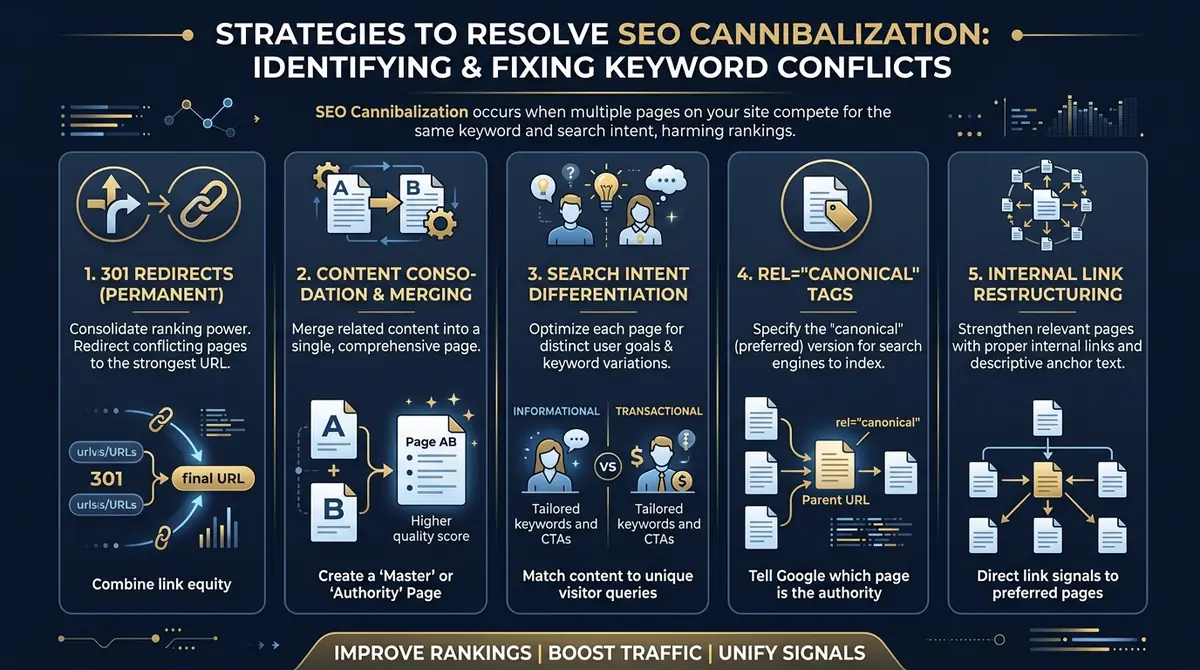
Once you confirm a destructive cannibalization issue, execute one of eight proven technical solutions based on your site architecture and business requirements:
1. Consolidate competing pages (The Gold Standard)
Consolidation is the most powerful and permanent solution for overlapping content:
- Identify overlapping URLs: Pinpoint all URLs competing for the target intent.
- Choose the primary URL: Select the URL with the strongest backlink profile, superior historical traffic, cleaner URL slug, and highest commercial conversion rate.
- Combine valuable content: Extract unique insights, statistics, diagrams, and expert commentary from the weaker pages and integrate them into the primary page.
- Improve the primary page: Re-optimize on-page copy, headers, schema markup, and media to establish an authoritative comprehensive resource.
- Redirect the redundant URL: Implement a server-side 301 permanent redirect from the secondary URL to the primary URL.
- Update internal links: Update all internal links across your website that previously pointed to the secondary URL, pointing them directly to the primary URL.
- Update XML sitemaps: Remove the old URL from your XML sitemap and ensure the primary URL is submitted. Check our technical reference on technical SEO audit guide.
- Monitor performance: Track GSC clicks, impressions, and ranking stability over the following 4 to 8 weeks.
2. Use 301 redirects
A 301 permanent redirect passes full link equity, historical PageRank, and user traffic directly from the deprecated URL to the primary URL:
- When to use: When the secondary page offers no independent business purpose and has acquired valuable external backlinks that must not be wasted. For status code strategy, read our analysis on are 404s bad for SEO.
- When not to use: When the two pages serve completely unrelated topics (soft-404 risk) or when both URLs must remain live for customer navigation.
- Avoid redirect chains: Always point the redirected URL directly to the final 200-OK destination; never daisy-chain through intermediary hops.
3. Differentiate search intent
If both pages provide genuine standalone value, re-engineer their content to serve distinct stages of the buyer journey:
- Informational Intent: "What Is Local SEO? An In-Depth Primer" (target informational queries, definitions, and high-level concepts).
- Commercial Intent: "Local SEO Services & Packages Comparison" (target prospective buyers evaluating agency capabilities and pricing).
- Transactional Intent: "Hire a Local SEO Agency: Request a Proposal" (optimized exclusively for direct lead capture and consultation bookings).
4. Re-optimize competing pages
Modify the on-page optimization signals of the secondary page so search engines recognize its distinct topical focus:
- Assign a unique primary keyword and distinct secondary long-tail queries.
- Rewrite the title tag, meta description, and H1 header.
- Adjust H2 and H3 subheadings to address unique angles of the subject.
- Integrate supporting semantic entities unique to the differentiated topic.
- Add a prominent contextual internal link pointing toward the primary page.
5. Use canonical tags correctly (rel="canonical")
A canonical tag is an HTML link element placed in the <head> that specifies the preferred master version of a page:
When to use canonicalization: Canonical tags are the ideal solution when multiple URLs must remain live and accessible to users—such as ecommerce product variants, campaign landing pages with tracking parameters, and paginated category views—while instructing Google to consolidate ranking credit into a single indexable master URL.
Critical Caveat: Canonical tags are algorithmic hints, not rigid server directives. If the two pages have radically different content, Google may ignore the canonical tag. For genuine content duplication, a 301 redirect remains the superior choice.
6. Use noindex selectively
The <meta name="robots" content="noindex, follow"> tag instructs search engines not to display a page in search results while permitting crawlers to follow its internal links:
- Ideal use cases: Internal search result pages, thin tag archives, facet filter combinations with zero search demand, and private client portal pages.
- Important distinction: Noindex does not solve content overlap between two important public pages; it merely removes the secondary page from search entirely without passing backlink equity.
7. Delete obsolete pages (410 Gone / 404 Not Found)
If an overlapping page is completely obsolete, generates zero organic traffic, has accumulated zero external backlinks, and serves no business purpose, deleting it is appropriate:
- Return an HTTP
410 Gonestatus code to prompt search crawlers to de-index the URL quickly. - Remove all internal links pointing to the deleted page to avoid crawl waste.
8. Improve internal linking
Internal link architecture is one of the most powerful signals Google uses to discern your preferred master page:
- Ensure all contextual links within blog posts and service content use descriptive anchor text pointing exclusively to your primary URL.
- Structure your site into clear topic clusters: supporting subtopic pages link upward to the primary pillar page, while the pillar page links downward to relevant subtopics.
- Never use the exact primary target keyword as anchor text to link to auxiliary pages.
How to Prevent SEO Cannibalization
Preventing cannibalization requires proactive operational governance across your digital publishing pipeline.
Build an authoritative keyword-to-URL map
Maintain a centralized repository documenting every indexable page on your domain, its assigned primary keyword, secondary query clusters, search intent, and topical ownership:
| Target URL | Primary Topic | Primary Keyword | Search Intent | Supporting Keywords | Status |
|---|---|---|---|---|---|
/services/onpage-seo/ |
On-Page Optimization | on-page seo services | Commercial / Transactional | on page seo agency, hire on page specialist | Active Pillar |
/blog/what-is-on-page-seo/ |
On-Page Fundamentals | what is on-page seo | Informational | on page seo guide, on page optimization basics | Active Cluster |
Assign one primary search intent to each page
Every newly created URL must own a distinct primary keyword and a singular search intent. If a proposed article does not introduce a unique intent or fresh angle, integrate its points into existing content rather than launching a redundant URL.
Perform SERP analysis before publishing
Before drafting a single sentence, analyze the live Google SERP for your target keyword. Inspect what content formats (tools, step-by-step guides, product collections, or case studies) Google currently rewards. If the SERP for your proposed secondary topic matches the SERP for an existing page on your site, Google considers them the same query.
Check existing content before creating a new page
Enforce a strict editorial checklist: require writers to run a site:yourdomain.com "topic keyword" search and inspect GSC data before pitching new article briefs.
Build topic clusters instead of keyword clusters alone
Organize content around comprehensive thematic pillars supported by granular subtopic assets. Each subtopic page must delve into a specific sub-dimension without duplicating the overarching pillar's general summary.
Create a recurring content overlap audit
Conduct quarterly cannibalization audits on mid-sized domains and monthly audits on enterprise or ecommerce sites publishing dozens of URLs each week.
Maintain consistent internal linking
Establish sitewide linking guidelines to ensure writers link to the designated champion URL whenever using core industry terminology in anchor text.
Review cannibalization after major content updates
Whenever conducting extensive content refreshes or site redesigns, monitor GSC URL performance closely over the subsequent 30 days to catch accidental intent collisions early.
SEO Cannibalization for Ecommerce Websites
Ecommerce platforms represent the most volatile environment for keyword and intent cannibalization due to large catalog sizes, multi-faceted filtering, and dynamic taxonomy.
Key ecommerce risk zones include:
- Category vs. Subcategory: When broad category pages (e.g., "Men's Footwear") feature duplicate introductory text and overlapping product listings with specific subcategories (e.g., "Men's Running Shoes").
- Product vs. Category: Flagship hero products that dominate sales can unintentionally cannibalize category pages if the product title and description mimic the general category query.
- Product Variants: Generating indexable URLs for minor attribute variations (such as colors, sizes, or bundle quantities) fractures review schema and PageRank.
- Faceted Navigation & Attribute Filters: Dynamic filter combinations (brand + color + size + price) creating millions of duplicate URLs that consume crawl budget and cannibalize primary category hubs.
- Pagination URLs: Poorly managed paginated pages (
/category?page=2) competing with root category pages for generic commercial queries. - Sorting Parameters: Parameter strings for sorting (e.g.,
?sort=price_ascor?sort=popularity) generating near-duplicate versions of category listings. - Manufacturer vs. Brand Pages: Creating separate landing pages for "Nike Manufacturer Overview" and "Shop Nike Products" that divide commercial intent.
- Discontinued Products: Leaving hundreds of out-of-stock product pages live without 301 redirects to parent categories or equivalent successor products.
- Seasonal Pages: Creating new URLs every year (e.g.,
/black-friday-2024,/black-friday-2025) instead of maintaining a permanent, evergreen URL (/black-friday/) that accumulates compounding authority.
SEO Cannibalization for Local SEO
Local SEO cannibalization occurs when multi-location businesses, regional franchises, or service-area contractors generate dozens of geographically targeted pages with near-identical copy:
- Service vs. Location Page Collision: Publishing both
/roof-repair/and/roof-repair-dallas/with overlapping local schema and ambiguous geographic intent. - City vs. Neighborhood Sprawl: Creating separate landing pages for adjacent suburban neighborhoods that Google's local algorithm clusters within the greater metropolitan service area.
- Service + Location Matrix Spam: Programmatically generating hundreds of pages combining every permutation of services and zip codes (e.g., "Emergency Plumber Austin," "24/7 Plumber Austin," "Best Plumbing Austin"). Google recognizes this pattern as doorway content, depressing rankings across the entire domain.
- Google Business Profile (GBP) Landing Page Misalignment: Linking your Google Business Profile listing to an auxiliary blog post or disconnected subpage rather than the primary localized service hub, creating a disconnect between organic SERP rankings and the Local 3-Pack.
SEO Cannibalization and AI Search / LLM Visibility
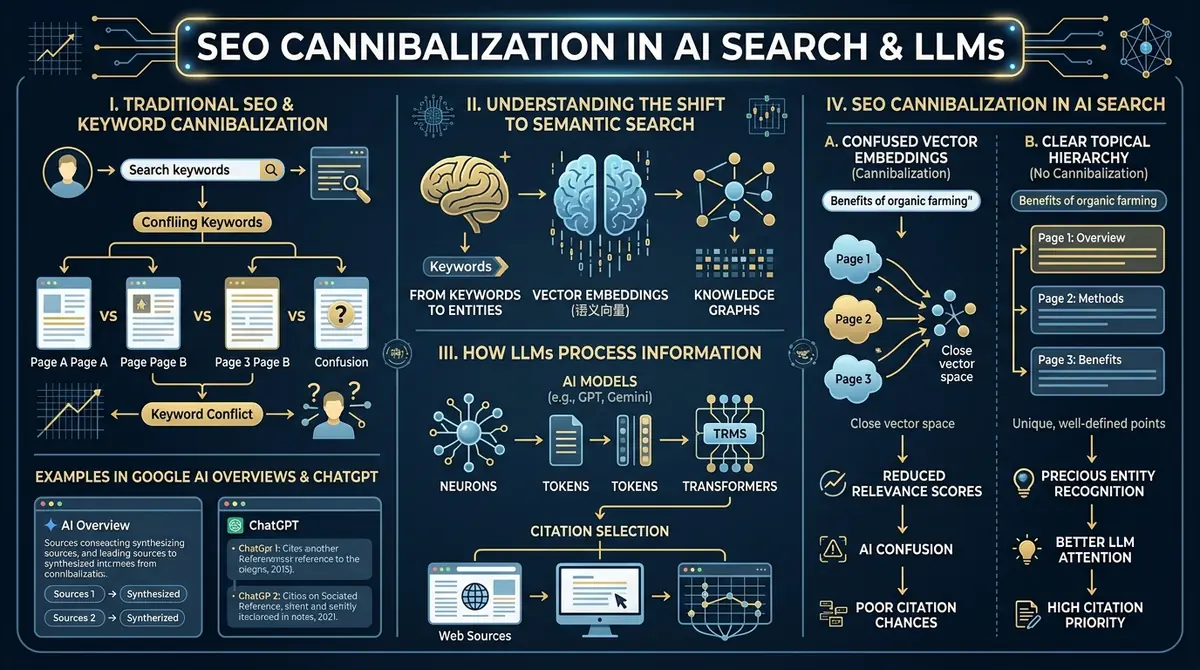
As search evolves toward generative AI engines—such as Google AI Overviews, ChatGPT Search, and Perplexity—the negative impact of cannibalization has multiplied significantly. Explore our cutting-edge optimization methodologies with our dedicated GEO, LLM & AI SEO services.
Does keyword cannibalization affect ChatGPT and AI search?
Yes. While traditional search engines rank ranked blue links, Large Language Models (LLMs) synthesize answers using semantic vector embeddings and Retrieval-Augmented Generation (RAG).
When an AI search system crawls a website containing multiple pages answering the same core question with slight variations:
- Vector Embedding Proximity Conflict: In multi-dimensional vector space, two overlapping pages generate near-identical mathematical embeddings. The retrieval engine cannot determine which passage represents the authoritative factual truth of your domain.
- Diluted Citation Probability: Rather than recognizing your domain as the definitive subject matter authority, the AI model perceives fragmented, redundant context chunks, reducing the likelihood that your brand is cited as a primary source.
- Inconsistent Model Responses: AI engines synthesize fragmented data points, potentially surfacing outdated facts from deprecated articles rather than your current product specifications.
Entity and topical differentiation
To win AI citations, each page on your website must correspond to a distinct semantic entity node in Google's Knowledge Graph. Clear topical differentiation ensures AI systems map distinct concepts to distinct URLs without semantic collision.
Avoiding multiple pages answering the same question
LLMs rely heavily on direct question-and-answer patterns. If three separate blog posts provide competing answers to "How long does technical SEO take?", AI synthesis algorithms reduce confidence in your domain's expertise. Provide one definitive, comprehensive answer on your authoritative guide.
Creating a clear canonical source for important concepts
Establish a single, authoritative "definition page" or cornerstone pillar for every major concept in your industry. When AI models retrieve background context, this definitive resource serves as the unequivocal source of truth.
Internal linking and contextual relationships
Rigorous internal linking acts as a knowledge graph roadmap for AI crawlers. By connecting supporting subtopics hierarchically to primary pillar assets, you assist RAG models in understanding exact topical boundaries and conceptual authority.
SEO Cannibalization Audit Checklist
Execute this step-by-step checklist during your next structural content audit to eliminate keyword overlap and restore peak organic velocity:
- ✓ Identify pages targeting the same topic: Crawl your domain and group URLs by core subject matter.
- ✓ Compare primary keywords: Verify that no two active URLs share identical primary target queries.
- ✓ Compare search intent: Ensure each URL fulfills a distinct user goal (informational vs. commercial vs. transactional).
- ✓ Check GSC query/page data: Inspect the Pages tab for queries where multiple URLs receive significant impressions.
- ✓ Check ranking history: Identify URL volatility or alternating ranking patterns in Semrush or Ahrefs.
- ✓ Check organic traffic: Measure historical traffic trends to determine which URL delivers superior user engagement.
- ✓ Check backlinks: Inspect referring domains to preserve off-page equity before making structural changes.
- ✓ Check internal links: Verify that internal anchor text consistently points to the preferred URL.
- ✓ Compare title tags and H1s: Differentiate headline phrasing across all closely related pages.
- ✓ Compare on-page content: Eliminate redundant paragraphs, identical data tables, and duplicate value propositions.
- ✓ Determine preferred champion URL: Select the definitive master asset for the topic.
- ✓ Merge or differentiate pages: Consolidate redundant copy or rewrite the secondary page for a distinct intent.
- ✓ Implement redirects/canonical/noindex: Execute server-side 301 redirects or canonical tags where appropriate.
- ✓ Update internal links: Repoint legacy links to the consolidated master URL.
- ✓ Update XML sitemap: Remove retired URLs and re-index the updated master URL.
- ✓ Monitor rankings and traffic: Track post-remediation performance over 60 days to verify ranking recovery.
Frequently Asked Questions About SEO Cannibalization
What is SEO cannibalization?
SEO cannibalization occurs when multiple pages on the same website compete for identical or closely related search queries and satisfy substantially the same search intent, confusing search engines and dividing organic rankings, internal equity, and organic conversions.
What causes keyword cannibalization?
Keyword cannibalization is caused by publishing multiple pages targeting identical primary keywords, lack of systematic keyword mapping, iterative blogging on overlapping topics over time, uncontrolled faceted navigation, programmatic page generation, and ecommerce category-product intent overlap.
Is keyword cannibalization bad for SEO?
Yes, true keyword cannibalization hurts SEO because it splits internal linking signals, fragments click-through rates and backlinks across multiple URLs, triggers ranking volatility, and often causes Google to rank an inferior or lower-converting page instead of your primary commercial asset.
How do I know if my website has keyword cannibalization?
You can detect keyword cannibalization by filtering queries in Google Search Console's Performance tab to see if multiple URLs receive clicks or impressions for the same query, inspecting position tracking volatility in Semrush or Ahrefs, and running site: searches on Google to identify intent collisions.
Can two pages rank for the same keyword?
Yes, two pages from the same domain can legitimately rank for the same query if they satisfy distinctly different search intents, such as an informational troubleshooting guide ranking alongside a transactional product landing page, or a parent category ranking above a subcategory.
Does duplicate content cause keyword cannibalization?
While duplicate content involves identical or nearly identical blocks of text across URLs, keyword cannibalization focuses on intent collision. However, duplicate and near-duplicate content frequently accelerates cannibalization by presenting identical semantic entities to search engine indexers.
How do I fix keyword cannibalization?
You fix keyword cannibalization by consolidating overlapping pages into a single authoritative master URL with 301 redirects, clearly differentiating content angles and search intent, re-optimizing metadata and headers, implementing canonical tags where both URLs must remain live, and realigning internal links.
Should I delete pages affected by keyword cannibalization?
You should only delete cannibalized pages if they have zero traffic, zero backlinks, and zero historical utility. If the competing page has acquired backlinks or external visibility, you should always merge its best content into the primary URL and execute a 301 permanent redirect rather than returning a 404 or 410 status code.
Should I use a canonical tag for keyword cannibalization?
You should use a rel=canonical tag when multiple URLs must remain accessible to human users for browsing or tracking purposes (such as ecommerce product variants or filtered category views), signaling to Google which specific URL should be indexed as the authoritative master version.
Is a 301 redirect better than a canonical tag?
A 301 redirect is stronger and more definitive than a canonical tag because 301 redirects are strict server-level directives that eliminate duplicate URLs and pass full link equity, whereas canonical tags are algorithmic hints that Google may ignore if page content differs substantially.
Can internal linking fix keyword cannibalization?
Yes, strategic internal linking can resolve cannibalization by consistently using target anchor text pointing exclusively to the preferred primary URL while ensuring secondary pages link back up to the primary page as topical clusters rather than competing for the primary term.
Does keyword cannibalization affect Google rankings?
Yes, keyword cannibalization destabilizes Google rankings because search engines struggle to identify which URL provides the best user satisfaction, resulting in rapid ranking switches (URL hopping), lower average SERP positions, and suppressed organic impressions.
Does keyword cannibalization affect AI search?
Yes, keyword cannibalization undermines AI search and Large Language Models (LLMs) such as ChatGPT, Perplexity, and Google AI Overviews. Overlapping content fragments vector embeddings, disperses topical authority, and prevents LLMs from recognizing a single authoritative entity citation source.
How can I prevent keyword cannibalization?
You can prevent keyword cannibalization by maintaining an exhaustive keyword-to-URL mapping sheet, conducting SERP intent analysis before drafting new content, searching existing domain assets prior to publishing, building structured topic clusters, and enforcing disciplined internal linking protocols.
Final Takeaway
The fundamental truth of modern search architecture is simple: SEO cannibalization is not merely "two pages ranking for the same keyword." The genuine issue is competing internal URLs that satisfy the exact same search intent without a legitimate architectural justification for both pages to exist.
When internal pages wage war against each other, your domain hemorrhages ranking equity, divides link authority, and introduces algorithmic friction that caps your organic growth ceiling. Resolving cannibalization transforms this fragmented footprint into a concentrated, authoritative topical fortress.
Whenever auditing your search footprint, adhere to this streamlined 6-stage operational cycle:
The 6-Step Cannibalization Remediation Workflow
Detect → Compare Intent → Decide Page Purpose → Consolidate or Differentiate → Strengthen Internal Signals → Monitor
If your organization suspects that structural keyword overlap or legacy content sprawl is capping your organic revenue potential, reach out to our senior consultancy team at Professional SEO Services for a free SEO strategy audit. We engineer high-performance search architectures that dominate search engine results and drive measurable commercial growth.