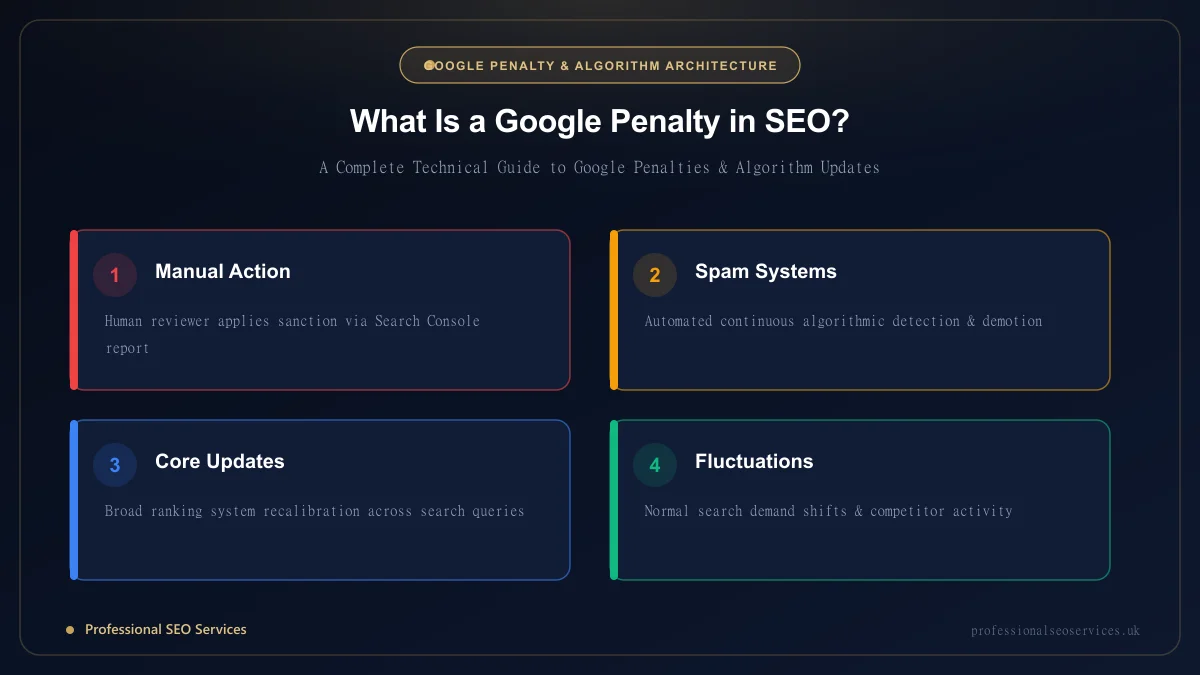
A Google penalty in Search Engine Optimization (SEO) is a punitive ranking suppression or indexation removal applied to a website that violates Google spam policies or Search Essentials. When marketers speak of a Google penalty, they refer to an abrupt loss of organic impressions and keyword rankings. However, a sharp drop in organic performance does not automatically signal a formal penalty. Website visibility drops stem from four distinct occurrences: human-reviewed manual actions, automated spam filtering systems, broad core ranking system updates, and ordinary competitive ranking fluctuations. This guide explains how Google penalties operate, how algorithmic updates shift search performance, how to diagnose root causes with accuracy, and how to execute step-by-step penalty recovery.
The main benefits of understanding what is Google penalty in SEO include safeguarding organic revenue streams, preventing deceptive optimization practices, and establishing durable search visibility. Websites engineered around transparent compliance avoid severe algorithmic demotions, preserving digital market share across competitive industry verticals.
The primary uses and applications of Google penalty knowledge involve forensic backlink profile auditing, content quality sanitation, technical crawl error resolution, and structured reconsideration filings. Digital marketing directors and site owners deploy these diagnostic frameworks to systematically reverse search sanctions and restore lost commercial traffic.
The core parts and components of Google search governance comprise human webspam manual reviewers, continuous automated spam detection models, periodic broad core ranking algorithms, and Google Search Console (GSC) reporting interfaces. Applying knowledge of these interconnected mechanisms allows webmasters to resolve compliance issues methodically. Many businesses partner with Professional SEO Services to audit their domain health, eliminate toxic footprints, and build authoritative organic equity that withstands ongoing algorithmic updates.
What Is a Google Penalty in SEO?
Targeting what is google penalty in seo reveals that a penalty represents an intentional demotion or de-indexing of web pages triggered by non-compliance with Google published quality standards. In practical digital marketing, penalties inflict sudden visibility drops across primary target queries, crippling inbound organic lead volume.
Google penalty definition
A Google penalty is an administrative or programmatic punishment that depresses organic rankings, strips visibility, or expels pages from the Google Search Index. The severity of a penalty manifests across three structural tiers:
- Individual URL suppressions targeting isolated pages that host manipulative text or deceptive markup.
- Subdirectory or folder demotions affecting discrete sections of a domain, such as an unmoderated community forum or a spammy blog subdirectory.
- Sitewide domain removals that purge every page belonging to the root domain from Search Engine Results Pages (SERPs).
Is a Google penalty the same as a manual action?
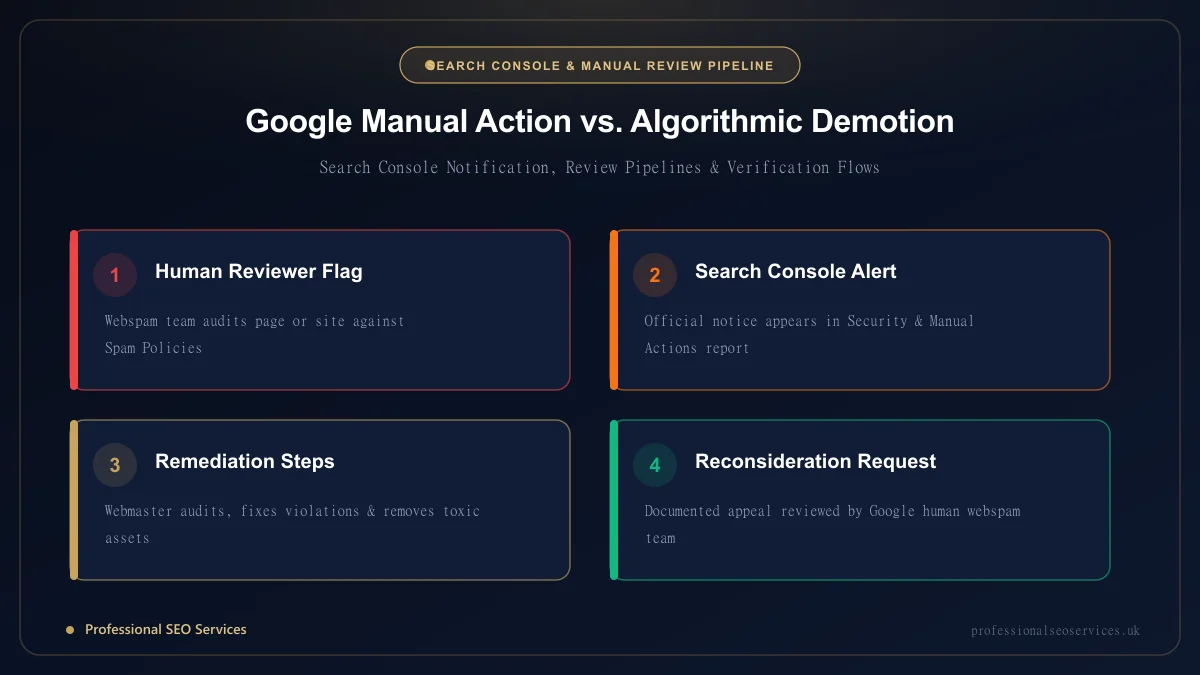
Yes, a manual action is Google formal terminology for an official penalty. A manual action occurs when a human reviewer at Google assesses a website and determines that specific pages fail to adhere to Google spam policies. Human reviewers log violations directly within Google Search Console. Site administrators receive a direct notification inside the Manual Actions report specifying the exact violation category, including unnatural links, thin content, or deceptive cloaking.
Can Google lower your rankings without giving you a manual penalty?
Yes, Google can lower your rankings without issuing a manual penalty through automated spam systems, continuous ranking systems, and broad core updates. Automated spam systems operate algorithmically in the background without human intervention. When an automated system identifies low-quality signals or manipulative link patterns, the algorithm adjusts rankings downward. Search Console generates zero alerts for automated demotions, leaving the Manual Actions panel displaying the message "No issues detected."
How Does the Google Algorithm Work for SEO?
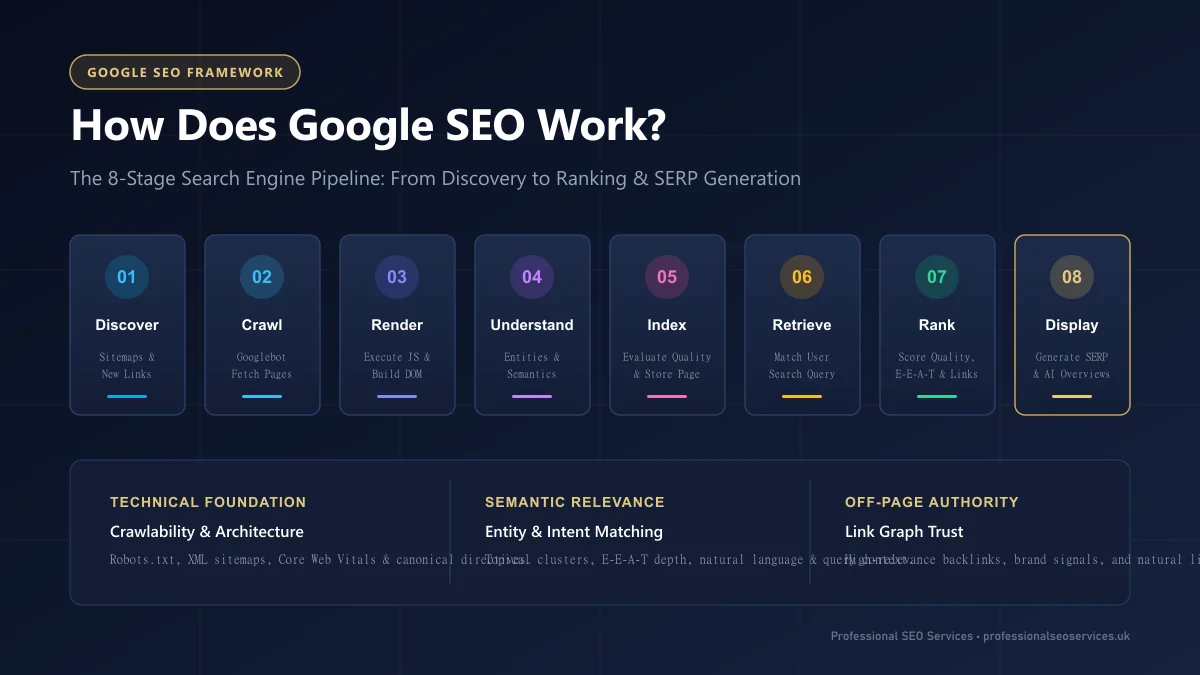
Understanding what is google algorithm for seo requires examining the computational pipeline that processes billions of documents to deliver relevant search results. To examine the underlying technical pipeline, read our technical breakdown on how does google seo work.
What is the Google algorithm for SEO?
The Google algorithm for SEO is an interconnected collection of automated mathematical models, machine-learning classifiers, and heuristic ranking rules that evaluate indexed pages to answer user search queries. It processes language semantics, user intent parameters, and technical page signals to generate ordered SERP listings.
What is a Google algorithm for SEO? Examples
Google algorithm functions across five foundational computational phases:
- Crawling and indexing: Googlebot discovers raw page code and stores parsed text inside the Search Index database.
- Understanding queries: Natural language models such as Bidirectional Encoder Representations from Transformers (BERT) interpret contextual search meanings.
- Matching content: Information retrieval algorithms identify indexed documents containing semantic entities aligned with the query.
- Ranking systems: Algorithmic components score candidate pages across hundreds of ranking factors, including PageRank, freshness, and usability.
- Spam detection: Automated defenses detect keyword stuffing, scraped text, and abusive link schemes before assembling final SERPs.
Google algorithm vs. Google ranking system
Google ranking systems operate continuously to evaluate web documents, whereas algorithm updates represent periodic recalibrations of those underlying systems. In late 2022, Google updated its official documentation to clarify terminology. Google retired the concept of a single monolithic "algorithm," explaining that modern Search relies on numerous specialized, automated ranking systems. Examples include the Helpful Content system, the PageRank system, and the Link Analysis system.
What is a Google algorithm update?
A Google algorithm update is a planned adjustment to one or more ranking systems or spam-detection models. Google implements updates to reward high-utility content, neutralize newly emerging manipulation tactics, and adapt to shifting human search patterns. When Google modifies system parameters, ranking calculations recalculate across millions of search queries, causing normal ranking volatility across the web.
Google Penalty vs. Algorithm Update: What's the Difference?
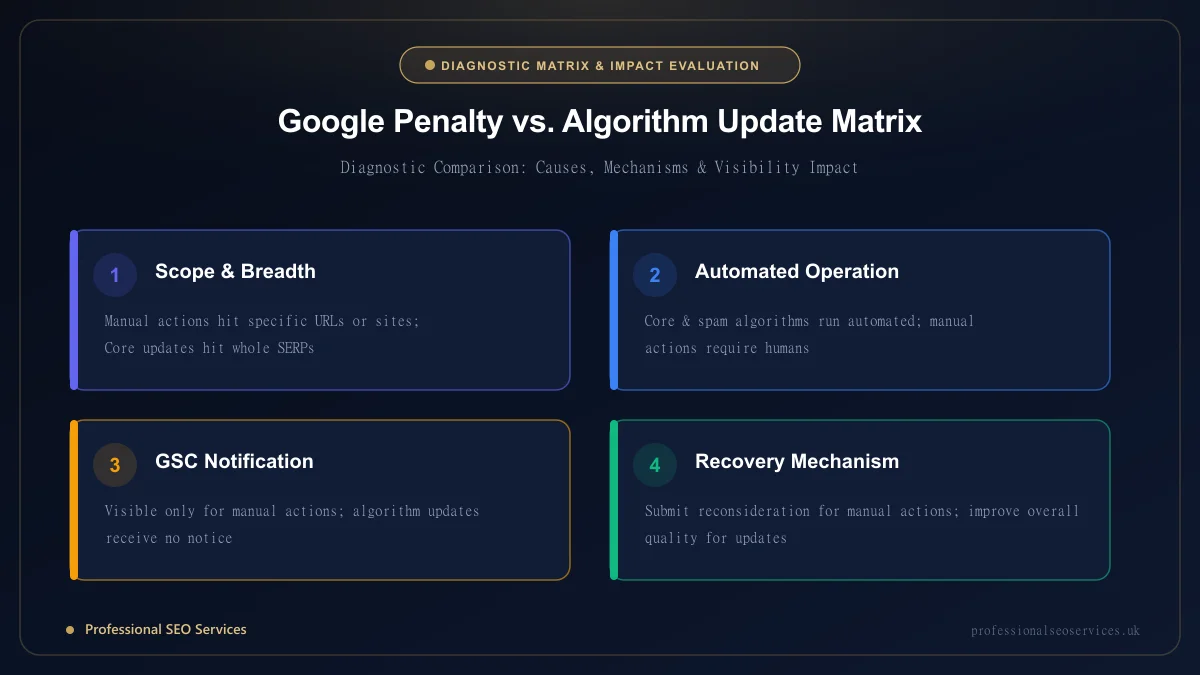
The primary difference between a Google penalty and an algorithm update centers on the evaluation mechanism and the administrative channel: manual penalties involve human review with Search Console notices, while algorithm updates are automated system adjustments without direct messaging.
Google penalty
A Google penalty is a deliberate demotion applied against a site for violating published webmaster spam policies. The penalty suppresses visibility until the offending infractions undergo remediation.
Google algorithm update
A Google algorithm update is an automated recalibration of ranking criteria affecting all indexed pages across specific language or query categories.
Google core update
A Google core update is a broad modification to Google foundational ranking systems that reassesses how content satisfies user expectations across the entire web. Core updates do not target specific sites or penalize webmasters; they rank competing pages higher when those documents offer superior utility.
Google spam update
A Google spam update is a targeted deployment of automated spam-filtering classifiers engineered to identify and neutralize web manipulation. Sites demoted by a spam update remain suppressed until the automated system detects clean signals during subsequent crawl cycles.
Manual action
A manual action is an official penalty issued by a human reviewer after inspecting a website against Google Search Essentials. Reversing a manual action requires filing an explicit reconsideration request.
Normal ranking fluctuation
A normal ranking fluctuation is a standard day-to-day position variation caused by competitor updates, algorithm testing, index recrawling, and changing user query patterns.
Quick comparison: penalty vs. update vs. ranking change
Review the structural differences between search performance shifts in the comparison matrix below:
| Situation | Automated? | Human Review? | Search Console Alert? | Reconsideration Request? |
|---|---|---|---|---|
| Manual Action | No | Yes | Yes (Manual Actions Report) | Yes (Required) |
| Spam System Demotion | Yes | No | No | No (Algorithmic Recovery) |
| Core Update Reassessment | Yes | No | No | No (Quality Improvement) |
| Normal Ranking Fluctuation | Yes | No | No | No (Standard Dynamics) |
How Often Does Google Update SEO and Its Ranking Systems?
Targeting how often does google seo update demonstrates that Google refines its ranking systems continuously, testing thousands of potential enhancements each quarter.
How often does Google update its algorithm?
Google updates its algorithm approximately 10 to 14 times per day, amounting to more than 4,500 modifications each calendar year. The vast majority of these micro-adjustments pass without public announcements because they fine-tune query parsing and language semantics.
Does Google update its rankings every day?
Yes, Google updates its rankings every day across millions of queries as Googlebot indexes fresh content and recalculates relevance scores in real time.
How often are Google core updates released?
Google releases broad core updates 3 to 4 times per year, with rollout windows lasting between 2 and 4 weeks. Google confirms these deployments via the official Search Status Dashboard.
Why can rankings change even when there is no announced update?
Rankings change in the absence of an announced update across eight continuous market dynamics:
- Competitor changes: Rival domains publish superior guides, earn fresh backlinks, or resolve site technical errors.
- Search intent changes: Seasonal buying shifts or breaking news events alter what searchers expect to find.
- Freshness calculations: The Query Deserves Freshness (QDF) system elevates newly published commentary for time-sensitive queries.
- New content: Fresh web pages enter the index, expanding the pool of candidate documents competing for top positions.
- Links: Organic link decay or newly discovered external citations modify internal PageRank distributions.
- Technical changes: CMS template alterations, canonical tag bugs, or server downtime disrupt crawl accessibility.
- User search behavior: Shifting click patterns and reformulation trends inform machine-learning ranking adaptations.
- SERP layout changes: The addition of AI Overviews, PAA question panels, or Local Packs compresses traditional organic space.
What Are the Main Types of Google Penalties?
There are 3 main classifications of search demotions: human manual actions, algorithmic spam filters, and core update re-evaluations.
Manual actions
Manual actions are explicit sanctions administered by human reviewers from Google Search Quality team. Reviewers inspect flagged domains when automated heuristics identify suspicious behavior, such as link schemes or scraped text. Impact ranges from targeted keyword downgrades on single URLs to complete domain de-indexing.
Algorithmic demotions and automated spam systems
Algorithmic demotions are automated suppressions executed by background systems like SpamBrain without human staff issuing a notification. Calling these drops "algorithmic penalties" is common, but Google characterizes them as automated quality filters that disqualify non-compliant web pages.
Ranking losses caused by core updates
Ranking losses caused by core updates reflect broad systemic re-evaluations rather than punitive sanctions. Google Search Relations representatives note that pages dropping after a core update have broken no rules; instead, competing documents demonstrate stronger utility and topical authority.
What SEO Practices Can Trigger a Google Penalty?
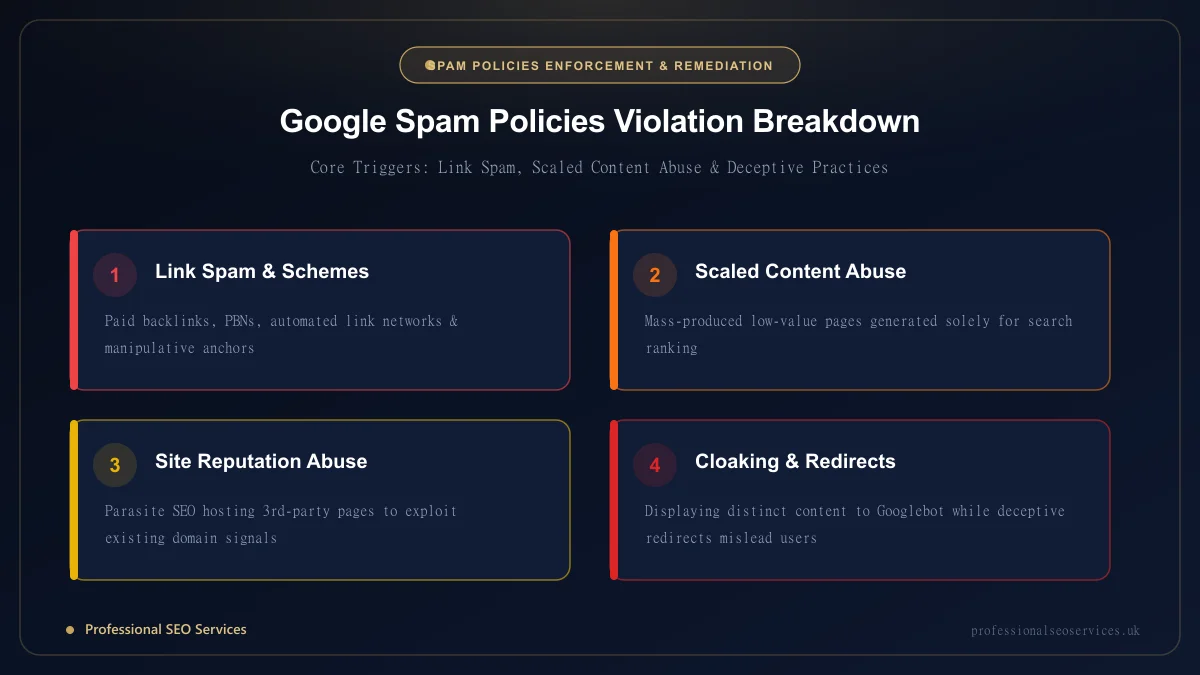
There are 11 primary SEO violations that trigger manual actions and automated spam demotions under Google Spam Policies:
Keyword stuffing
Keyword stuffing is the practice of loading web pages with repeated keywords to manipulate search rankings. Repeating target phrases unnaturally degrades readability. An example of keyword stuffing is: "We sell custom leather boots. If you want cheap custom leather boots, our custom leather boots are the best custom leather boots in London." Google systems flag repetitive syntactic patterns and demote the document.
Cloaking
Cloaking is the deceptive practice of presenting one piece of content to search engine crawlers while delivering completely different content to human visitors. This deception violates Google foundational trust standards.
Link spam and unnatural backlinks
Link spam involves buying, selling, or exchanging links to manipulate PageRank and search visibility. Toxic practices include Private Blog Networks (PBNs), excessive commercial anchor text, automated forum links, and un-attributed paid editorial endorsements.
Scaled content abuse
Scaled content abuse is the automated generation of large volumes of low-value pages designed primarily to manipulate search rankings rather than help users. While Google permits responsible AI-assisted authoring, publishing thousands of unedited programmatic summaries triggers aggressive algorithmic filters.
Site reputation abuse
Site reputation abuse occurs when third-party content is published on an authoritative host domain to exploit the host search ranking signals without editorial oversight. Commonly referred to as "parasite SEO," Google penalizes both host and third-party directories under this dedicated policy.
Doorway pages
Doorway pages are low-quality landing pages built solely to funnel search visitors into a separate, unrelated commercial destination.
Hacked content
Hacked content is unauthorized material placed on a compromised website by malicious actors, including illicit pharmaceutical links and drive-by malware scripts.
User-generated spam
User-generated spam consists of abusive comments, spammy forum threads, and profile links submitted by automated bots on unmoderated web platforms.
Hidden text and links
Hidden text and links involve placing invisible keywords within HTML code using white fonts on white backgrounds or positioning text off-screen via Cascading Style Sheets (CSS).
Sneaky redirects
Sneaky redirects send users to a destination page that differs fundamentally from the URL Googlebot crawled and indexed.
Automatically generated spam
Automatically generated spam includes programmatic text compiled from RSS feeds, machine translations, or automated word spinning that lacks original synthesis.
What Was the Panda Update in SEO?
Targeting what is panda update in seo highlights Google landmark 2011 algorithm update that revolutionized content quality standards across search.
What did Google Panda target?
Google Panda targeted content farms, duplicate articles, auto-generated pages, and websites with high ad-to-content ratios. Launched in February 2011, Panda evaluated document depth and original reporting.
How Panda affected low-quality content
Panda demoted domains where shallow, duplicated text accounted for a significant portion of indexed URLs, stripping up to 80% of their organic search traffic overnight.
Panda and thin content
Panda penalized thin content by calculating site-wide quality ratios, meaning a high volume of low-value pages dragged down the organic rankings of high-quality pages on the same domain.
Is Panda still a separate Google penalty today?
No, Panda is not a standalone algorithm today; Google integrated Panda foundational quality assessment principles into its core ranking system in 2016.
What SEO lessons can you learn from Panda?
The primary lesson of Panda is to prioritize comprehensive, original editorial value over mass-produced, thin landing pages.
What Was the Penguin Update in SEO?
Targeting what is penguin update in seo identifies Google historic 2012 algorithmic offensive against link manipulation schemes.
What did Google Penguin target?
Google Penguin targeted unnatural backlinks, automated link generation tools, and manipulative commercial anchor text patterns. Introduced in April 2012, Penguin penalized websites utilizing paid directories and comment spam to inflate PageRank.
Penguin and unnatural backlinks
Penguin identified sites whose incoming link profiles showed abnormal spikes in exact-match anchor text from low-quality, topically irrelevant web properties.
Penguin and link schemes
Penguin neutralized link schemes by stripping ranking equity from sites participating in reciprocal linking cartels and private link farms.
Is Penguin still a separate algorithm today?
No, Penguin is not an independent filter today; Google incorporated Penguin into the real-time core algorithm with Penguin 4.0 in September 2016, enabling systems to ignore manipulative links automatically.
What SEO lessons can you learn from Penguin?
The core lesson of Penguin is that acquiring high-authority editorial citations delivers sustainable rankings, whereas purchasing cheap bulk backlinks invites severe algorithmic demotions.
What Was the Google Medic Update?
Targeting what is medic seo update addresses the unconfirmed August 2018 broad core update that altered search visibility for wellness, finance, and health websites.
What was the Medic update?
The Medic update was an industry term coined by Search Engine Roundtable for Google August 1, 2018 broad core update, which impacted medical, nutrition, and e-commerce websites disproportionately.
Why health and YMYL websites were heavily discussed
Health and Your Money or Your Life (YMYL) websites experienced dramatic ranking volatility because Google applied heightened scrutiny to pages capable of impacting a user physical safety, health, or financial wellbeing.
E-E-A-T and Google's quality evaluation
The Medic update emphasized Experience, Expertise, Authoritativeness, and Trustworthiness (E-E-A-T), prioritizing content produced by verified practitioners, accredited physicians, and recognized subject-matter authorities.
Was Medic an official Google penalty?
No, the Medic update was not an official penalty; it was a broad core ranking update with zero manual actions or punitive site-specific filters.
Major Google Algorithm and SEO Updates You Should Know
Understanding historical search updates contextualizes how modern ranking systems evaluate digital credibility:
Google updates in 2014
Google 2014 updates introduced the Pigeon update for local search proximity and established HTTPS encryption as an official lightweight ranking signal.
Google updates in 2015
Google 2015 updates launched Mobilegeddon to reward mobile-friendly websites and introduced RankBrain, Google first machine-learning retrieval system.
Google updates in 2016
Google 2016 updates integrated Penguin 4.0 into the core ranking engine in real time and applied mobile pop-up interstitials demotions.
Google updates in 2017
Google 2017 updates featured the unconfirmed Fred update, which demoted ad-heavy websites containing aggressive affiliate links and low-value content.
Google updates in 2018
Google 2018 updates deployed the Mobile Page Speed update and the August broad core Medic update, reinforcing technical performance and author credentials.
Google updates in 2020
Google 2020 updates introduced multiple broad core recalibrations amid changing global search demands, prioritizing factual authority and search intent satisfaction.
What was the May 2020 SEO update?
The May 2020 SEO update was a broad core update launched on May 4, 2020, that heavily adjusted rankings across travel, finance, health, and local directory niches.
What was the May 2022 SEO update?
The May 2022 SEO update was a comprehensive broad core update that rewarded comprehensive topical depth, penalized AI-spun affiliate blogs, and prioritized first-hand user experiences.
Major Google updates from 2023 onward
Google updates from 2023 onward established strict reviews guidelines, expanded E-E-A-T evaluation models, and integrated generative search experiences across global SERPs.
What changed with Google's Helpful Content system?
Google Helpful Content system transitioned from a standalone periodic classifier into a permanent, automated signal embedded directly within the core ranking architecture during the March 2024 core update.
How Google's spam systems evolved
Google spam systems evolved from static keyword filters into SpamBrain, an automated AI machine-learning architecture that detects link manipulation, automated content spinning, and parasite SEO in real time.
What Is the Latest Google SEO Update?
Targeting what is the latest google seo update requires referencing Google Search Status Dashboard, where engineering updates are verified in real time.
Latest Google core update
The latest Google core updates prioritize original insights, technical performance, and penalize generic aggregator websites that replicate existing web documentation.
Latest Google spam update
The latest Google spam updates target scaled content abuse and enforce strict penalties against site reputation abuse.
Latest changes to Google Search systems
Recent architectural changes integrate AI Overviews into standard search results, evaluating documents for clear semantic entities and authoritative citations.
What the latest update means for SEO
For digital marketers, the latest updates mandate building deep topical authority, verifying author expertise, and maintaining fast, secure website code. Learn how to evaluate your technical foundation with our in-depth Technical SEO Guide.
How to Tell If Your Website Has a Google Penalty
Determining whether your website suffered a Google penalty requires methodical forensic diagnostics across Search Console metrics and crawl logs:
Check Google Search Console for manual actions
Check Google Search Console under Security & Manual Actions > Manual Actions. If a human reviewer penalized your site, an active warning banner will state the violation reason and affected URLs.
Check the Security Issues report
Open the Security Issues tab in Search Console to confirm your website has not been compromised by malware, code injection, or deceptive phishing scams.
Analyze the Performance report
Examine the Search Console Performance report by filtering clicks and impressions across a 16-month window to identify the exact date your traffic drop began.
Compare the traffic drop with Google update dates
Align the start date of your traffic decline with official Google Search update announcements logged on the Search Status Dashboard.
Identify which pages and queries lost visibility
Segment your traffic loss by URL subdirectories and keyword groups to determine whether the demotion is page-specific or domain-wide.
Check whether competitors experienced the same decline
Audit competitor visibility in Ahrefs or SEMrush to determine whether your drop is site-specific or reflects an industry-wide SERP reorganization.
Audit recent SEO changes
Review development deployments, CMS plugin updates, robots.txt edits, or URL restructuring implemented immediately prior to the traffic drop.
Check indexing and technical SEO issues
Inspect the GSC Page Indexing report to verify that pages were not excluded by accidental noindex tags, 5xx server errors, or canonical conflicts. Resolving deep code and server anomalies requires specialized Technical SEO Services to restore smooth search engine access.
Analyze backlinks and anchor text
Audit your inbound link profile using backlink analysis tools to identify toxic link clusters, commercial anchor text manipulation, or negative SEO attacks.
Check content quality and search intent
Compare your underperforming landing pages against the current top 3 ranking results to pinpoint gaps in search intent fulfillment or original media.
Don't assume every traffic drop is a Google penalty
Do not assume a traffic decline represents a penalty, because seasonality, product stock depletion, tracking code drops, and site redesign errors regularly mimic algorithmic demotions.
Google Penalty Recovery: How to Recover From a Penalty
To recover from a Google penalty, execute this 10-step remediation protocol:
Select your specific symptoms to discover the likely cause and exact remediation protocol.
Manual Action Detected in Search Console
A human reviewer flagged your site for specific Spam Policy violations. You must audit the offending pages or links, remove the non-compliant elements completely, and submit a documented Reconsideration Request inside Google Search Console.
Step 1: Identify the exact problem
Isolate whether your decline stems from an official manual action, an algorithmic spam filter, or an unannounced core ranking recalibration.
Step 2: Check Google Search Console
Inspect the Manual Actions tab and review historical Search Console Messages for formal notifications from the Google Webspam team.
Step 3: Audit your website
Conduct a comprehensive audit across 6 foundational website pillars:
- Technical SEO: Audit server header response codes, canonical directives, robots.txt restrictions, and XML sitemap integrity.
- Content: Scan all URLs for thin word counts, programmatic duplication, keyword stuffing, and unoriginal syndicated text.
- Backlinks: Review referring domains for private blog networks, unnatural commercial anchor text, and manipulative spam links.
- Internal links: Check for broken site paths, redirect loops, and manipulative internal anchor repetition.
- User-generated content: Screen comment sections, user profiles, and community forums for automated bot spam.
- Security: Scan server files for malware injections, malicious .htaccess redirects, and unauthorized admin accounts.
Step 4: Remove or fix the violating content
Delete deceptive landing pages, remove hidden text, and eliminate auto-generated programmatic text that fails to provide unique value.
Step 5: Improve thin or unhelpful content
Rewrite shallow web documents by adding first-hand evidence, verified case studies, structured tables, and original research.
Step 6: Clean up unnatural links
Contact webmasters to remove paid or unnatural backlinks, and upload a formatted disavow file via Google Disavow Tool to neutralize toxic citations.
Step 7: Fix cloaking and redirects
Eliminate deceptive user-agent switches and ensure human visitors receive the identical HTML markup delivered to Googlebot.
Step 8: Resolve hacked or compromised pages
Purge injected malicious code, update CMS software and plugins, renew SSL certificates, and request a security review inside Search Console.
Step 9: Submit a reconsideration request for manual actions
File a reconsideration request within Google Search Console if your site received a manual action. Provide a detailed account outlining the exact violations discovered, the specific remediation actions taken, the bad links removed or disavowed, and the safeguards implemented to prevent recurring issues.
Step 10: Monitor rankings and organic traffic
Track impression recovery and keyword re-indexing in Google Search Console and Google Analytics over a 90-day observation window.
How long does Google penalty recovery take?
Google penalty recovery takes between 2 to 4 weeks for manual actions after filing a reconsideration request, and 3 to 9 months for algorithmic spam demotions and core updates.
Can a website fully recover from a Google penalty?
Yes, a website can fully recover from a Google penalty if the site eliminates all non-compliant elements, secures a manual action revocation, and builds sustained topical authority.
How to Recover After a Google Core or Spam Update
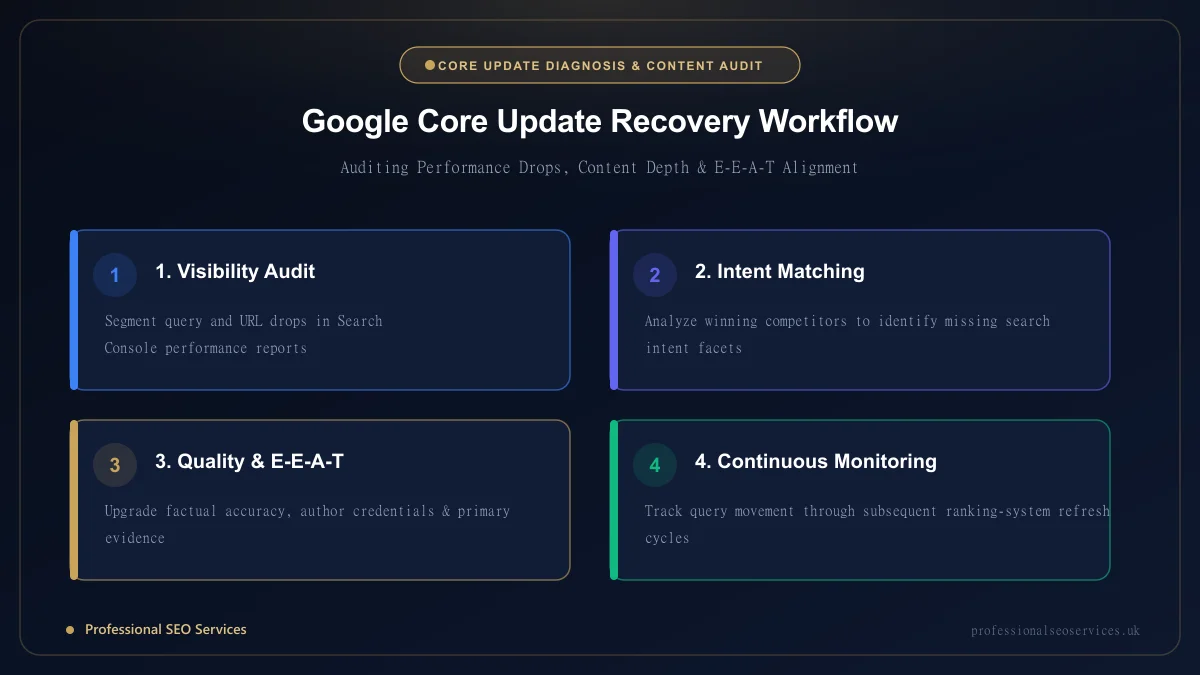
Recovering after an algorithmic core or spam update requires strategic quality enhancements rather than filing administrative appeals:
What to do after a core update
Assess your entire website objectively against Google self-assessment questions, upgrading content accuracy, factual references, and author credentials.
What to do after a spam update
Purge manipulative link networks, remove scaled low-value programmatic content, and adhere strictly to Google Search Essentials.
Should you immediately change your website?
No, do not alter your website during an active update rollout, because search volatility continues until Google confirms completion.
How to identify pages that lost visibility
Use Search Console comparison filters to identify specific URLs and search queries that suffered statistically significant impression declines.
How to compare before-and-after performance
Export 28-day pre-update and post-update performance data into spreadsheets to calculate absolute click deltas across query clusters.
Should you delete content after a Google update?
Delete or consolidate content if web pages are completely redundant, unhelpful, or lack search demand; otherwise, expand and improve thin pages.
When should you wait instead of making major changes?
Wait until the official update finishes rolling out before executing sitewide template redesigns or structural URL migrations.
How SEO Agencies Handle Google Algorithm Updates
Addressing how agencies handle algorithm updates SEO reveals a disciplined, data-driven workflow designed to minimize commercial disruption:
Monitoring Google Search updates
Professional agencies monitor the Google Search Status Dashboard and SERP volatility trackers like Semrush Sensor to detect updates early.
Tracking ranking and traffic volatility
Agencies track daily keyword ranking shifts across thousands of tracked client keywords to measure volatility intensity.
Segmenting affected pages
Senior strategists isolate URL clusters by content type, template architecture, and topical category to pinpoint systemic vulnerabilities.
Analyzing competitors
Agencies evaluate newly elevated competitor pages to reverse-engineer intent matching, content structure, and backlink velocity.
Conducting content audits
Auditors examine editorial assets for E-E-A-T signals, factual freshness, and schema structured data validation.
Conducting technical SEO audits
Engineers inspect server logs, crawl budgets, Core Web Vitals (CWV) metrics, and JavaScript rendering performance.
Reviewing backlink profiles
Specialists screen referring domain graphs for spam spikes, un-attributed affiliate links, and toxic anchor text clusters.
Checking Search Console data
Consultants analyze click-through rates (CTR), impression shares, and index status reports to identify crawl anomalies.
Building an update-response strategy
Agencies formulate a phased remediation roadmap prioritizing high-impact content rewrites and technical fixes.
Measuring recovery after changes
Analysts monitor search metrics through subsequent algorithmic refreshes to confirm positive ranking trajectories.
When should you hire an SEO agency after a Google update?
Hire an SEO agency if your business loses over 25% of its organic search traffic, receives an active manual action, or lacks in-house forensic diagnostic expertise. Discover how structured campaigns operate in our beginner guide on what is seo.
How to Prevent Google Penalties
Preventing Google penalties requires ongoing adherence to Google Search Essentials:
Follow Google's Search Essentials
Review Google Search Essentials quarterly to align website architecture and content development with current search requirements.
Create helpful, reliable, people-first content
Produce original content created primarily to inform and assist human users rather than trick search engine algorithms.
Avoid manipulative link building
Avoid purchasing backlinks, joining link syndication networks, or utilizing automated link generators.
Don't keyword stuff
Write in natural, fluent language, incorporating semantically related terms without artificial keyword density targets.
Avoid cloaking and deceptive redirects
Deliver identical page content to search engine crawlers and human visitors across all device viewports.
Monitor user-generated content
Implement comment moderation systems, automated captcha challenges, and rel="ugc" attributes on all community links.
Keep your website secure
Enforce two-factor authentication, install security firewalls, and update server software to prevent malicious hacking injections.
Audit technical SEO regularly
Crawl your website monthly using site auditing software to catch broken internal links, duplicate canonicals, and server errors.
Monitor Google Search Console
Review Search Console alerts weekly to identify indexing drops, security warnings, or manual action flags immediately.
Keep up with Google algorithm updates
Follow verified industry publications such as Search Engine Land and official updates from Google Search Relations team members John Mueller, Gary Illyes, and Danny Sullivan.
Google Penalty vs. Ranking Drop: 7 Reasons Your Traffic May Have Fallen
There are 7 distinct technical and market catalysts behind sudden organic traffic drops:
You received a manual action
A human Google reviewer applied a penalty against your site, logged inside Search Console.
A Google spam system affected your site
An automated spam filter demoted your URLs algorithmically from manipulative links or thin content.
A core update changed rankings
A broad core update elevated competing websites that deliver superior topical depth and user utility.
Your competitors improved
Competing domains refreshed outdated articles, acquired authoritative links, or upgraded mobile user experiences.
Search demand changed
Seasonal consumer interest declined, or macroeconomic events decreased total query search volume.
Your website has technical/indexing problems
Server crashes, mistaken noindex robots tags, or botched redirects prevented search engines from crawling primary pages.
Your site experienced a security or hacking issue
Malware infections or spam injection scripts caused Google to display security warning interstitials to searchers.
Frequently Asked Questions About Google Penalties and SEO Updates
Final Takeaway: Google Penalties Are Different From Algorithm Updates
A Google penalty in Search Engine Optimization (SEO) represents a specific enforcement action fundamentally distinct from broad algorithmic system updates. Distinguishing between manual actions, automated spam systems, core updates, and normal ranking fluctuations prevents reactionary website modifications that often inflict additional damage.
The enduring benefits of disciplined Google penalty management focus on diagnosing root causes accurately before altering site code, relying on Google Search Console diagnostic data as primary verification, and adhering to people-first SEO best practices. By understanding how Google algorithms evaluate quality and strictly respecting Google spam policies, website owners protect organic visibility and cultivate sustainable digital growth.