The search landscape in 2026 is fundamentally distinct from any prior era. In an environment shaped by autonomous crawling agents, AI search overviews, and strict user-experience ranking thresholds, technical SEO is no longer a passive maintenance checklist. It is the core engineering foundation upon which all topical authority, brand visibility, and organic revenue depend.
Too many organizations invest hundreds of thousands of dollars into high-caliber editorial content and digital PR outreach, only to see their organic visibility stagnate. The culprit is almost always an unaddressed technical bottleneck: render-blocking scripts, inefficient crawl queues, convoluted internal linking hierarchies, or improperly formatted structured data entities.
—Technical SEO doesn — t simply help search engines discover your pages; it dictates how efficiently Googlebot processes your computing footprint and whether your content is synthesized accurately in the modern search ecosystem.—
In this comprehensive guide, we dissect the technical optimizations that genuinely move the needle for high-growth enterprises and competitive domains in 2026.
1. Why Technical SEO Matters More Than Ever in 2026
Historically, technical SEO was treated as a binary discipline: a page was either crawlable or non-crawlable, indexable or non-indexable. Today, search engines evaluate websites through a multidimensional lens of computational efficiency, structural hierarchy, and perceived real-world user performance.
Search engines crawl billions of documents every single day. As the volume of web pages continues to explode exponentially, search systems deploy rigorous resource allocation heuristics. If your web architecture wastes server requests on non-canonical URL variants, fails to render dynamic client-side frameworks swiftly, or triggers layout instability on mobile viewports, your crawl velocity slows and your rank potential diminishes.
Furthermore, with AI-driven search models synthesising information directly from DOM structures, clear semantic markup and pristine DOM hierarchy are essential. Technical SEO is the catalyst that enables search bots and machine intelligence to parse your value proposition without ambiguity.
2. Core Web Vitals: LCP, INP, and CLS Deep Dive
Google — s Core Web Vitals represent user-centric performance metrics that directly influence mobile and desktop rankings. In 2026, passing the 75th percentile of real-user Chrome User Experience Report (CrUX) field data across all three metrics is the baseline requirement for top-tier competitive SERPs.
Largest Contentful Paint (LCP) — Target: < 2.5s
LCP measures perceived load speed by identifying when the largest visual content element in the viewport has rendered. In most cases, this element is a hero image, a background video poster, or a prominent heading block.
- Optimize Time to First Byte (TTFB): Ensure your server response time is below 800ms by deploying edge caching, distributed CDNs (Cloudflare Workers, Fastly), and HTTP/3 protocol support.
- Eliminate Resource Load Delay: Preload your critical hero asset in the
<head>using<link rel="preload" as="image" href="/blog/..." fetchpriority="high">. Never lazy-load above-the-fold images. - Adopt Modern Image Formats: Serve AVIF or optimized WebP files with responsive
srcsetattributes, reducing payload size by up to 65% compared to legacy JPEGs. - Prioritize Critical CSS: Inline above-the-fold styling directly within the document head and defer non-critical style sheets asynchronously.
Interaction to Next Paint (INP) — Target: < 200ms
INP assesses overall page responsiveness by measuring the latency of every user interaction (clicks, taps, key presses) throughout the entire lifespan of the page session. It evaluates the time from user input until the browser successfully renders the updated frame.
- Break Up Long Tasks: Any JavaScript execution exceeding 50ms is classified as a Long Task that locks the main thread. Break intensive computations into smaller asynchronous chunks using the native
scheduler.yield()API orrequestIdleCallback(). - Reduce Main-Thread JavaScript Execution: Audit and tree-shake heavy third-party tracking pixels, customer support widgets, and unoptimized analytics bundles.
- Avoid Layout Thrashing: Prevent consecutive DOM read/write operations that force the browser to recalculate styles and reflow the document repeatedly during user events.
Cumulative Layout Shift (CLS) — Target: < 0.1
CLS quantifies visual stability by measuring unexpected layout shifts that occur while a user is actively consuming or interacting with page content.
- Specify Explicit Dimensions: Always include
widthandheightattributes or CSSaspect-ratioon all images, video embeds, iframes, and dynamic containers. - Reserve Space for Dynamic Elements: Allocate static placeholder dimensions or skeleton loaders for dynamic ad units, banner notices, and personalized modules.
- Match Font Fallback Metrics: Utilize modern CSS font descriptor overrides (
size-adjust,ascent-override,descent-override) to prevent visual jumping during Web Font load swaps.
3. Crawl Budget Optimization: Maximizing Bot Efficiency
Crawl budget represents the number of URLs Googlebot can and wants to crawl on your domain within a given timeframe. It is determined by two critical factors: Crawl Capacity Limit (how many simultaneous requests your server can handle without degradation) and Crawl Demand (how frequently Google believes your pages warrant re-evaluation based on popularity and update frequency).
For websites with more than 10,000 pages — such as e-commerce platforms, directory listings, and multi-regional enterprise domains — inefficient crawl budget management directly suppresses indexation of revenue-critical landing pages.
Strategic Log File Analysis
Server log analysis is the ultimate source of truth in technical SEO. By inspecting raw access logs, our technical team identifies:
- Exact Googlebot crawl frequencies across specific subdirectories and content clusters.
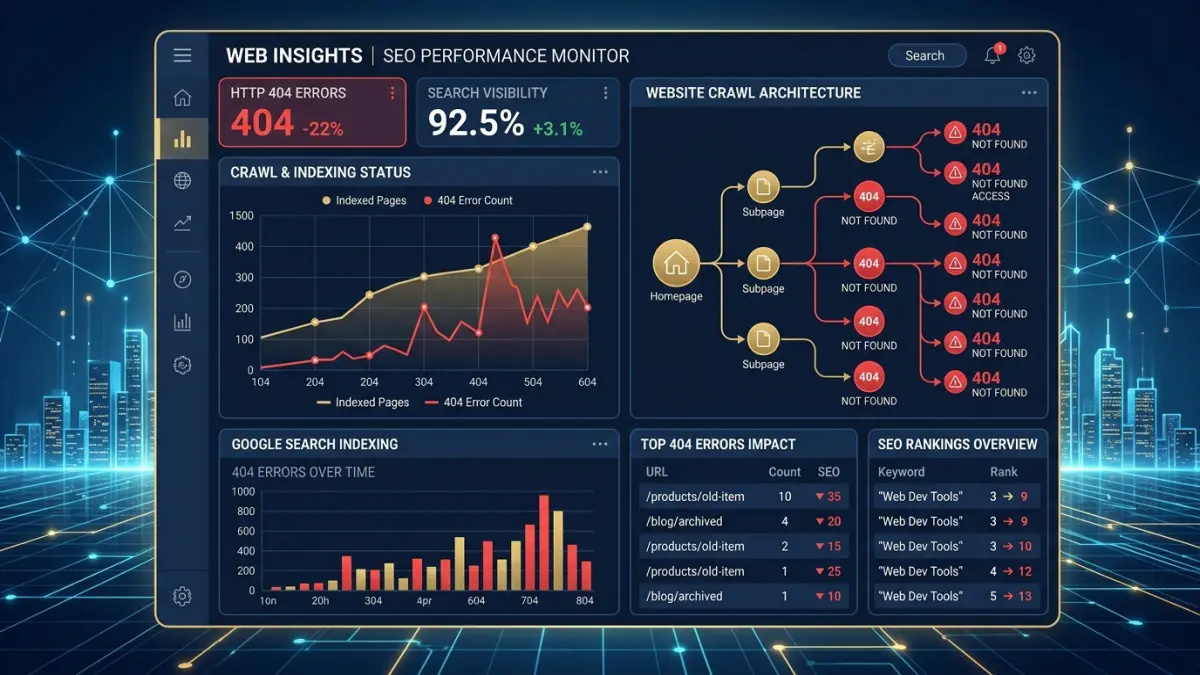
- Wasted crawl bandwidth expended on 404 error pages, 301 redirect chains, and legacy URLs.
- Orphan pages receiving organic user traffic but missing from internal site navigation.
- Discrepancies between desktop and mobile bot crawl distributions.
A common question during crawl optimization audits is are 404s bad for seo — while isolated missing pages represent a normal operational function of the web and do not trigger domain penalties, leaving broken internal links unresolved and misconfiguring soft 404 redirects wastes crawler bandwidth and leaks earned backlink equity.
Controlling Faceted Navigation and Index Bloat
Faceted navigation filters (sort by price, size, color, rating) create millions of parameterized URL permutations that consume crawl bandwidth and generate duplicate content penalties.
- Disallow Non-Search-Valuable Facets: Use
robots.txtrules to disallow multi-attribute filter strings (e.g.,Disallow: /*?*filter=*). - Canonicalize Secondary Variations: Enforce self-referential canonical tags on high-demand search combinations (e.g., /mens-shoes/leather/) while pointing deep filter permutations back to the category root.
- Implement Clean HTTP Status Codes: Return clean
410 Goneheaders for permanently decommissioned content rather than endless 301 chains to the homepage.
4. Modern JavaScript Rendering Pipelines and SEO
As modern web development relies heavily on frameworks like React, Next.js, Vue, Nuxt, and Angular, technical SEOs must understand the mechanics of search engine rendering pipelines.
Google uses a multi-stage rendering process: when Googlebot fetches a page, it immediately parses the initial HTML response. If the content requires client-side JavaScript execution, the URL enters a rendering queue. Depending on computational resources, full JavaScript execution can be delayed by hours or even days.
Evaluating Rendering Architectures
- Client-Side Rendering (CSR): The initial HTML is nearly empty, relying on client-side JS bundles to fetch APIs and construct the DOM. High SEO risk due to render latency and potential crawler execution timeouts.
- Server-Side Rendering (SSR) & React Server Components: The server executes the code on each request and delivers fully rendered HTML markup. Optimal for SEO, ensuring instantaneous crawler readability.
- Static Site Generation (SSG) & Incremental Static Regeneration (ISR): Pre-renders static HTML pages at build time with scheduled incremental revalidation. Best-in-class performance and reliability.
- Edge Island Architecture: Streams lightweight static HTML while selectively hydrating only interactive interface components on demand.
Critical JavaScript SEO Best Practices
- Ensure Semantic HTML Links: Always output standard
<a href="/destination/">anchors. Search crawlers do not reliably execute JavaScript event listeners (e.g.,<div onclick="...">) or synthetic route changes. - Verify DOM Parity: Compare raw HTML source code with the rendered DOM in Google Search Console — s URL Inspection Tool to guarantee that critical copy, internal links, and structured data exist in both states.
- Avoid Lazy-Loading Above-the-Fold Content: Never hide critical text or primary navigation behind scroll-triggered JavaScript observers.
5. Structured Data, Schema Markup & Entity Graphs
Structured data markup via JSON-LD is the universal syntax search engines use to understand entities, relationships, and context. In 2026, schema is no longer just about securing rich snippet stars; it is the definitive method for training search algorithms and generative AI models on your domain's real-world entity identity.
The Shift to Connected Entity Graphs
Rather than declaring fragmented, isolated schema objects on each page, advanced technical SEO requires building an interconnected entity graph using unambiguous @id URI identifiers.
- Organization & Corporation: Define official corporate entities, subsidiary relationships, executive personnel, and authoritative
sameAssocial/Wikidata references. - TechArticle / BlogPosting: Connect editorial content to verified author entities (linking to comprehensive author biographies and external professional citations to demonstrate E-E-A-T).
- Product & Offer Catalog: Provide real-time merchant pricing, availability, aggregate ratings, shipping policies, and return guarantees.
- BreadcrumbList: Explicitly outline site hierarchy and parent-child taxonomy to reinforce category depth.
—Entity-first schema connects your digital footprint into a cohesive knowledge graph that search algorithms can confidently reference in AI Overviews and answer engines.—
6. Site Architecture & Internal Linking Topology
A well-architected website distributes PageRank equity efficiently, clarifies topical relationships, and ensures that high-intent commercial landing pages rank for their target queries.
The 3-Click Rule for Information Architecture
Every indexable, revenue-driving page on your domain should be reachable within three clicks from the homepage. Deep crawl depths (pages buried 5, 6, or 7 clicks down the hierarchy) receive significantly lower internal equity and are crawled far less frequently.
Hub-and-Spoke Topical Clusters
To establish undeniable topical authority in competitive industries, organize content into structured hub-and-spoke networks:
- Pillar Page (The Hub): A high-level, exhaustive guide targeting broad, high-volume keywords (e.g., "Technical SEO Services").
- Subtopic Articles (The Spokes): Specialized deep dives targeting long-tail queries (e.g., "Core Web Vitals Optimization", "JavaScript SEO Auditing", "Schema JSON-LD Guide").
- Bidirectional Interlinking: Every spoke links back to the pillar with descriptive, varied anchor text, while the pillar references each supporting spoke, creating an impenetrable semantic cluster.
Internal Link Hygiene Checklist
- Replace generic anchor text ("click here", "read more") with keyword-rich, contextual descriptors.
- Audit and remediate internal 301 redirects, replacing them with direct canonical endpoints.
- Regularly crawl for orphan pages and re-integrate high-value assets into contextual body copy and navigation menus.
7. Mobile-First Indexing & Technical Parity
Google operates exclusively under a 100% Mobile-First Indexing system. The smartphone Googlebot is the sole benchmark used to determine indexing, rendering, and ranking calculations.
Technical parity between desktop and mobile versions is non-negotiable:
- Content Parity: Ensure all text, data tables, client reviews, and media present on desktop are completely accessible on the mobile rendering. Never truncate important copy on mobile viewports for design brevity.
- Metadata & Structured Data Parity: Canonical tags, robots directives, Open Graph properties, and JSON-LD schema must be identical across both viewport executions.
- Mobile Interactive Usability: Maintain minimum touch target sizes of 48x48 CSS pixels with at least 8px spacing between tap targets to avoid mobile usability penalties.
8. The 2026 Technical SEO Action Checklist
To turn these strategies into measurable organic gains, execute the following technical roadmap:
- Core Web Vitals Audit: Measure real-user CrUX metrics and eliminate long JS tasks to bring INP below 200ms and LCP below 2.5s.
- Crawl Log Analysis: Inspect server access logs quarterly to identify crawl waste and resolve status code regressions.
- Rendering Verification: Audit DOM rendering in Google Search Console to verify complete HTML/JS parity for single-page applications.
- Entity Schema Deployment: Implement connected JSON-LD graphs with author E-E-A-T credentials and business organization identifiers.
- Architecture Compression: Restructure navigation and category facets to bring all target pages within a 3-click depth.
Technical SEO is not a one-time project — it is an ongoing operational standard. By engineering a fast, accessible, and semantically unambiguous digital foundation, your brand secures the structural advantage necessary to dominate search results in 2026 and beyond. Check out our listing on DesignRush to explore our agency profile, verified reviews, and specialized search engine optimization services.