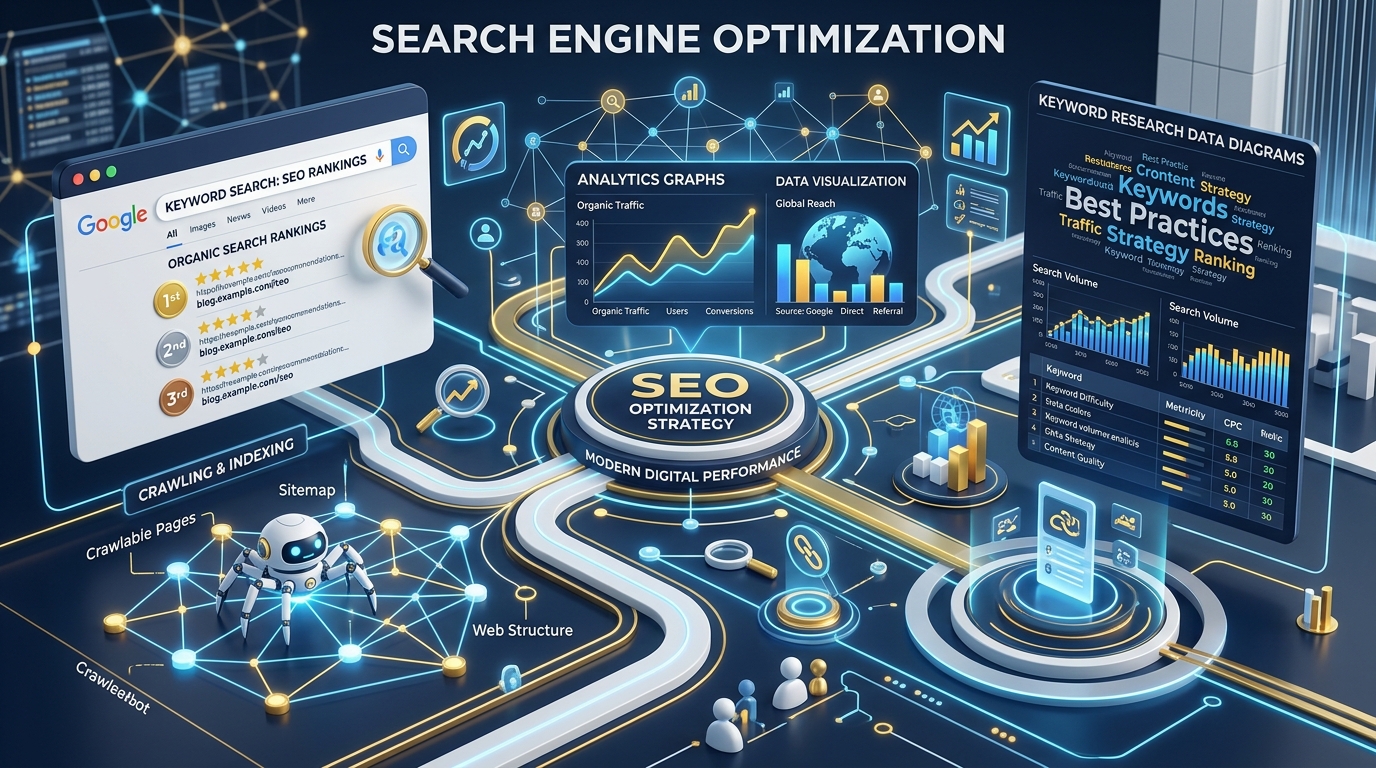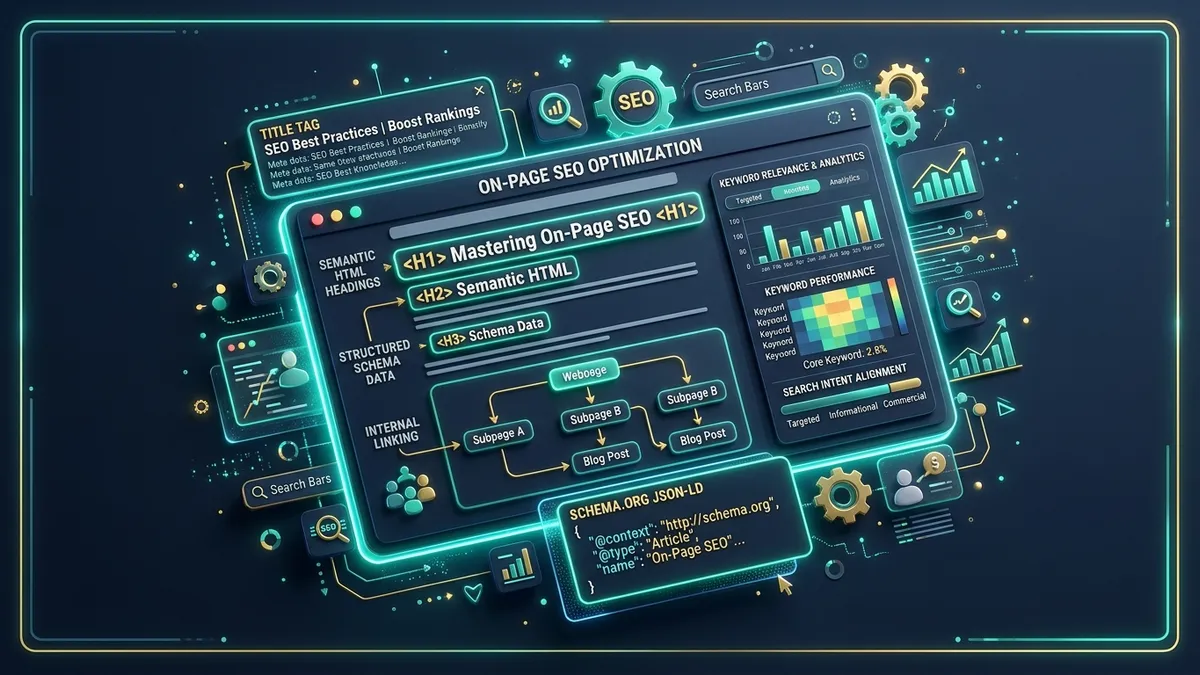
On-page SEO is the practice of optimizing the content, structure, HTML elements, links, media, and other page-level signals of a webpage so search engines and AI-powered search systems can understand its topic, relevance, purpose, and value.
In simple terms, on-page SEO refers to every deliberate optimization applied directly within the boundaries of an individual webpage—unlike off-page SEO, which takes place across third-party websites, or sitewide technical infrastructure. When someone asks what “on-page” actually means, it describes all elements you control directly in the source code, visual layout, and editorial text of the URL itself.
At its core, on-page optimization encompasses a cohesive ecosystem of page elements: search intent alignment, substantive content quality, strategic keyword targeting, hierarchical headings (H1, H2, H3), click-worthy title tags, clean URLs, contextual internal links, high-performance images, machine-readable structured data (schema markup), frictionless page experience, deep semantic relevance, and direct compatibility with AI search retrieval systems.
Why does this matter? Because search does not operate in a vacuum. On-page SEO bridges the crucial tri-party relationship between human searchers, traditional algorithmic search crawlers, and modern generative AI answer engines. Users seek immediate answers and trustworthy solutions; search crawlers require structured HTML and semantic entities to index pages accurately; and AI models need extractable, modular facts to synthesize answers. To master the broader discipline, explore our foundational guide to What is SEO, or discover how enterprise teams leverage senior-led Professional SEO Services to dominate high-competition search landscapes.
How Does On-Page SEO Work?
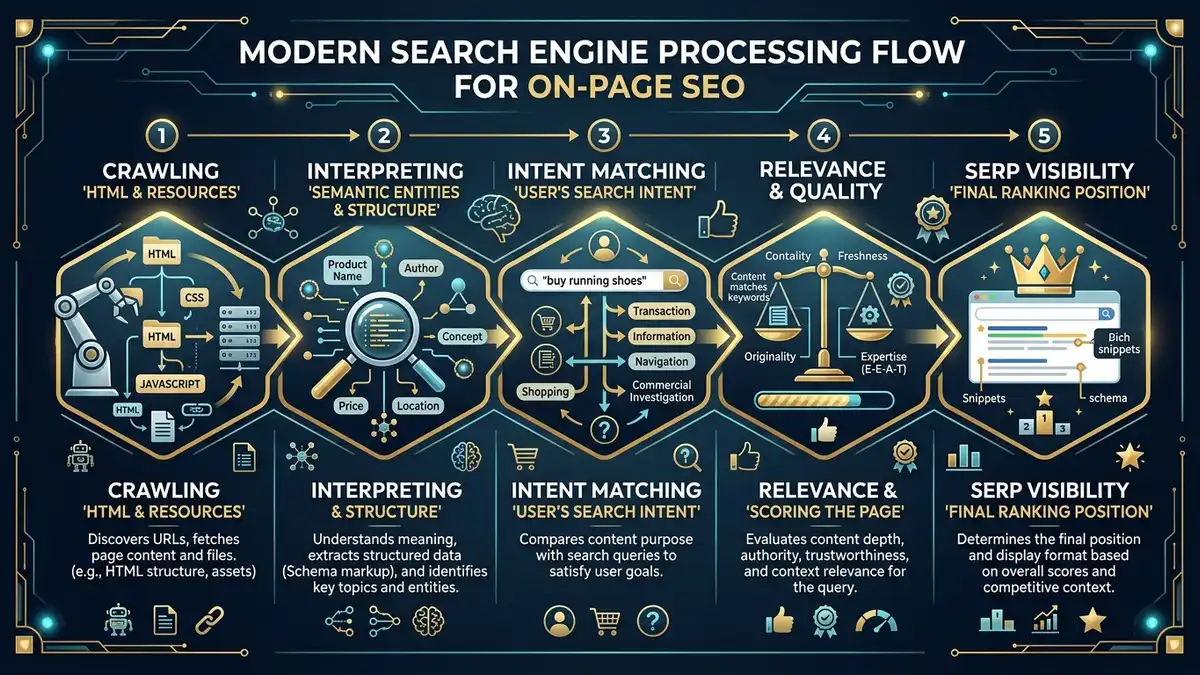
Too many guides treat on-page SEO as a superficial checklist: slap a target keyword in the title tag, write 1,500 words, and hope for top rankings. In practice, modern search engines like Google and Bing do not grade webpages through simplistic point tallies. They execute a sophisticated, multi-stage pipeline designed to parse, contextualize, score, and serve information. Understanding how this underlying mechanism functions elevates your optimization strategy from blind guesswork to algorithmic precision.
1. Search engines crawl the page
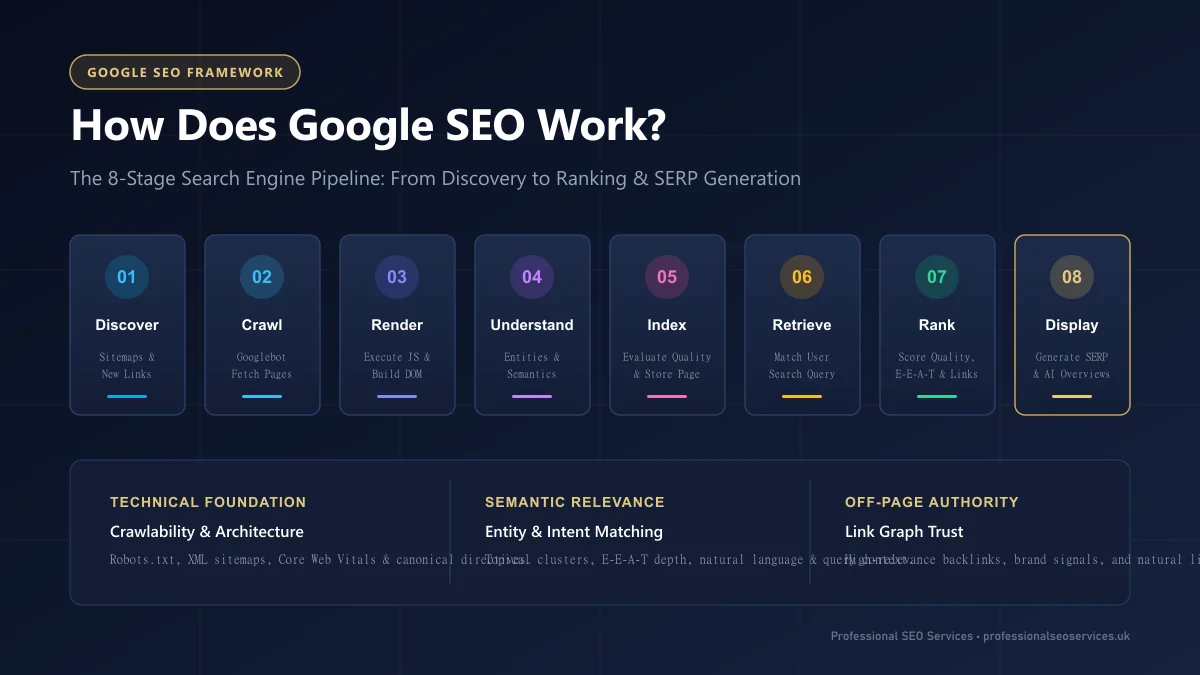
The on-page optimization journey begins when automated web spiders (such as Googlebot) discover and request your URL. The crawler fetches the initial raw HTML document, initiates headless browser rendering to execute JavaScript, and downloads critical page assets including stylesheets, media files, and external scripts. During this crawl, search systems inspect the rendered DOM, parse outbound and inbound hyperlinks, and extract embedded structured data (JSON-LD). If the HTML structure is clean, resources are accessible, and the HTTP status returns a valid 200 OK, the document advances seamlessly into the interpretation pipeline. For a technical breakdown of how Googlebot processes URLs from discovery to indexing, review our detailed guide on How does Google SEO Work.
2. Search engines interpret the page
Once rendered, natural language processing (NLP) models and semantic parsing algorithms analyze the document. Rather than merely counting strings of text, search engines identify named entities (people, organizations, places, concepts), dissect their attributes, and map the semantic relationships connecting them. Algorithms read the hierarchical heading structure (H1 through H4), evaluating context clues, paragraph co-occurrences, and layout positioning. The engine determines what the page is fundamentally about, separating main boilerplate elements (navigation, footers) from the primary unique content.
3. The page is matched to search intent
Search algorithms compare the interpreted content against real-world user queries and classified intent buckets:
- Informational intent: Users seeking knowledge, tutorials, definitions, or procedural guides (e.g., “what is on-page SEO”).
- Navigational intent: Users attempting to reach a specific brand destination or portal (e.g., “Google Search Console login”).
- Commercial investigation: Users comparing options, reading reviews, or evaluating vendors before buying (e.g., “best on-page SEO software 2026”).
- Transactional intent: Users ready to execute a purchase, hire a service, or download software immediately (e.g., “hire on-page SEO consultant”).
- Local intent: Users requiring geographically constrained services or brick-and-mortar locations (e.g., “SEO agency near me”).
If your webpage targets an informational query with an aggressive sales pitch, or attempts to rank a product page for a research inquiry, intent mismatch will disqualify your URL regardless of link metrics.
4. Search systems evaluate relevance and usefulness
After intent classification, scoring systems evaluate topical completeness and utility. Ranking systems assess whether the page covers the subject comprehensively, answers inevitable follow-up inquiries, delivers original data or insights, and conveys credible firsthand experience (E-E-A-T). Pages offering superficial, duplicate, or AI-spun generalities receive low utility scores, while pages demonstrating deep topical mastery and verified author trustworthiness earn preferential evaluation.
5. The page competes for visibility
Finally, the page enters the live auction for search visibility. It is critical to recognize that flawless on-page optimization does not guarantee page-one rankings. On-page SEO establishes relevance and index eligibility; whether the page ranks #1 or #15 depends on composite ranking forces:
- SERP competition: The strength and depth of rival documents competing for the identical query.
- Domain authority and backlinks: External votes of confidence and PageRank transferred from reputable websites.
- Sitewide quality: The overall trustworthiness and technical health of your root domain.
- Technical accessibility: Speed, Core Web Vitals, indexability, and clean crawl architectures.
- User context: Searcher geography, search history, language, and device type.
- Query freshness: The algorithm's demand for recently published or updated data (Query Deserves Freshness - QDF).
Why Is On-Page SEO Important?
Without robust on-page SEO, even the most authoritative website with thousands of backlinks will struggle to rank for its target search queries. On-page optimization provides the semantic scaffolding that tells algorithms exactly which user questions your page is uniquely qualified to answer.
It helps search engines understand your page
Search crawlers cannot infer nuance without clear semantic structure. Structured on-page elements—such as descriptive title tags, explicit headings, Schema.org entities, and clean body copy—translate human concepts into machine-readable knowledge nodes.
It aligns content with search intent
Search engines reward pages that satisfy users with minimal friction. Optimizing on-page factors forces you to design page architecture around what the user actually wants to achieve, eliminating bounce rates and long clicks back to search results.
It improves organic search visibility
By optimizing for primary entities, secondary variations, and long-tail questions, a single well-crafted page can rank across hundreds of related search queries simultaneously, driving exponential traffic expansion.
It improves user experience
On-page SEO directly elevates readability and utility. Clean heading hierarchies allow readers to skim complex topics; responsive images reduce page load times; and intuitive layouts keep visitors engaged across mobile and desktop devices.
It supports internal topical relevance
Through strategic internal linking, on-page optimization distributes link equity across your domain and builds tightly themed topic clusters that reinforce sitewide authority in your industry.
It can improve SERP CTR
Compelling title tags, rich snippet schema, and persuasive meta descriptions directly influence click-through rates (CTR) on the SERP. Outranking a competitor is pointless if their search snippet captures 80% of user clicks.
It creates better sources for AI-generated answers
In the modern era of Google AI Overviews, Perplexity, and ChatGPT Search, generative engines rely on semantic text fragments to synthesize answers. Clear on-page definitions and extractable bullet points dramatically increase your likelihood of being cited as a primary source.
Crucial SEO Nuance: Not Every On-Page Element Is a Direct Ranking Factor
Professional SEOs distinguish carefully between direct ranking signals (e.g., content relevance, topical depth), relevance signals (title tags, headings), usability factors (Core Web Vitals, mobile UX), crawl and indexation factors (canonical tags, robots directives), SERP/CTR influences (meta descriptions, rich snippets), and AI retrieval/citation considerations (passage modularity, entity disambiguation). Conflating these mechanisms leads to wasted effort on elements that influence clicks rather than algorithmic rank.
What Is the Difference Between On-Page, Technical, and Off-Page SEO?
Successful organic search performance requires three complementary pillars working in concert. While novice practitioners frequently blur their boundaries, each discipline operates with distinct scopes, tools, and objectives.
| SEO Type | Primary Focus | Core Examples |
|---|---|---|
| On-Page SEO | Page content, semantic relevance, and page-level HTML signals | Search intent matching, headings (H1–H3), title tags, keyword targeting, internal links, media optimization |
| Technical SEO | Crawling, rendering, indexing, site architecture, and speed | XML sitemaps, robots.txt directives, canonical tags, server response times (TTFB), Core Web Vitals, JS rendering |
| Off-Page SEO | External authority, brand reputation, and industry trust | Backlinks, digital PR coverage, brand citations, unlinked mentions, podcast appearances, social amplification |
Is internal linking on-page SEO or technical SEO?
Internal linking is primarily on-page SEO when evaluated at the page level, but functions as technical SEO at the architectural level. From an on-page perspective, choosing contextual anchor text, deciding which related cluster articles to link within a paragraph, and aligning semantic relationships is pure on-page optimization. Conversely, sitewide crawl depth, click depth from the homepage, pagination systems, and programmatic faceted navigation fall under the domain of technical SEO.
Is schema markup on-page SEO or technical SEO?
Schema markup represents a direct overlap between on-page and technical SEO. It is technical because it requires structured JSON-LD syntax, adherence to Schema.org standards, and proper code execution in the DOM without validation errors. However, it is fundamentally on-page because schema exists solely to describe the specific entities, authors, FAQs, and propositions of that individual page's visible content.
What Are the Main Elements of On-Page SEO?
Before exploring practical execution steps, review the master framework of on-page elements. Search systems analyze these 14 components to gauge relevance, utility, and user satisfaction:
| Element | What It Does | What to Optimize |
|---|---|---|
| Search intent | Defines the ultimate purpose and format of the webpage | Format alignment (guide vs tool vs category), funnel stage, problem satisfaction |
| Keyword targeting | Establishes topical relevance against search volume | Primary keyword, secondary queries, semantic synonyms, question variations |
| Content | Satisfies user needs with answers and insights | Factual depth, accuracy, originality, readability, immediate answer placement |
| Title tag | Communicates the primary page topic to crawlers and SERPs | Target keyword upfront, character length (50–60), compelling click appeal, brand token |
| H1 Heading | Establishes the on-page primary topic for readers | One clear H1 per page matching user intent, containing core topic naturally |
| Subheadings (H2–H4) | Organize information into logical subtopics | Strict hierarchical nesting, question-based phrasing, semantic entity coverage |
| URL Slug | Communicates permanent page identity and taxonomy | Short, lowercase, hyphen-separated, keyword-focused, devoid of dates/numbers |
| Meta description | Provides a compelling marketing pitch on SERPs | Actionable summary (150–160 chars), target keywords, clear call-to-action |
| Internal links | Connect related pages and pass topical PageRank | Descriptive anchor text, topic cluster alignment, avoidance of orphan pages |
| External links | Validate claims and credit primary sources | Citing trusted research, government/academic studies, reputable industry data |
| Images & Media | Enhance comprehension and capture image search traffic | Descriptive filenames, contextual alt text, modern WebP/AVIF formats, <100KB compression |
| Schema markup | Clarifies entities and unlocks SERP rich snippets | Valid JSON-LD (Article, FAQ, Product, Breadcrumb), accurate entity matching |
| Page experience | Ensures smooth, frustration-free interaction | Core Web Vitals (LCP < 2.5s, INP < 200ms, CLS < 0.1), mobile responsiveness, zero intrusive popups |
| E-E-A-T signals | Demonstrates credible expertise and trustworthiness | Verified author bios, professional credentials, firsthand data, editorial transparency |
How to Do On-Page SEO Step by Step
Executing on-page optimization requires an ordered, repeatable methodology. Rather than editing code haphazardly, follow this two-step research foundation before touching a single line of text.
Step 1: Define the page's primary search intent
Every search query represents a user attempting to resolve a specific friction or curiosity. Your first responsibility is diagnosing what the searcher actually demands, what content archetype dominates the existing SERP, what funnel stage they occupy, and what secondary questions naturally accompany their inquiry.
How to identify search intent
Search intent is categorized through linguistic modifiers and contextual goals. Queries featuring words like “how to,” “guide,” “examples,” or “what is” denote informational intent. Queries containing “best,” “top,” “vs,” or “review” signal commercial comparison. Queries containing “buy,” “pricing,” “discount,” or specific SKU numbers denote transactional intent.
How to validate intent from the SERP
Never guess intent based on intuition; inspect the live search results. Perform a fresh incognito search for your target term. If the top 10 results are in-depth ultimate guides, Google is signaling that informational long-form text satisfies the user. If the top results are ecommerce category grids with product filters, an informational article will struggle to rank. Observe featured snippets, video carousels, and "People Also Ask" (PAA) blocks to confirm exact user expectations.
What happens when your page targets the wrong intent?
Targeting the wrong intent is the single most common reason high-effort content fails. If you publish a commercial sales landing page for an informational query, visitors will bounce back to the search results within seconds (pogosticking). Search algorithms interpret these user behavioral signals as poor satisfaction, progressively suppressing your ranking positions regardless of backlink strength.
Step 2: Choose the primary keyword and related queries
Modern search engines evaluate pages as comprehensive semantic documents. Effective on-page targeting maps an entire hierarchy of keywords:
- Primary query: The highest-volume, most descriptive phrase that defines the core page topic (e.g., “what is on-page SEO”).
- Secondary keywords: Direct synonyms and alternate word orders (e.g., “on-page optimization guide,” “on-page SEO factors”).
- Long-tail queries: Highly specific, lower-volume queries with elevated intent (e.g., “how to do on page seo step by step for beginners”).
- Question queries: Explicit interrogatives pulled from PAA boxes and forum discussions (e.g., “does on page seo include backlinks?”).
- Entities and attributes: Key nouns, specifications, and related concepts that co-occur within authoritative industry texts.
Should you use the exact keyword everywhere?
No. Forcing the exact target phrase into every heading and paragraph is an obsolete 2010 tactic that triggers spam penalties. Google's neural matching and RankBrain systems understand natural phrasing, plurals, and contextual synonyms. Strive for linguistic diversity and natural readability.
What is keyword clustering?
Keyword clustering is the process of grouping multiple queries that share the identical search intent under a single unified URL, rather than building separate thin pages for each minor variation. For example, queries like “on page SEO checklist,” “on page SEO factors,” and “on page SEO elements” belong on one master guide rather than three fragmented posts.
Keyword density vs. topical coverage
Keyword density (repeating a phrase a fixed mathematical percentage of times) is a completely discredited concept in modern SEO. Search systems reward topical coverage—whether you thoroughly address all the relevant entities, mechanisms, subtopics, and edge cases necessary to solve the user's inquiry from start to finish.
How Do You Optimize Content for On-Page SEO?
Content is the foundation of on-page SEO. Without authoritative, well-crafted body copy, HTML tags and schema markup have nothing meaningful to represent. Follow these 10 core content principles:
Match the content to search intent
Structure your article around the exact format, depth, and tone the searcher expects. If they need a concise diagnostic checklist, do not bury it beneath 3,000 words of autobiographical fluff.
Answer the primary question early
Practice answer-first journalism (the inverted pyramid). Provide a clear, unambiguous definition or resolution in the very first paragraph. This delivers instant gratification to readers and provides search engines with ideal text for featured snippets and AI Overviews.
Cover the topic comprehensively
Anticipate the user's subsequent questions. If explaining on-page SEO, naturally explain how it differs from technical SEO, how to audit it, common pitfalls, and measurement metrics. Comprehensive coverage prevents users from needing to visit competing sites.
Add original information and insights
Google actively penalizes generic "echo-chamber" content that merely rehashes existing top results. Incorporate unique proprietary case studies, proprietary agency data, contrasting viewpoints, or custom diagrams to establish distinct information gain.
Demonstrate first-hand experience
Incorporate real-world practitioner anecdotes. Discuss concrete challenges encountered during live site audits, client campaigns, or algorithmic updates. First-hand commentary proves human expertise that algorithmic evaluators value.
Use concise, extractable answers
Structure core takeaways into self-contained 40-to-60-word paragraphs, ordered lists, and concise tables. This modular architecture makes it effortless for search bots and LLMs to extract exact citations.
Support claims with credible sources
Back every statistical assertion or algorithm claim with authoritative citations. Link out to primary documentation from Google Search Central, academic studies, or recognized industry benchmarks.
Keep information accurate and current
Search algorithms prioritize accuracy and freshness, particularly on fast-evolving technical subjects. Routinely audit your published articles to prune obsolete advice, update tool interfaces, and reflect current search guidelines.
Avoid keyword stuffing
Never artificially force repetitive keyword phrases into your prose. If a sentence feels awkward when read aloud, rephrase it using natural conversational vocabulary and related conceptual terms.
Remove unnecessary information
Do not pad word count with generic throat-clearing sentences (e.g., “In today's fast-paced digital world, search engine optimization is very important for all modern companies...”). Edit ruthlessly to ensure every sentence delivers tangible value.
What Is Semantic SEO and How Does It Relate to On-Page SEO?
Traditional SEO treated webpages as bags of keywords. Semantic SEO transforms webpages into rich networks of entities, attributes, and relationships. It is the primary vehicle through which modern search algorithms understand contextual meaning.
What are entities in SEO?
In search science, an entity is a distinct, well-defined thing or concept that can be uniquely identified, regardless of language or the specific word used to describe it. Google's Knowledge Graph houses billions of entities—ranging from historical figures and companies to abstract concepts like Search Engine Optimization or Canonical URL.
What are entity attributes?
An entity attribute is a characteristic or property that describes an entity. For the entity "Title Tag," key attributes include character length, pixel width, primary keyword positioning, branding token, and HTML placement within the <head> element.
What are semantic relationships?
A semantic relationship is the directional logic connecting two or more entities. Search algorithms analyze these relationship predicates to determine subject depth:
- On-page SEO → includes → title tag
- On-page SEO → includes → internal linking
- Title tag → communicates → page topic
- Search intent → determines → content format
Why entity coverage matters
When Google evaluates a page about on-page SEO, its algorithms expect to encounter related entities like structured data, Core Web Vitals, HTML headers, crawl budget, and information architecture. Omitting these essential co-entities signals that the document is shallow or incomplete.
Entity optimization vs. keyword optimization
Keyword optimization asks: “How many times did I place 'on-page SEO' in this text?” Entity optimization asks: “Did I thoroughly explain the components, mechanisms, technologies, and relationships associated with the concept of on-page SEO?” The latter builds long-term algorithmic defensibility.
How to build semantic depth without keyword stuffing
Build semantic depth by mapping the conceptual ecosystem of your topic. When discussing images, discuss compression codecs (WebP, AVIF), accessibility protocols (alt text, ARIA attributes), and layout shift metrics (CLS). By systematically exploring related components, you naturally introduce rich semantic context without ever repeating your primary keyword unnecessarily.
How Do You Optimize a Title Tag?
The <title> element remains one of the single most influential on-page relevance signals. It appears as the primary clickable headline on search engine result pages, in social media shares, and in the browser tab.
To maximize both algorithmic relevance and human click-through rates, implement these engineering best practices:
- Front-load the primary keyword: Position your core query as close to the beginning of the title as grammatically possible.
- Match precise search intent: Include intent modifiers like “Guide,” “Review,” “Checklist,” or “Pricing” to signal content format.
- Ensure absolute uniqueness: Every single URL on your domain must possess a distinct, non-duplicated title tag.
- Manage character limits: Keep titles between 50 to 60 characters (or under 600 pixels) to prevent awkward truncation on mobile and desktop displays.
- Incorporate branding: Conclude the title with your site or brand name separated by a clean pipe or dash (e.g.,
| Professional SEO Services). - Understand title rewrites: Google frequently replaces visible SERP titles if the raw tag is stuffed with keywords, overly generic, or discordant with the on-page H1 heading.
Title tag examples
On-Page SEO - On Page SEO Tips - Best On Page SEO Services 2026
Keyword-stuffed, repetitive, repetitive branding, triggers algorithmic title rewrites, unappealing to human searchers.
On-Page SEO: The Complete Guide to Website Optimization
Front-loaded primary keyword, exactly 55 characters, clear intent promise, zero clutter, high organic CTR potential.
How Do You Optimize an H1 and Heading Structure?
HTML headings create an intuitive table of contents for both human readers and search crawlers. A disciplined heading hierarchy breaks complex guides into modular, digestible units.
H1 vs. title tag
The title tag lives in the HTML <head> and functions as your external advertisement on the SERP. The H1 heading lives in the HTML <body> and functions as the primary editorial headline experienced by the user upon landing on the page. While they should closely align in topic and primary keyword, the H1 can be slightly more conversational or descriptive because it is not constrained by strict SERP pixel truncation.
H2 vs. H3
H2 headings demarcate major structural chapters of your topic (e.g., “Why Is On-Page SEO Important?”). H3 headings represent secondary subtopics nested strictly within that specific H2 (e.g., “It improves organic search visibility”). Never jump haphazardly from an H2 to an H4 without intervening H3s.
Should you use one H1?
Yes. While modern HTML5 specifications technically permit multiple H1 elements, best SEO practice remains using exactly one clear H1 per URL. A single H1 leaves zero algorithmic ambiguity regarding the primary subject matter of the document.
How to write descriptive headings
Avoid vague, single-word headers like “Details” or “Overview.” Instead, write descriptive, entity-rich headings such as “Core Web Vitals and On-Page Page Experience.” Descriptive headings establish clear topical boundaries for search bots and AI retrieval systems.
Question-based headings for search intent
Phrasing subheadings as explicit questions (e.g., “What is the difference between on-page and off-page SEO?”) mirrors real user search queries. Following a question-based heading with a direct, single-paragraph answer positions your content perfectly for Google Featured Snippets and PAA blocks.
Heading hierarchy mistakes
The most frequent heading errors include: skipping heading levels (e.g., H2 followed immediately by H4), using headings solely for visual styling rather than semantic structure, styling entire long paragraphs as headings, and stuffing identical keyword phrases across every subheader.
How Do You Optimize URLs for On-Page SEO?
Your page URL is a permanent structural address that communicates taxonomy and content relevance to both users and crawlers.
- Descriptive and concise: Keep slugs short, clear, and focused strictly on the core target entity (e.g.,
/blog/what-is-on-page-seo/). - Use standard hyphens: Separate words exclusively with hyphens (
-). Never use underscores (_) or spaces, which can cause encoding anomalies. - Avoid unnecessary dynamic parameters: Strip tracking IDs, session parameters, and dynamic query strings (
?id=123&cat=4) from indexable URLs. - Exclude dates and years: Omit dates like
/2026/09/from your slugs. Adding dates makes content appear prematurely stale and forces messy URL migrations when you refresh the article next year. - Be cautious when changing existing URLs: If an existing URL already ranks and has earned backlinks, do not change its slug solely for minor cosmetic reasons. If a migration is mandatory, always implement an immediate, permanent 301 redirect.
How Do You Write SEO-Friendly Meta Descriptions?
A meta description is an HTML attribute (<meta name="description" content="...">) summarizing your page's premise.
While meta descriptions are not a direct algorithmic ranking signal, they exert enormous influence over your organic click-through rate (CTR). Think of your meta description as free commercial ad copy on the SERP:
- Front-load your primary keyword: When a user searches for a term matching your description, Google highlights those keywords in bold text, catching the searcher's eye.
- Target optimal length: Maintain a concise length of 150 to 160 characters to prevent ellipsis truncation.
- Provide a compelling value proposition: Clearly state what actionable insight, solution, or takeaway the reader will gain.
- Include a clear call to action (CTA): Encourage clicks with phrases like “Learn practical tactics,” “Master proven steps,” or “Read the complete guide.”
- Why Google rewrites meta descriptions: Research shows Google rewrites meta descriptions over 60% of the time, typically when the provided tag fails to reflect the searcher's specific long-tail query or reads like automated spam. Writing highly relevant, intent-aligned descriptions minimizes rewrite frequency.
How Does Internal Linking Improve On-Page SEO?
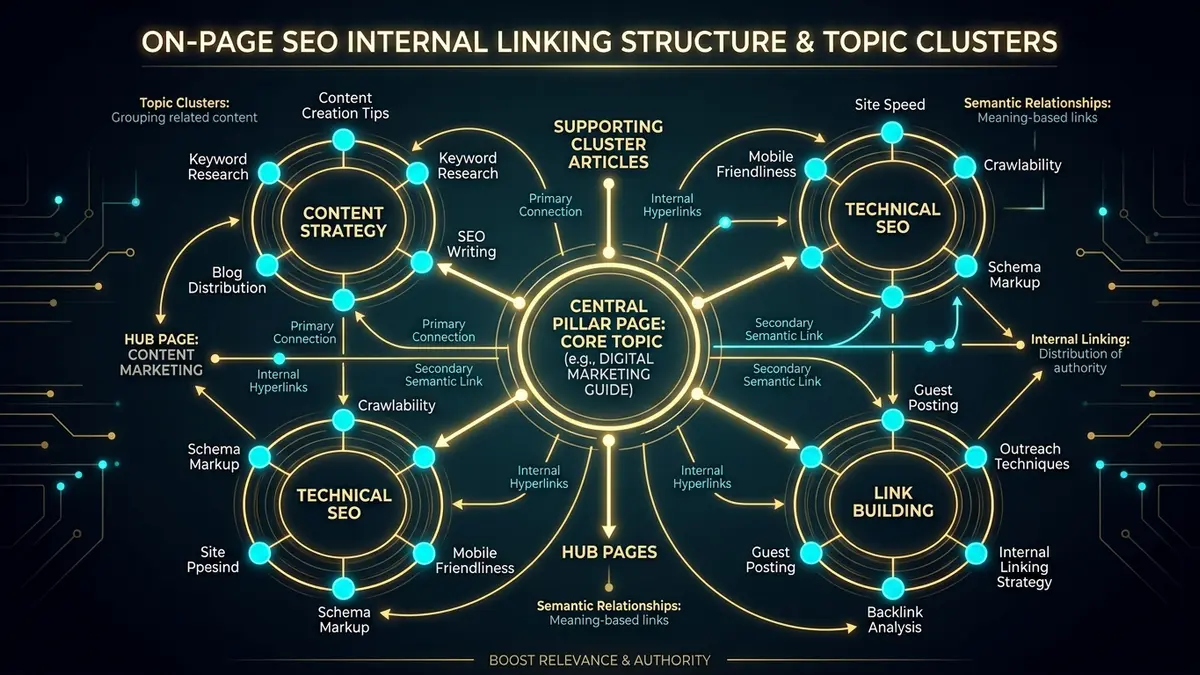
Internal links are hyperlinks that connect one page on your domain to another page on the same domain. While frequently treated as a secondary after-thought, disciplined internal linking is one of the highest-leverage on-page optimization mechanisms available.
What is internal linking?
Internal linking is the structural practice of weaving contextual bridges between interrelated pages across your website. Unlike navigational header menus or footer links, in-content editorial links establish specific conceptual relationships between individual documents.
Why internal links matter
Internal links accomplish three vital tasks:
- Crawl discovery: Search spiders discover new and updated URLs by traversing hyperlinks.
- PageRank distribution: High-authority pages (such as your homepage or viral articles with heavy backlink profiles) transfer equity downwards to commercial landing pages and deep cluster articles.
- Semantic context: The link anchor text tells search engines exactly what the destination page represents.
Contextual internal links
Contextual links appear naturally within body paragraphs where a related topic is organically mentioned. Search engines assign significantly higher algorithmic weight to in-content editorial links than to boilerplate sidebar or footer links.
Descriptive anchor text
Never use generic anchors like “click here,” “read more,” or raw URLs. Always use descriptive, keyword-rich anchor text that clearly specifies the destination page topic (e.g., “Core Web Vitals performance guide” or “Technical SEO audit checklist”).
Pillar-to-cluster linking
In a topic cluster model, a comprehensive pillar page (such as this complete on-page SEO guide) provides a high-level overview of the entire subject and links contextually down to dedicated, in-depth cluster posts covering specific subtopics (e.g., title tag optimization, schema implementation).
Cluster-to-pillar linking
Every supporting cluster post must link back up to the main pillar page using the pillar's primary target keyword as the anchor text. This bidirectional relationship signals to search engines that the pillar is the authoritative hub of the entire topical cluster.
Hub pages
Topic hubs or category archives act as centralized clearinghouses that aggregate all related articles under a single thematic umbrella, creating logical site taxonomy and clean navigation paths for both crawlers and users.
Orphan pages
An orphan page is a webpage that has zero incoming internal links from anywhere else on the website. Search engine crawlers struggle to discover orphan pages, and because they receive zero internal PageRank, they almost never rank for competitive queries.
Internal link depth
Maintain a shallow link depth. Crucial commercial and informational pages should be reachable within three clicks or fewer from the homepage. Deeply buried pages receive low crawl priority from search bots.
Avoiding excessive internal links
Do not turn your article into an unreadable sea of blue links. Linking dozens of times in every paragraph dilutes internal link equity and frustrates readers. Limit links to naturally relevant, high-value destinations that genuinely help the user expand their understanding.
How to build an internal linking map
Construct a simple spreadsheet tracking your core topic clusters. Map each pillar page alongside its 5 to 15 supporting cluster URLs, target keywords, and primary anchor text variations. Before publishing any new blog post or service page, reference your map to identify at least 3 to 5 existing pages that should link to the new asset.
How Do Images Affect On-Page SEO?
Visual assets enhance content comprehension, reduce cognitive fatigue, and capture organic traffic across Google Image Search. However, unoptimized media remains the #1 cause of slow page load times and Core Web Vitals failures.
Image file names
Never upload raw camera names like IMG_8492.jpg. Rename image files with descriptive, hyphen-separated keywords that describe the visual subject before uploading (e.g., what-is-on-page-seo-guide.webp).
Alt text
Alternative text (alt="...") serves two crucial functions: it provides accessibility descriptions for visually impaired readers using screen readers, and it helps search engine bots understand image content. Write accurate, contextual descriptions that naturally incorporate relevant keywords without stuffing.
Image captions
Captions positioned beneath diagrams and infographics enjoy higher readership rates than standard body text. Use captions to highlight core takeaways and explain complex data visualizations.
Image relevance
Avoid cheesy, generic stock photography of handshakes or puzzle pieces. Use meaningful, topic-specific diagrams, workflow charts, and user interface screenshots that tangibly illustrate the concepts discussed in surrounding paragraphs.
Image compression
High-resolution raw images can easily exceed 5MB, severely dragging down page speed. Run every asset through lossless or lossy compression to reduce file sizes to under 100 KB while preserving crisp visual clarity.
Modern image formats
Replace legacy JPEG and PNG files with next-generation formats such as WebP or AVIF. WebP provides superior compression ratios, delivering 25% to 35% smaller file sizes at identical visual fidelity.
Image SEO and accessibility
Search accessibility and SEO go hand-in-hand. Always specify explicit width and height attributes in your HTML image tags. This reserves layout space before media renders, preventing Cumulative Layout Shift (CLS).
When should decorative images have empty alt text?
When an image serves purely aesthetic purposes—such as abstract background textures, dividing lines, or decorative icon flourishes that add zero substantive meaning—set the alt attribute to an empty string: alt="". This signals screen readers to skip the asset silently rather than cluttering the auditory experience for disabled users.
What Is Schema Markup and How Does It Support On-Page SEO?
Structured data is a standardized machine-readable vocabulary developed through Schema.org. It translates human-oriented webpage content into unambiguous, structured code that search engines and AI models can ingest instantaneously.
In modern SEO, structured data is implemented primarily through JSON-LD (JavaScript Object Notation for Linked Data) inserted in the <head> or <body> of the document.
Common schema types
Deploy specific schema types aligned with your page template:
- Article / BlogPosting: Identifies editorial headlines, publication dates, author identity, and publisher logos for news and informational blogs.
- Product: Specifies prices, currency, inventory availability, SKU numbers, and customer review aggregates on ecommerce product pages.
- LocalBusiness: Defines physical addresses, geographic coordinates, opening hours, and phone numbers for local establishments.
- Organization: Establishes global brand identity, official corporate name, and verified social media profiles.
- BreadcrumbList: Illustrates site taxonomy, enabling rich breadcrumb navigation trails directly in Google search snippets.
- FAQPage: Outlines structured questions and answers (note: Google now restricts visible FAQ rich results primarily to authoritative health and government domains, but schema remains invaluable for AI engine knowledge extraction).
- Review: Encapsulates individual customer testimonials and critical editorial evaluations.
- SoftwareApplication: Outlines operating requirements, licensing models, and software ratings for SaaS products.
- Service: Dissects specific commercial service offerings, target audiences, and service areas.
Schema vs. visible content
Google strictly mandates that structured data must accurately reflect content that is fully visible to human readers on the page. Hiding text inside schema markup that does not exist in the rendered DOM is a severe violation of Google Search Essentials and can trigger manual spam actions.
Can schema improve rankings?
Schema markup is not a direct algorithmic ranking factor. Adding valid schema to a poorly written, unauthoritative page will not push it to position one. However, schema helps search engines understand entities with zero ambiguity, enables eye-catching rich snippets that significantly boost click-through rates, and provides structured data feeds that AI answer engines rely on for citation sourcing.
How Does Page Experience Relate to On-Page SEO?
Search engines exist to satisfy users. If a webpage boasts exceptional keyword relevance but loads sluggishly, shifts abruptly while reading, or bombards visitors with unclosable popups, users will abandon the page immediately. Google formalizes these user experience criteria under its Page Experience framework.
Core Web Vitals
Google evaluates real-world user experience through three standardized Core Web Vitals metrics:
- LCP (Largest Contentful Paint): Measures loading performance. The main content element (such as hero image or heading) must render within 2.5 seconds of initial request.
- INP (Interaction to Next Paint): Measures page responsiveness and interactivity. The page should respond to user clicks, taps, or key presses within 200 milliseconds.
- CLS (Cumulative Layout Shift): Measures visual stability. Content must not unexpectedly jump or reflow as external scripts and ads load, maintaining a score below 0.1.
Mobile usability
Google evaluates and indexes pages exclusively through mobile-first indexing. Your content, typography, image sizing, and touch targets must function seamlessly across smartphone screens without horizontal scrolling.
Intrusive interstitials
Aggressive full-screen promotional popups that obscure main content immediately upon arrival frustrate users and violate page experience guidelines. Use unobtrusive banners or timed slide-ins instead.
Layout stability
Ensure stylesheets load synchronously and dimensions are defined on all media elements. When fonts load smoothly without Flash of Unstyled Text (FOUT), reading stability is preserved.
Page speed vs. content quality
It is vital to clarify that technical performance is never a substitute for topical relevance. A blazing-fast webpage that fails to answer the user's search query will not outrank a slightly slower page that delivers thorough, authoritative solutions. Page speed acts as a tiebreaker and retention driver, not an excuse for shallow content.
How Does E-E-A-T Apply to On-Page SEO?
Google's Quality Rater Guidelines emphasize E-E-A-T: Experience, Expertise, Authoritativeness, and Trustworthiness. While E-E-A-T is not a single mathematical algorithmic score, Google trains its automated ranking systems to reward pages that exhibit these qualitative hallmarks.
Experience
Demonstrate firsthand involvement with the subject matter. Show photos of actual physical testing, discuss proprietary campaign data, or share personal operational lessons learned in the field.
Expertise
Provide depth and intellectual nuance that only a verified subject matter specialist possesses. Break down advanced mechanics rather than regurgitating elementary definitions.
Authoritativeness
Establish that your brand or author is recognized as a go-to reference within your industry sector, supported by industry citations, published research, and speaking engagements.
Trustworthiness
Trust is the central anchor of E-E-A-T. Ensure the site provides secure HTTPS connections, explicit editorial corrections policies, transparent business ownership, and easy-to-find contact channels.
Author bios
Every editorial article should showcase a clear author byline linked to a verified author bio. Include professional credentials, career history, and links to external authority profiles such as LinkedIn.
First-hand examples
Differentiate your content from synthetic AI generation by embedding proprietary case studies, client test results, and concrete before-and-after metrics.
Original research
Publishing original data surveys, proprietary industry benchmarks, or custom experiments establishes instant information gain and attracts organic editorial backlinks naturally.
Citations and references
Attribute empirical data and quotes directly to primary sources. Transparently acknowledging foundational references reinforces scholarly authority.
Transparent claims
Avoid hyperbolic clickbait or unverifiable guarantees. Present realistic expectations, acknowledge edge cases, and clearly disclose affiliate relationships or sponsorships.
How Is On-Page SEO Changing for AI Search?
Search is experiencing its most profound architectural evolution since the invention of the PageRank algorithm. With the advent of Google AI Overviews, Perplexity, Claude, and ChatGPT Search, millions of queries are resolved directly via synthesized answers rather than ten blue links.
Traditional search vs. AI search
Traditional search acts as an index librarian: it points users to external web documents where they must locate answers themselves. AI search acts as an executive research assistant: it reads multiple web documents, extracts relevant factual fragments, and synthesizes a direct response in real time, appending source citations.
What is AI Overviews?
Google AI Overviews (formerly Search Generative Experience - SGE) dynamically generates multi-paragraph summaries atop standard search results for complex or multi-step queries, citing reputable publisher URLs within interactive carousel chips.
What is answer-engine optimization?
Answer-Engine Optimization (AEO) is the practice of engineering content specifically to be ingested, verified, and delivered by conversational voice assistants and automated answer engines.
What is generative engine optimization?
Generative Engine Optimization (GEO) is the systematic optimization of digital assets so large language models (LLMs) select and cite your brand as an authoritative reference during real-time Retrieval-Augmented Generation (RAG).
How AI systems retrieve information from webpages
Generative engines do not read webpages like humans. They convert text into mathematical vector embeddings, segment documents into semantic "chunks" (passages), and calculate semantic similarity scores between the user prompt and stored text chunks.
Why passage-level clarity matters
Because LLMs retrieve information at the passage level, every subtopic within your article must make grammatical and conceptual sense in complete isolation. If a crucial definition relies on context explained three sections earlier, the retrieval algorithm may discard it as incomplete.
Why self-contained sections matter
Format subheadings and opening paragraphs so that an AI engine can snip out an H3 and its subsequent 50-word explanation as a standalone answer snippet without requiring surrounding context.
Why explicit entities and relationships help
LLMs excel at mapping entity graphs. When your prose states unequivocally: “On-page SEO consists of X, Y, and Z,” the AI system parses that declarative statement with high confidence, increasing citation likelihood.
Why original information can differentiate a source
Commoditized summaries are easily replicated by AI models from baseline training data. However, when an AI search system searches the web for fresh, proprietary data or novel frameworks, it actively seeks out and cites the original source of that unique information gain.
What Is Query Fan-Out and Why Does It Matter for On-Page SEO?
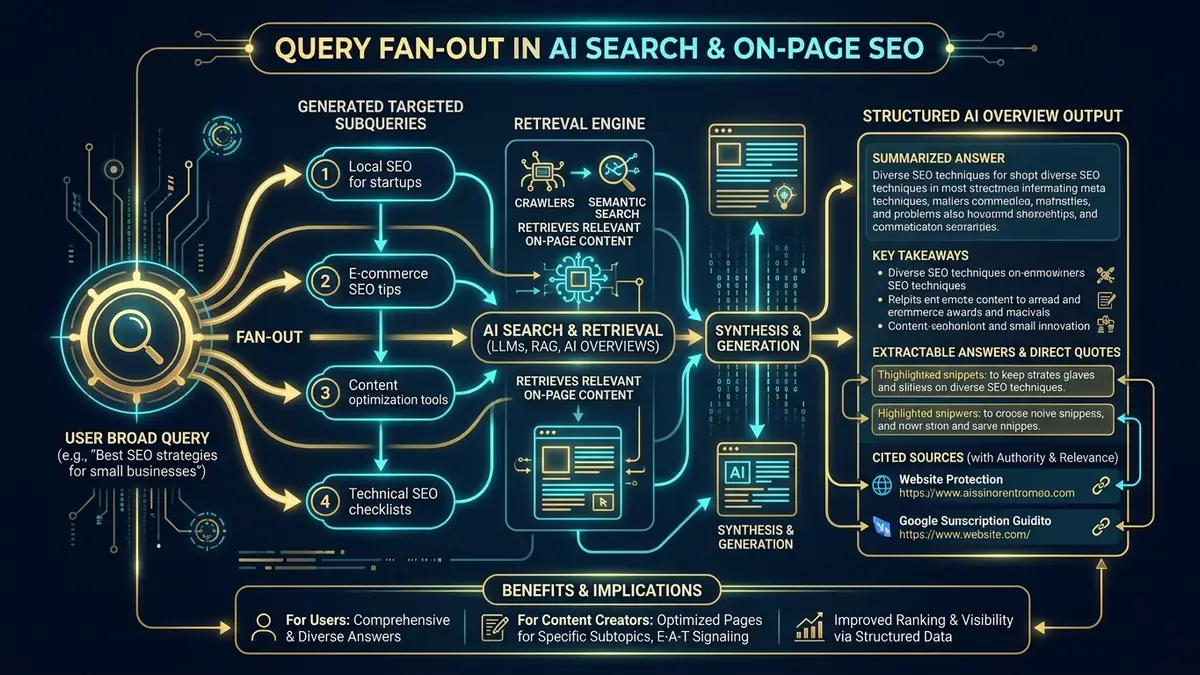
One of the most powerful concepts in modern search retrieval is query fan-out. Both Google's internal search algorithms and advanced AI retrieval systems use query fan-out to ensure users receive comprehensive, multidimensional answers.
What is query fan-out?
Query fan-out is an algorithmic retrieval mechanism where an AI system or search engine decomposes a single broad user prompt into multiple related subqueries, executes parallel searches across those subqueries, and synthesizes the retrieved findings into a unified, comprehensive answer.
How one search query can become multiple subqueries
Consider a user entering a deceptively simple query into an AI search engine:
Primary User Query:
“What is on-page SEO?”
Algorithmic Query Fan-Out (Subqueries Generated):
- What is on-page SEO in simple terms?
- How does on-page SEO work step by step?
- Why is on-page SEO important for business websites?
- What are the core elements and ranking factors of on-page SEO?
- How do you optimize title tags and headings?
- How does internal linking help on-page SEO?
- What is search intent and how do you validate it?
- What is semantic SEO and entity optimization?
- What is the difference between on-page SEO, technical SEO, and off-page SEO?
- How does schema markup support on-page SEO?
- How do images affect on-page SEO performance?
- How does page speed and Core Web Vitals impact on-page SEO?
- How do you measure on-page SEO performance and conversions?
- Why isn't my optimized page ranking in Google?
- How does on-page SEO work for ecommerce and local businesses?
- How can content be optimized for AI search and LLM retrieval?
How to create content that covers the fan-out
Do not make the rookie mistake of writing disjointed, repetitive paragraphs for each individual subquery. Instead, architect a coherent information hierarchy where one primary pillar topic naturally and logically encompasses its associated subqueries. When your article structure mirrors the AI engine's anticipated fan-out tree, your URL becomes the single authoritative source capable of resolving all aspects of the user's inquiry.
Query fan-out vs. keyword stuffing
Keyword stuffing repeats identical words in a futile attempt to manipulate frequency algorithms. Query fan-out coverage addresses distinct, intellectually substantive sub-problems, expanding conceptual breadth while maintaining pristine editorial quality.
Query fan-out vs. FAQ stuffing
Slapping 40 random, disconnected FAQ questions at the bottom of a page does not constitute proper fan-out optimization. High-performing pages integrate major subqueries directly into the primary narrative flow using logical H2 and H3 chapters, reserving FAQs strictly for rapid, focused clarifications.
How to create extractable answers
Follow every question-based heading immediately with a bold, declarative 1-to-2-sentence summary that answers the question directly. Follow that summary with granular evidence, bullet points, or data tables. This gives retrieval models an immediate extractable snippet.
How to optimize individual sections for independent retrieval
Treat each H2 and H3 subsection as a micro-article. State the topic clearly, avoid ambiguous introductory pronouns (e.g., replace “As we mentioned above, it works by...” with “On-page SEO works by...”), and ensure all factual assertions are verified within that section.
How Do You Optimize Content for LLMs and AI Search?
Optimizing for large language models and generative engines is not about “tricking ChatGPT.” It is about engineering your content so retrieval systems can ingest, parse, and cite your data with maximum confidence and minimal compute overhead:
- Put the answer before the explanation: State the core conclusion in sentence one; elaborate on the reasoning thereafter.
- Use descriptive, unambiguous headings: Craft headings that explicitly state the concept being resolved.
- Keep important answers self-contained: Ensure the answer passage does not depend on text located pages away.
- Define entities explicitly: Use formal declarative sentences (e.g., “An entity attribute is...”) that knowledge graphs parse easily.
- Use consistent terminology: Do not rotate between five different whimsical metaphors for the same technical concept.
- Avoid ambiguous pronouns: Minimize use of “it,” “they,” or “this” at the start of paragraphs where the referent could be ambiguous to an NLP parser.
- Use lists and tables where appropriate: Structured tables and ordered steps possess higher semantic density and are prioritized by AI summarizers.
- Cite authoritative sources: Hyperlink to primary scientific studies, official patents, and industry documentation to enhance credibility scores.
- Include original proprietary information: Provide unique survey results, calculations, or diagnostic frameworks that exist nowhere else.
- Cover related questions comprehensively: Preemptively address the next three questions the searcher will logically ask.
- Make factual claims easy to verify: Present concrete statistics with dates, sample sizes, and attribution.
- Keep important information close to relevant headings: Place the definitive answer directly beneath the heading rather than burying it three paragraphs down.
On-Page SEO for Different Page Types
On-page SEO is not one-size-fits-all. Optimal page structure shifts dramatically depending on the commercial intent and business model of your site:
On-page SEO for blog posts
Informational blog posts prioritize topical depth, answer-first paragraphs, logical heading structures, internal links to commercial hubs, and Article/BlogPosting schema.
On-page SEO for service pages
Commercial service pages must balance search relevance with conversion rate optimization (CRO). Prioritize clear value propositions, client outcome metrics, transparent deliverable breakdowns, customer testimonials, Service schema, and prominent strategy audit CTAs.
On-page SEO for product pages
Ecommerce product pages require keyword-rich product titles, unique benefit-driven descriptions, high-resolution WebP product photography, verified review markup, clear pricing/availability tokens, and Product schema.
On-page SEO for category pages
Category and collection pages capture high-volume commercial intent. Include concise introductory category descriptions, intuitive faceted navigation, internal links to top-selling items, and CollectionPage schema.
On-page SEO for landing pages
PPC and conversion landing pages target bottom-of-funnel queries. Maintain a 1:1 attention ratio, eliminate distracting external navigation, showcase trust badges, and deliver immediate headline-to-query alignment.
On-page SEO for local business pages
Local landing pages must weave localized geographical relevance into titles, H1s, body copy, and LocalBusiness schema alongside verified Name, Address, and Phone (NAP) citations.
On-page SEO for ecommerce websites
Scale on-page optimization programmatically across thousands of SKUs using templated title tag formulas, automated alt text rules, and robust breadcrumb taxonomies.
On-page SEO for SaaS websites
Software-as-a-Service platforms must optimize product feature pages, integration directories, and comparison pages (“Competitor A vs Competitor B”), supported by interactive product demos and SoftwareApplication schema.
On-Page SEO for Ecommerce
Ecommerce websites face unique on-page challenges: thousands of dynamic URLs, thin manufacturer descriptions, out-of-stock items, and faceted navigation filters.
To dominate transactional commercial search, optimize these critical on-page ecommerce touchpoints:
- Unique product titles: Include brand, model, size, color, and defining specifications (e.g., “Men's Waterproof Trail Running Shoes - Dark Navy / Size 10”).
- Original product descriptions: Never copy-paste boilerplate manufacturer descriptions that appear on hundreds of competing retail sites. Write original, benefit-oriented copy addressing materials, use cases, and care instructions.
- Faceted navigation and filters: Ensure faceted URL parameters (color, size, price) use canonical tags pointing back to the clean master category URL to prevent duplicate content bloat.
- Product schema markup: Embed valid JSON-LD specifying
price,priceCurrency,availability(InStock/OutOfStock), andaggregateRatingto unlock rich star ratings on the SERP. - Product photography: Provide multiple angles, zoom capabilities, descriptive alt text, and lightweight WebP compression.
On-Page SEO for Local Businesses
Local on-page optimization connects your brick-and-mortar storefront or localized service offering with customers searching in your immediate geographic vicinity.
Key on-page local optimization factors include:
- Localized title tags and H1s: Naturally incorporate your primary service and targeted city/region (e.g., “Emergency Plumber in Manchester | 24/7 Rapid Response”).
- Consistent NAP data: Ensure your Business Name, Street Address, and Telephone number match your Google Business Profile (GBP) character-for-character in the page footer.
- LocalBusiness schema: Embed geographic coordinates (
latitudeandlongitude), postal codes, opening hours, and service area radii. - Dedicated Service + Location pages: If servicing multiple metropolitan areas, construct unique, non-templated location pages featuring localized case studies, customer testimonials, and local driving directions.
Important distinction: Local SEO is a broader discipline than on-page SEO alone. On-page optimization creates geographic relevance on your website, but local visibility also depends on off-page Google Business Profile optimization, local citation consistency across directories, and authentic customer reviews.
How to Audit On-Page SEO
Before executing redesigns or publishing new content, run your existing URLs through this systematic 14-step diagnostic audit:
- Check indexability: Verify the URL returns HTTP 200, has no accidental
noindexmeta robots tags, and is not blocked in robots.txt. - Confirm search intent: Compare the page format and messaging against the current top 5 ranking results in Google.
- Check title tag: Ensure the primary keyword is front-loaded, length is between 50–60 characters, and copy inspires clicks.
- Check H1 heading: Verify there is exactly one H1 clearly stating the page topic without duplicate phrasing.
- Review heading hierarchy: Confirm H2s and H3s follow a logical nesting order and use descriptive, entity-rich wording.
- Analyze content depth: Check whether the content provides an immediate answer in paragraph one and covers all relevant subtopics.
- Check semantic coverage: Confirm related entities, industry terminology, and follow-up questions are thoroughly explored.
- Review internal links: Ensure the page links contextually to related cluster articles and receives links from authoritative internal pages.
- Check images: Verify all images use descriptive file names, contextual alt text, modern WebP formats, and are compressed under 100 KB.
- Check structured data: Validate JSON-LD schema using Google's Rich Results Test tool to ensure zero syntax errors.
- Review page experience: Check Core Web Vitals performance (LCP, INP, CLS) and verify mobile touch responsiveness.
- Check competing pages: Analyze competitor word count, multimedia usage, and unique data to find information gain gaps.
- Check keyword cannibalization: Ensure no other URL on your domain is actively competing for the identical primary search query.
- Check AI-search visibility: Test whether definitions and key takeaways are written as self-contained, extractable passages.
Why Isn't My Page Ranking Even After On-Page SEO?
It is intensely frustrating to execute thorough on-page optimization only to watch your page stall on page three of Google. When on-page optimization fails to generate rankings, diagnose these 12 root causes:
The page targets the wrong intent
If searchers want a free calculation tool and you provide a 3,000-word history lesson, your page will never rank. Re-examine the live SERP and adjust your content archetype.
The topic is too competitive
Attempting to rank a new domain for an ultra-competitive term like “credit cards” or “CRM software” without massive domain authority is nearly impossible. Target specific long-tail variations first.
Content lacks depth
If rival pages thoroughly dissect 20 subtopics with custom charts and your article provides only superficial paragraphs, algorithms will downgrade your relevance score.
Content lacks originality
If your content merely synthesizes information already ranking on page one without introducing new data or unique case studies, Google's Helpful Content systems assign zero information gain score.
Site lacks topical authority
Google rarely ranks an isolated article on a complex subject if the root domain has never published content in that topical neighborhood before. You must publish an entire supporting topic cluster.
Internal linking is weak
If the page is an orphan or buried four clicks deep in your site architecture without contextual inbound links from high-authority hubs, search bots will allocate minimal crawl budget.
Page lacks external authority
On-page SEO makes your page eligible to rank; high-quality backlinks provide the votes of confidence required to beat entrenched competitors. Build authoritative digital PR and industry backlinks.
Technical/indexing issues exist
Verify in Google Search Console that the page is actually indexed. Unintentional noindex tags, canonical misconfigurations, or rogue disallow rules in robots.txt will render on-page efforts useless.
Search demand changed
Search trends fluctuate. Seasonality, economic shifts, or new technological breakthroughs can cause historical search volume to drop precipitously.
Content is outdated
If your guide references outdated guidelines or defunct tools, search algorithms prioritizing freshness will swap your URL for more current competitors.
Another page is cannibalizing it
If two or more pages on your website target the same keyword, search engines split ranking authority between them, causing both URLs to underperform. Consolidate competing pages with 301 redirects.
The SERP requires a different content format
Sometimes Google shifts SERP real estate toward video carousels, interactive tools, or local map packs. If the SERP landscape has transformed, text alone may no longer capture prime visibility.
How Do You Measure On-Page SEO Performance?
Effective on-page SEO is an iterative process requiring rigorous performance measurement across leading and lagging indicators:
- Organic clicks and impressions: Track whether total search exposure is expanding across Google Search Console.
- Click-through rate (CTR): Measure snippet effectiveness before and after optimizing title tags and meta descriptions.
- Keyword ranking trajectories: Monitor average positions for primary and secondary keyword clusters.
- Indexed query breadth: Count how many total unique long-tail search queries your URL ranks for.
- Conversions and revenue: Track assisted conversions, form submissions, and sales generated by organic traffic via GA4.
- SERP feature captures: Monitor acquisition of Featured Snippets, People Also Ask boxes, and Image carousels.
- AI search visibility: Track brand citations and excerpt inclusion across Google AI Overviews, Perplexity, and ChatGPT.
Google Search Console
GSC provides direct first-party data on organic performance. Filter by page URL to inspect exact search queries driving impressions, identify striking-distance keywords (ranking #8–#20), and spot click-through bottlenecks.
GA4
Google Analytics 4 measures on-page engagement metrics. Track average engagement time, scroll depth, key events, and landing page conversion pathways.
Rank tracking
Deploy dedicated enterprise rank tracking tools to monitor daily keyword position shifts across desktop and mobile devices, benchmarked against direct competitors.
AI visibility tracking
Regularly audit your target queries inside AI search engines. Track whether your brand URL appears in AI Overview citation carousels and examine how generative summaries synthesize your content.
Before-and-after content optimization analysis
Whenever you refresh an existing page, annotate the exact date in your analytics. Compare performance in 30-day, 60-day, and 90-day windows post-optimization to validate whether content and heading adjustments generated measurable traffic gains.
On-Page SEO Checklist
Use this actionable on-page SEO checklist before publishing or refreshing any page on your website:
Keyword & Intent Alignment
- ✓ Primary search query identified with verified commercial/informational intent
- ✓ Search intent validated against live Google page-one SERP results
- ✓ Secondary keywords, long-tail variations, and question queries mapped
- ✓ Core topic entities, attributes, and relationships defined
Content Engineering
- ✓ Primary question answered directly in the first paragraph (answer-first format)
- ✓ Topic covered comprehensively, answering anticipated follow-up queries
- ✓ Original insights, proprietary data, or unique case studies included (information gain)
- ✓ Claims supported with external links to authoritative primary sources
- ✓ Zero keyword stuffing or repetitive phrasing
- ✓ Verified author byline with credentials and link to complete bio
HTML & Structural Elements
- ✓ Unique title tag (50–60 chars) with primary keyword front-loaded
- ✓ Exactly one clear H1 heading matching user search expectations
- ✓ Logical H2 and H3 heading hierarchy with descriptive phrasing
- ✓ Short, clean, hyphen-separated URL slug devoid of dates and numbers
- ✓ Compelling meta description (150–160 chars) featuring target keyword and CTA
Internal & External Linking
- ✓ Contextual internal links pointing to related cluster articles using descriptive anchors
- ✓ Cluster-to-pillar link pointing to the core topic hub
- ✓ Inbound links added from at least 3 to 5 existing relevant pages on your domain
- ✓ Zero orphan status; reachable within 3 clicks of homepage
Media & Visual Assets
- ✓ Descriptive, keyword-rich image file names (e.g.,
on-page-seo-guide.webp) - ✓ Contextual alt text describing image content for accessibility and bots
- ✓ Modern image formats (WebP/AVIF) compressed strictly under 100 KB
- ✓ Explicit width and height attributes declared to eliminate layout shifts (CLS)
Structured Data & AI Visibility
- ✓ Valid JSON-LD schema (Article, Product, LocalBusiness, FAQ) implemented
- ✓ Schema data strictly matches content visible to human readers
- ✓ Subsections designed as self-contained, extractable passages for RAG systems
- ✓ Clear tables and bulleted lists utilized for high-density factual information
Page Experience & Performance
- ✓ Core Web Vitals validated (LCP < 2.5s, INP < 200ms, CLS < 0.1)
- ✓ Flawless mobile responsiveness across multiple device viewport widths
- ✓ Zero intrusive popups or blocking interstitials
On-Page SEO FAQs
Explore concise, expert answers to the most common on-page SEO questions:
What is on-page SEO in simple words?
On-page SEO in simple words is the practice of optimizing everything directly on your webpage—including content, headings, images, HTML tags, and internal links—so search engines and AI systems can easily understand, index, and rank your page for relevant search queries.
What are examples of on-page SEO?
Common examples of on-page SEO include writing an intent-aligned title tag, formatting an article with logical H1–H3 headings, adding descriptive alt text to compressed WebP images, inserting contextual links to related blog posts, creating clean URL slugs, and implementing JSON-LD schema markup.
What are the main factors of on-page SEO?
The main factors include search intent alignment, content depth and originality, semantic topical coverage, title and header structure, internal link hierarchy, Core Web Vitals page experience, and structured entity data.
What is the difference between on-page and off-page SEO?
On-page SEO involves optimizations made directly within your website code and content to establish topic relevance. Off-page SEO consists of actions taken outside your domain—such as earning backlinks, digital PR coverage, and brand citations—to establish domain authority and trust.
Is on-page SEO still important?
Yes, on-page SEO is more critical than ever. As Google and AI retrieval systems like AI Overviews and ChatGPT rely on passage retrieval, clear semantic entities, and direct answers, on-page optimization directly dictates whether your content can be retrieved and cited.
Does on-page SEO include keywords?
Yes, but modern on-page SEO uses keywords semantically. Rather than repeating a single phrase, you target primary keywords alongside semantic variations, secondary entities, questions, and attributes that comprehensively satisfy search intent.
Does on-page SEO include backlinks?
No. Inbound backlinks from other websites are off-page SEO. However, on-page SEO manages internal links (hyperlinks pointing between pages on your own website) and external outbound citations.
Is schema markup part of on-page SEO?
Yes. Schema markup sits at the intersection of on-page and technical SEO. It is embedded directly in the page HTML to explicitly describe entities, authors, articles, FAQs, and products to search crawlers.
Does page speed count as on-page SEO?
Page speed is primarily a technical SEO and page experience factor, but on-page choices—such as image compression, layout stability, and script placement—directly determine page speed and user experience on a page-by-page level.
How long does on-page SEO take to work?
On-page SEO changes typically begin showing indexing and ranking shifts within days to a few weeks after Google re-crawls and re-indexes the page, although competitive queries may require months of compounded topical authority.
Can I do on-page SEO myself?
Yes, anyone can execute foundational on-page SEO by understanding search intent, writing comprehensive and original copy, adding descriptive headings, optimizing title tags and images, and creating logical internal links.
Why isn't my website ranking despite good on-page SEO?
On-page SEO is only one pillar of search visibility. If a page is not ranking, it may lack domain authority (backlinks), target a query dominated by different search intents, suffer from technical crawl blocks, or compete against deeply entrenched market leaders.
How does on-page SEO help AI search?
On-page SEO structures content into answer-first, self-contained passages with explicit entities and schema markup. This makes it effortless for Retrieval-Augmented Generation (RAG) engines and LLMs to extract, verify, and cite your page in AI Overviews and conversational search.
What is semantic SEO?
Semantic SEO is the practice of optimizing content around real-world entities, their attributes, and their relationships rather than isolated keywords, helping search algorithms understand meaning and context.
What is query fan-out in SEO?
Query fan-out is a search mechanism where an AI system or search engine splits a broad user prompt into multiple related subqueries and aggregates information across them. Optimizing for query fan-out means structuring a comprehensive page that covers these interconnected subqueries under one logical architecture.