
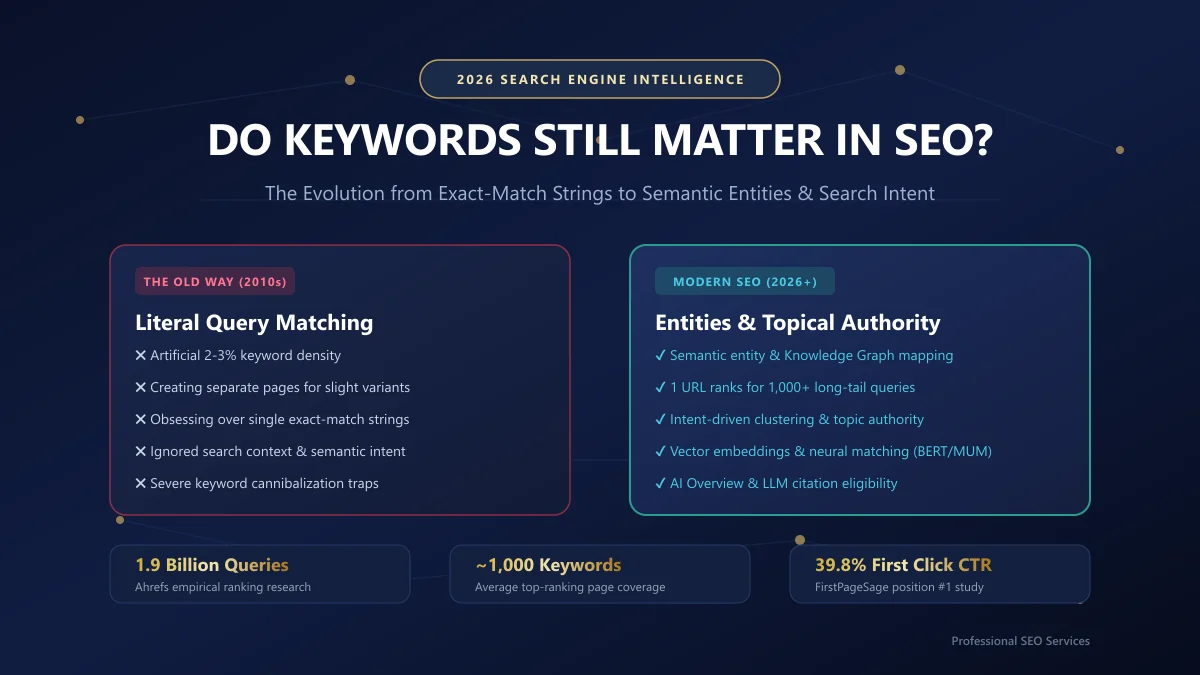
Executive Summary: The Verdict on Keywords in 2026
Do keywords still matter in SEO? Yes—unequivocally. However, the definition of what a keyword represents has undergone the most radical evolution in digital marketing history. Keywords are no longer character-for-character strings that you mechanically insert into web pages to manipulate PageRank. Today, keywords represent semantic entities, intent representations, and algorithmic vector anchors. While exact-match keyword stuffing is completely dead, understanding the exact vocabulary your audience uses remains the cornerstone of ranking, click-through performance, and Generative Engine Optimization (GEO).
Every few months, a provocative headline emerges declaring that "keywords are dead." With Google’s rapid rollout of large language models, AI Overviews, neural retrieval algorithms, and conversational search engines, it is tempting to believe that traditional keyword strategy has become obsolete. After all, if search engines can comprehend natural language, decipher nuanced human intent, and synthesise direct answers, why should marketers continue to obsess over individual search terms?
The short answer is that human beings still communicate through language. Every time a consumer experiences a problem, searches for a commercial product, or seeks specialized B2B expertise, they formulate that cognitive intent into specific words. In SEO, those words are search queries. As long as people use words to locate solutions, keywords will remain the indispensable bridge connecting prospective buyers to your business.
What has died is not the keyword itself, but the primitive, mechanical tactics of the 2000s and 2010s: arbitrary keyword density formulas, doorway pages for minor plurals, and mindless repetition. If your current organic strategy still relies on outdated exact-match targeting, your website is silently suffering algorithmic decay.
In this masterclass guide, we will unpack the empirical data, historical algorithm evolution, and modern technical architecture governing keywords in search engine optimization. We will explore how modern retrieval systems process language, present research from billions of search queries, pinpoint where keywords still exert massive ranking influence, and outline an actionable framework to build topical authority. If you are preparing your site for sustainable search dominance, discover how our specialized professional seo services engineer organic visibility that converts.
The Evolution of Keywords: From Literal Strings to Semantic Entities
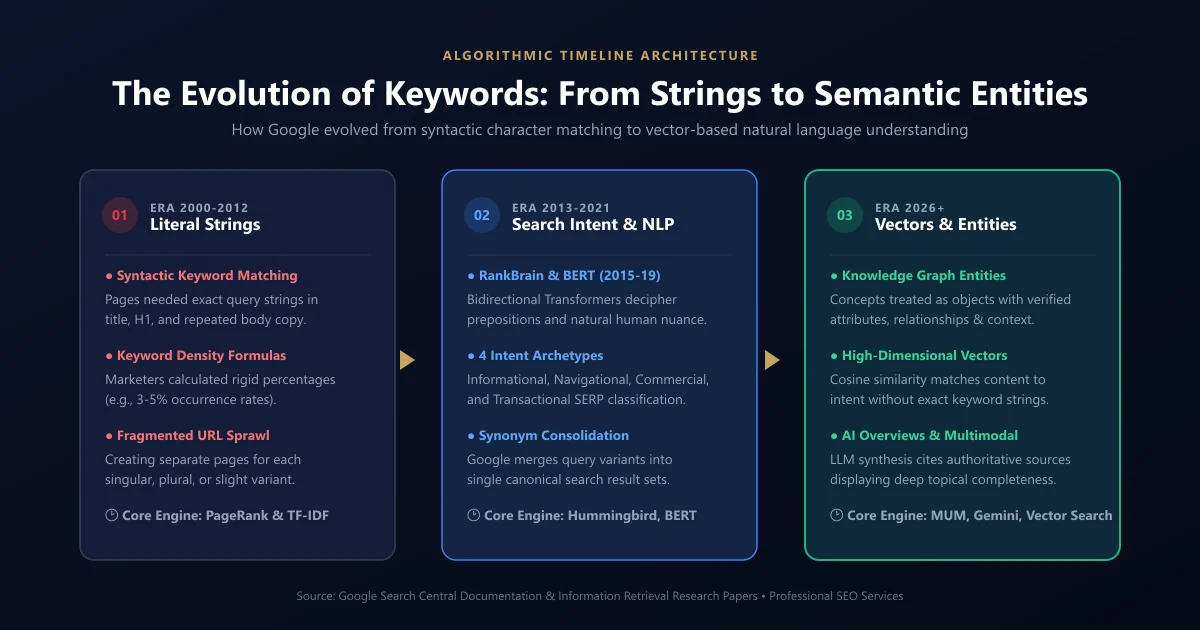
To understand why keywords still matter—and how to apply them properly—one must first examine the chronological evolution of Google's ranking infrastructure. Search engines were not born with the ability to understand human speech; they had to be methodically re-engineered across two decades of machine learning breakthroughs.
1. The Syntactic String Era (2000–2012): Exact Matches & Density Formulas
During Google’s first decade, the search engine relied heavily on syntactic term matching governed by Term Frequency-Inverse Document Frequency (TF-IDF) models. If a user searched for "best accounting software london", Google indexed the web as a database of literal strings. The pages that ranked highest were simply those that contained that exact character combination in their page title, headings, and body copy, supported by incoming PageRank links bearing the same anchor text.
This gave rise to black-hat and grey-hat practices that degraded the web:
- Keyword Stuffing: Forcing a keyword into body copy at an artificial 3% to 7% density to signal relevance.
- Fragmented URL Sprawl: Publishing hundreds of duplicate pages targeting near-identical variations (e.g.,
/best-accounting-software/,/top-accounting-software/, and/accounting-softwares/). - Hidden Text: Painting white keyword text on white backgrounds to game crawler algorithms.
While effective at the time, these primitive tactics collapsed when Google rolled out its groundbreaking Google Penalty algorithms—most notably Panda (2011) and Penguin (2012)—which penalized thin, keyword-stuffed web pages.
2. The Semantic & Intent Era (2013–2021): Hummingbird, RankBrain, and BERT
In 2013, Google launched Hummingbird, rewriting its core algorithm to transition from "strings to things." Hummingbird integrated Google’s nascent Knowledge Graph, recognizing that words represent real-world entities (people, places, concepts, organizations) with measurable attributes and interconnected relationships.
Two subsequent milestones fundamentally decoupled SEO from literal phrase repetition:
- RankBrain (2015): Google’s first deep machine learning ranking system. RankBrain converts search queries into mathematical vectors, enabling the engine to interpret ambiguous queries, colloquial slang, and queries it had never seen before by mapping them to known concept spaces.
- BERT (2019): Bidirectional Encoder Representations from Transformers revolutionized Natural Language Processing (NLP). As detailed in research published on Google's Official Technology Blog, BERT analyzes words in relation to all other words in a sentence simultaneously rather than sequentially. This allowed Google to understand nuanced prepositions like "for" or "to" (e.g., recognizing that "2026 brazil traveler to usa need visa" has the opposite intent of "usa traveler to brazil").
With BERT, the need to target exact grammatical oddities vanished. If your content explained a subject with authoritative clarity, Google understood your page even if the user typed an inverted, ungrammatical search query. For a deeper breakdown of this mechanism, read our comprehensive guide on how Google SEO works.
3. The Multimodal & Vector Era (2022–2026+): MUM, Gemini, and Generative AI
Today, search operates on the cutting edge of artificial intelligence. Models like MUM (Multitask Unified Model) and Gemini synthesize information across multiple modalities—text, imagery, video, and audio—1,000 times more powerfully than BERT.
In modern search engines, web documents and user queries are transformed into high-dimensional embedding vectors. Rather than counting how many times a word appears, neural retrieval calculates the cosine similarity between the user’s informational need and the semantic meaning of your paragraphs. Furthermore, the advent of Google’s AI Overviews and conversational answer engines means that pages are increasingly evaluated for whether they provide verified informational entities suitable for direct synthesis. To explore this frontier, explore our strategic overview of GEO, LLM & AI SEO services.
Empirical Research: What Billions of Search Queries Prove About Keywords
Do not take theoretical claims at face value. To truly answer whether keywords matter in SEO, we must inspect large-scale, empirical search industry data. Over the past several years, leading data intelligence platforms have crawled and analyzed billions of search results to quantify the mathematical relationship between keywords, rankings, and traffic.
Let's analyze what these research milestones tell us about modern SEO:
1. The 90.63% Invisibility Reality Check
In a massive study conducted by Ahrefs analyzing 1.9 billion pages, over 90% received precisely zero visits from Google search. Why? Because the authors wrote content based on internal assumptions rather than empirical keyword research. They created articles around topics nobody was searching for, or failed to align their vocabulary with what prospective customers type.
Keywords are the primary proof of market demand. If you write without keyword research, you are speaking into a soundproof room.
2. The 1,000-Keyword Ranking Multiplier
Ahrefs also discovered that a single top-ranking page consistently ranks for up to 1,000 secondary and long-tail search queries. In 2005, achieving this required publishing 1,000 separate, fragmented URLs. Today, it requires a single, deeply comprehensive pillar article structured around a unified semantic entity. This proves that keywords matter more than ever—not as isolated targets, but as an interconnected constellation of user queries.
3. The 39.8% First-Position Economic Reality
According to the authoritative FirstPageSage Click-Through Rate Study, the organic position #1 on Google captures nearly 40% of all clicks, whereas position #3 captures just 10.2%, and position #10 languishes at 1.4%. Knowing which high-intent commercial keywords drive revenue allows organizations to allocate their technical and content investments where they yield exponential commercial return.
How Google Processes Keywords Today: Entities, Embeddings & Vectors
To master keyword optimization in 2026, you must understand the underlying technical mechanics of information retrieval. When Google crawls and indexes your webpage, it does not merely build an alphabetical dictionary of word occurrences. Instead, it translates your content into three interconnected computational frameworks:
1. Named Entities & The Knowledge Graph
Google’s official documentation on Creating Helpful, Reliable, People-First Content makes it clear that search engines evaluate subject-matter expertise. Google accomplishes this by identifying entities.
An entity is a unique, unambiguous concept or thing that can be strictly defined—such as "Rehan Saeed" (Person), "Professional SEO Services" (Organization), or "Technical SEO" (Field of Study). When you write about a topic, Google inspects your content for co-occurring entities that naturally exist within that knowledge domain.
For example, if your page targets the primary keyword "technical seo guide", Google expects to encounter related entities such as crawling, indexing, Core Web Vitals, XML sitemaps, canonical tags, HTTP status codes, and robots.txt. If those related concepts are absent, Google's algorithms deduce that your page lacks topical depth—even if you repeated the phrase "technical SEO" thirty times.
2. High-Dimensional Vector Embeddings & Cosine Similarity
Modern search engines utilize transformer models that map text into a multidimensional vector space (often comprising hundreds or thousands of dimensions). In this mathematical space, words and concepts with related meanings are positioned close to one another:
- The vector for "car" sits directly adjacent to "automobile", "vehicle", and "sedan".
- The vector for "improve website ranking" aligns closely with "how to do search engine optimization".
When a user enters a query, Google converts that search string into an embedding vector and calculates the cosine angle between that query vector and the document vectors in its index. If your content exhibits high semantic alignment with the query's conceptual vector, you rank—regardless of whether you used the exact verbatim phrase.
3. Neural Matching: Bridging Language Nuances
Google introduced Neural Matching in 2018 to connect searchers' colloquial problem descriptions with technical web pages. For example, a searcher might type "why does my TV look weird like a soap opera". A legacy search engine would look for web pages about soap operas. Neural matching, however, understands the underlying concept and retrieves pages about the "motion smoothing effect" on modern television displays.
This does not mean keywords are unnecessary; it means you must understand both the formal industry terminology and the informal conversational phrasing used by real human beings.
Where Keywords Still Matter Most in Modern SEO: The 7 Core Placements
While keyword stuffing is dead, on-page keyword placement remains one of the strongest confirmed algorithmic relevance signals in search. Search engines scan specific HTML elements to determine what a page is fundamentally about.
Here are the 7 mission-critical HTML locations where strategic keyword inclusion directly drives ranking power and click-through performance:
1. The HTML Title Tag (<title>)
The title tag remains the single most influential on-page SEO signal. Search engines use it as the primary headline in SERP snippets, social shares, and browser tabs.
- Best Practice: Front-load your primary target keyword within the first 50 to 60 characters. Searchers scan search engine result pages in an F-shaped pattern; placing your primary keyword early reassures them instantly that your result matches their inquiry.
- Empirical Correlation: Multiple independent ranking factor analyses from Backlinko and Moz have consistently found a statistically significant correlation between primary keyword placement in the title tag and top 3 organic rankings.
2. The H1 Main Heading
Your H1 tag represents the thematic title of the rendered page. Google treats the H1 as a definitive summary of the document’s topic.
- Best Practice: Use exactly one H1 per page containing your primary keyword or a natural, compelling variation. Ensure the H1 reinforces the promise made in your title tag to prevent visitor bounce-backs.
3. The First 100 Words (Introductory Paragraph)
Crawlers give disproportionate weight to words appearing near the top of the HTML document Object Model (DOM). Establishing your core topic immediately signals context before diving into sub-sections.
- Best Practice: Naturally weave your primary keyword and core semantic entity into the opening paragraph or introductory thesis statement. This immediately satisfies both human skimmers and algorithmic crawlers.
4. Clean, Hyphenated URL Slugs
Google’s official search documentation confirms that URL structure provides a lightweight ranking signal and enhances snippet usability.
- Best Practice: Keep URL slugs concise, lowercase, and hyphenated, containing only your primary keyword string (e.g.,
/blog/do-keywords-matter-in-seo/instead of/blog/2026/11/24/category-strategy-do-keywords-really-matter-in-modern-seo-guide-v2/). For detailed technical rules, review our checklist on on-page SEO checklist optimization.
5. Structured Subheadings (<h2> and <h3>)
Headings establish the hierarchical semantic outline of your document. Google frequently extracts text beneath clear H2s and H3s to generate Featured Snippets and answer People Also Ask queries.
- Best Practice: Incorporate secondary long-tail keywords, question queries, and subtopic entities into your H2 and H3 tags. Never force keywords; phrase them as natural questions or clear topical headings.
6. Image Alt Attributes and File Names
Search engine image bots cannot visually "read" pixels with the same contextual precision as text without structured metadata. The alt attribute provides critical accessibility for visually impaired users using screen readers and serves as an image relevance signal.
- Best Practice: Save images with descriptive, hyphenated file names containing relevant keywords (e.g.,
evolution-of-keywords-in-seo.webp). Write alt text that genuinely describes the visual content while incorporating secondary keywords naturally.
7. Contextual Internal Link Anchor Text
Internal links distribute PageRank and pass thematic context across your website’s information architecture. The clickable anchor text tells Google precisely what the target destination URL is about.
- Best Practice: Avoid generic anchor text like "click here" or "read more". Use descriptive, keyword-rich anchor phrases such as professional on-page SEO services or how to do keyword research to transfer topical authority.
The Death of the "One Keyword, One Page" Rule: Topic Clusters Win
In legacy SEO, agencies advised clients to create a dedicated webpage for every conceivable keyword variation. If you targeted 50 search terms, you built 50 separate pages. In 2026, this approach is disastrous: it leads to severe keyword cannibalization, dilutes domain authority, and wastes crawl budget.
Today, successful organic growth is built upon Topic Clusters and Pillar Architecture.
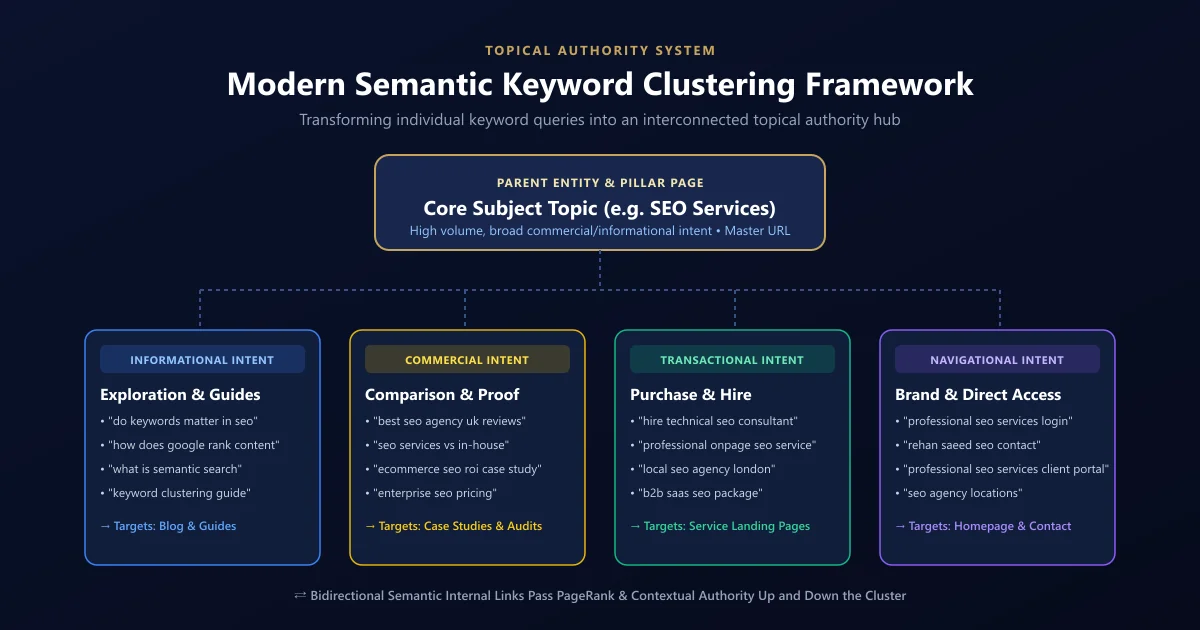
Under this modern model, you group dozens—or even hundreds—of related keyword queries that share the same underlying search intent into a unified content asset. Instead of publishing separate thin articles for "do keywords matter", "are keywords important for seo", and "do we still need keywords", you construct one definitive, authoritative masterclass guide that addresses every angle of that question.
By clustering queries semantically, your single URL develops deep topical authority, signaling to Google that it is the definitive web resource on that subject. To master this methodology, review our in-depth analysis on content strategy and topical authority.
Search Intent: The New Keyword Match Type
Targeting a keyword without understanding its search intent is the fastest way to waste marketing spend. Search intent represents the underlying motivation, objective, or psychological goal behind why a searcher entered that specific query into the search engine.
Google’s ranking algorithms evaluate whether the format and substance of your page satisfy the user's implicit intent. Modern SEO classifies search intent into four core categories:
1. Informational Intent
The User Wants to Learn
The user seeks answers, tutorials, definitions, or educational guides (e.g., "do keywords matter in seo", "how does canonicalization work").
Optimal Asset: In-depth blog post, whitepaper, video tutorial, or glossary guide.
2. Commercial Investigation
The User Is Evaluating Options
The user is researching solutions, comparing providers, or reading reviews prior to purchasing (e.g., "best seo agencies uk", "semrush vs ahrefs pricing").
Optimal Asset: Comparison matrix, case study, buyer's guide, or client testimonials.
3. Transactional Intent
The User Is Ready to Buy
High-converting bottom-of-funnel queries indicating immediate intent to transact or hire (e.g., "hire technical seo consultant", "buy enterprise seo audit").
Optimal Asset: Dedicated service landing page, pricing calculator, checkout portal.
4. Navigational Intent
The User Seeks a Specific Destination
The user already knows the brand or URL and uses Google as a shortcut (e.g., "professional seo services login", "rehan saeed contact").
Optimal Asset: Homepage, contact page, or client portal login.
If a prospective customer searches for "technical seo audit service" (Transactional Intent) and lands on a 4,000-word theoretical history of HTTP protocols (Informational Content), they will immediately bounce back to Google. This negative engagement signal informs Google that your URL failed to satisfy the query, causing your rankings to plummet.
Critical Keyword Mistakes That Destroy Modern Rankings
Even seasoned marketing teams frequently commit errors in keyword strategy that sabotage their search performance. Here are the three most dangerous pitfalls to eliminate:
1. Keyword Cannibalization: Competing Against Yourself
Keyword cannibalization occurs when multiple pages on your website target the same search query or identical search intent. Instead of helping you rank, you force Google to choose between your competing URLs. This fragments PageRank, splits internal links, confuses crawlers, and causes volatile ranking fluctuations. For a step-by-step diagnostic on resolving this issue, consult our guide on what is SEO cannibalization in SEO.
2. Chasing Vanity Search Volume Over Revenue Intent
Targeting a keyword solely because it has a 50,000 monthly search volume is a classic rookie blunder. High-volume terms are almost always ultra-competitive, broad, and low-converting. Conversely, a long-tail transactional keyword with only 250 monthly searches—such as "hire b2b saas seo agency london"—can generate hundreds of thousands of pounds in annual enterprise contract revenue.
3. Ignoring Intent Drift & Algorithmic SERP Shifts
Search intent is not static; it drifts over time. A query that previously triggered in-depth editorial guides may shift to a localized map pack or an ecommerce product carousel. If your ranking suddenly drops from position #2 to position #14, inspect the live SERP. If the top 10 results now feature interactive tools or product grids, updating your body text will not recover your position—you must adapt your page architecture to match the new intent.
The 2026 Modern Keyword Optimization Framework (Step-by-Step)
To turn modern semantic theory into tangible business revenue, follow this actionable, 5-phase keyword execution framework:
- Map Core Entities to Pillar URLs: Identify your primary service offerings and assign one authoritative URL slug to each primary entity. Establish clean site architecture with no overlapping topics.
- Conduct SERP Intent Deconstruction: Open an incognito browser window and search your target query. Carefully analyze the top 5 ranking results. Are they long-form guides, tool landing pages, or product comparisons? Note which SERP features (Featured Snippets, PAA, AI Overviews) dominate the screen.
- Harvest Semantic Entities & Co-Occurring Queries: Use tools like Google Search Console, Semrush, and Google's "People Also Search For" to harvest 15 to 30 related semantic entities and secondary questions that surround your core topic.
- Integrate Keywords Naturally Across HTML Hierarchy: Place your primary keyword in your Title tag, H1, opening paragraph, and URL slug. Structure your H2s and H3s around secondary questions and semantic subtopics. Ensure the prose reads effortlessly for human readers.
- Construct Contextual Internal Linking Clusters: Link related subtopic blog posts back to your core parent service page using descriptive, keyword-rich anchor text. This passes equity and proves to Google that your domain possesses comprehensive topical authority.
Ready to Transform Your Keyword Strategy into Predictable Revenue?
Stop guessing which keywords to target. Our senior organic search consultants analyze your market demand, eliminate cannibalization, and engineer high-authority content architectures that dominate Google rankings.
Request Your Strategy Audit TodayFrequently Asked Questions: Do Keywords Matter in SEO?
Below are clear, direct answers to the most frequently asked questions regarding the role of keywords in modern search engine optimization:
Do keywords still matter in SEO in 2026?
Yes, keywords still matter immensely in SEO, but their operational role has evolved. Rather than serving as exact-match strings to repeat across a page, keywords now function as semantic signals, intent indicators, and entity references that help Google and AI search models map your content to user needs.
Is keyword density still a Google ranking factor?
No. Strict keyword density formulas (such as repeating a phrase every 100 words or aiming for a 3% density) are completely obsolete. Google uses Natural Language Processing (NLP), BERT, and vector embeddings to measure semantic depth and topical coverage rather than literal occurrence ratios.
Can a single web page rank for multiple keywords?
Yes. According to empirical studies from Ahrefs analyzing over 1.9 billion search queries, the average page ranking in position #1 on Google also ranks in the top 10 for nearly 1,000 other relevant search queries across semantic long-tail variations.
Where is the most important place to put a keyword for SEO?
The most influential on-page locations for keywords remain the HTML title tag (<title>), the main H1 heading, the introductory 100 words of body copy, descriptive URL slugs, contextual internal link anchor texts, and image alt attributes.
What is the difference between keyword stuffing and semantic SEO?
Keyword stuffing is the legacy, spammy tactic of repeating exact-match terms artificially, which triggers Google spam algorithms. Semantic SEO, by contrast, covers an entire subject holistically by addressing subtopics, related entities, co-occurring terminology, and user search intent without forced repetition.
How does Google understand keywords without exact matches?
Google uses deep neural retrieval systems—including RankBrain, BERT, MUM, and high-dimensional vector embeddings. These systems calculate cosine similarity between the mathematical concept of a user's query and the informational entities contained within a webpage.
Final Thoughts: The Future of Keywords in Organic Growth
Keywords are far from dead—they have simply grown up. In 2026 and beyond, keywords are the linguistic representations of human intent, commercial desire, and informational need. They provide the empirical foundation that guides content strategy, website architecture, and technical optimization.
The brands that dominate tomorrow’s search results will not be those who mechanically repeat exact phrases, nor those who abandon keyword research in favor of unguided writing. The winners will be organizations that treat keywords as semantic entities, construct interconnected topic clusters, satisfy multi-stage buyer intent, and build enduring topical authority.
Rehan Saeed
Lead SEO Specialist & Technical Organic Strategist
Rehan Saeed is the Lead SEO Specialist at Professional SEO Services. With over a decade of specialized experience directing technical SEO architecture, semantic content modeling, and enterprise search growth across competitive B2B and ecommerce sectors, Rehan helps forward-thinking brands dominate organic search.