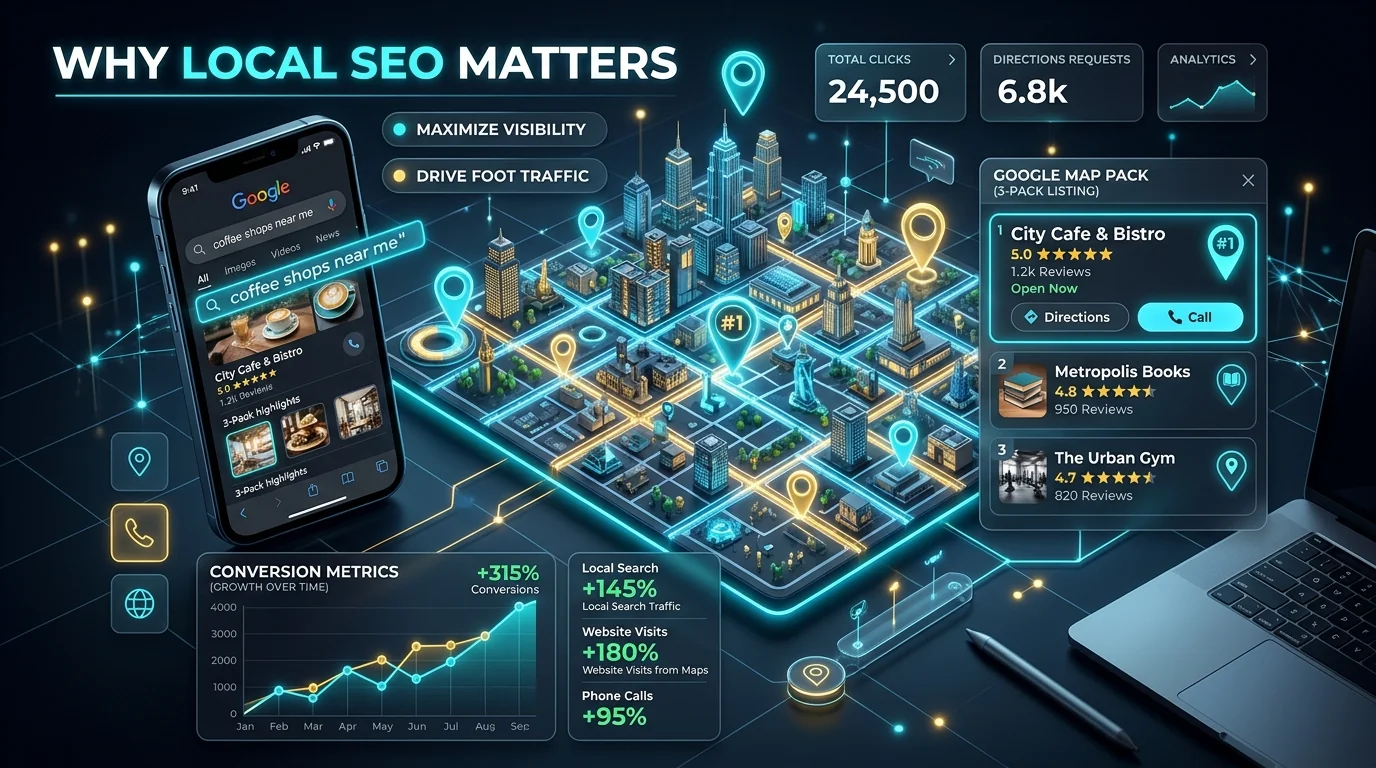
When a consumer in Manchester searches for "commercial litigation solicitor" or a homeowner in Surrey types "emergency boiler repair near me," Google's ranking engine does not evaluate the web using its traditional page-rank algorithms alone. Instead, search results trigger a dedicated, dual-algorithm ecosystem: the Google Local 3-Pack (Map Pack) positioned prominently above the organic web results, backed by Google's specialized local neural matching systems.
For regional enterprises, multi-location franchises, and service-area providers, understanding what affects local SEO is not merely an academic exercise—it is the direct catalyst for phone call inquiries, showroom visits, and high-margin contracted revenue. While traditional organic SEO prizes nationwide topical depth and global backlink profiles, local SEO hinges on an intricate matrix of geographic proximity, verified entity authority, consumer sentiment signals, and real-time operational availability.
Yet, most digital guides covering this topic stop at elementary advice: "claim your Google Business Profile and gather a few 5-star reviews." That superficial advice is why countless businesses remain stuck on page two of Google Maps while their rivals capture 80% of local market share. In this definitive technical breakdown, our senior strategists examine the empirical weighting models, geo-grid proximity decay curves, and natural language processing (NLP) algorithms that genuinely dictate local ranking performance in 2026.
Key Takeaways: What Truly Moves the Needle in Local SEO
- The Dominant Ranking Pillar (32% Weight): Your primary Google Business Profile category remains the single most powerful individual ranking lever in Google's Local Pack algorithm.
- The Proximity Decay Filter: Google applies strict distance radius boundaries based on user GPS coordinates; physical distance acts as an initial filter before prominence signals are computed.
- NLP Review Sentiment: Star ratings alone do not suffice. Google's algorithms parse the actual semantic nouns and phrases in customer reviews to award rich SERP review justifications.
- The "Open Hours" Algorithm Demotion: Google actively suppresses businesses marked as closed during the exact hours a transactional query occurs.
- Zero-Click Dominance: With over 60% of local interactions concluding inside the SERP (calls, directions, bookings), profile optimization directly impacts conversion before site clicks take place.
1. The Foundation: Google's Local Ranking Triad
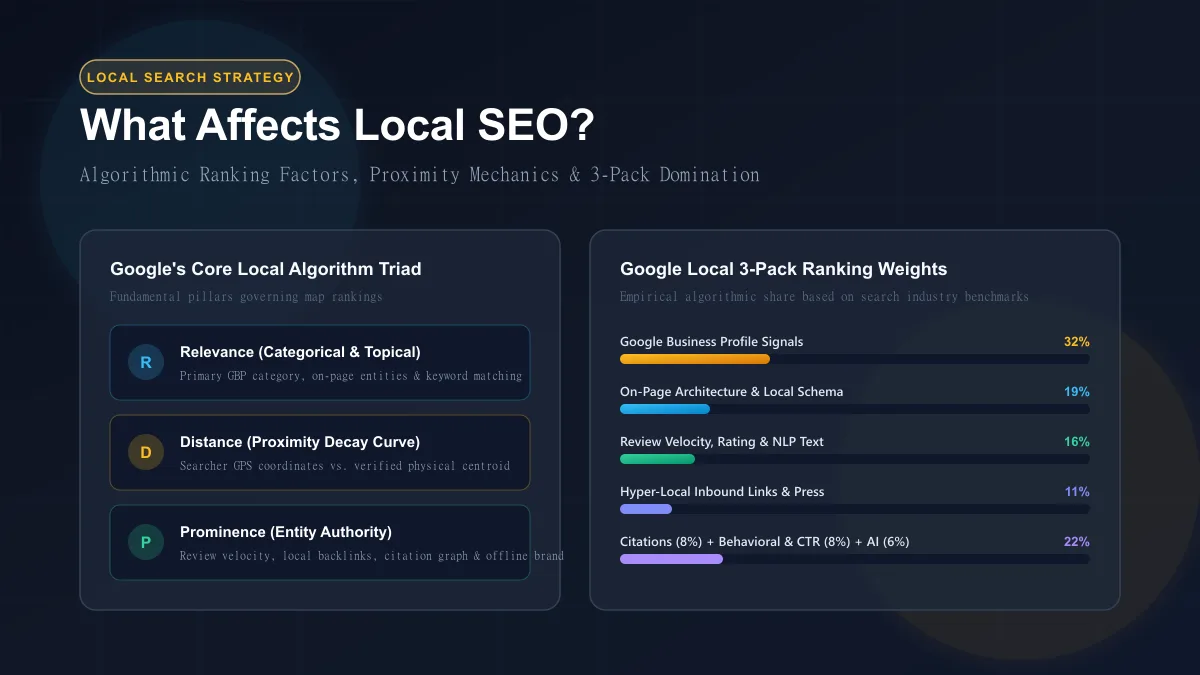
According to official documentation directly provided in the Google Business Profile Help Guidelines, Google calculates local rankings based on three foundational dimensions:
- Relevance: How accurately a business's local entity matches the user's explicit or implicit search query. Relevance is established through primary/secondary GBP categories, on-page topical architecture, and localized content semantics.
- Distance (Proximity): The calculated geographic span between the searcher's physical GPS location (or the location term specified in their query) and the verified physical address of the enterprise.
- Prominence: How well-known, established, and reputable the business is across the digital ecosystem. Prominence reflects offline brand authority, review volume and velocity, directory citations, local news coverage, and backlink equity.
While Google acknowledges these three pillars, it intentionally conceals the exact mathematical weighting assigned to each factor. However, extensive cross-industry statistical analyses—such as the annual research conducted by Whitespark's Local Search Ranking Factors—reveal clear empirical distributions that distinguish Local Pack winners from losers.
2. Empirical Breakdown: What Factors Affect Local SEO Rankings?
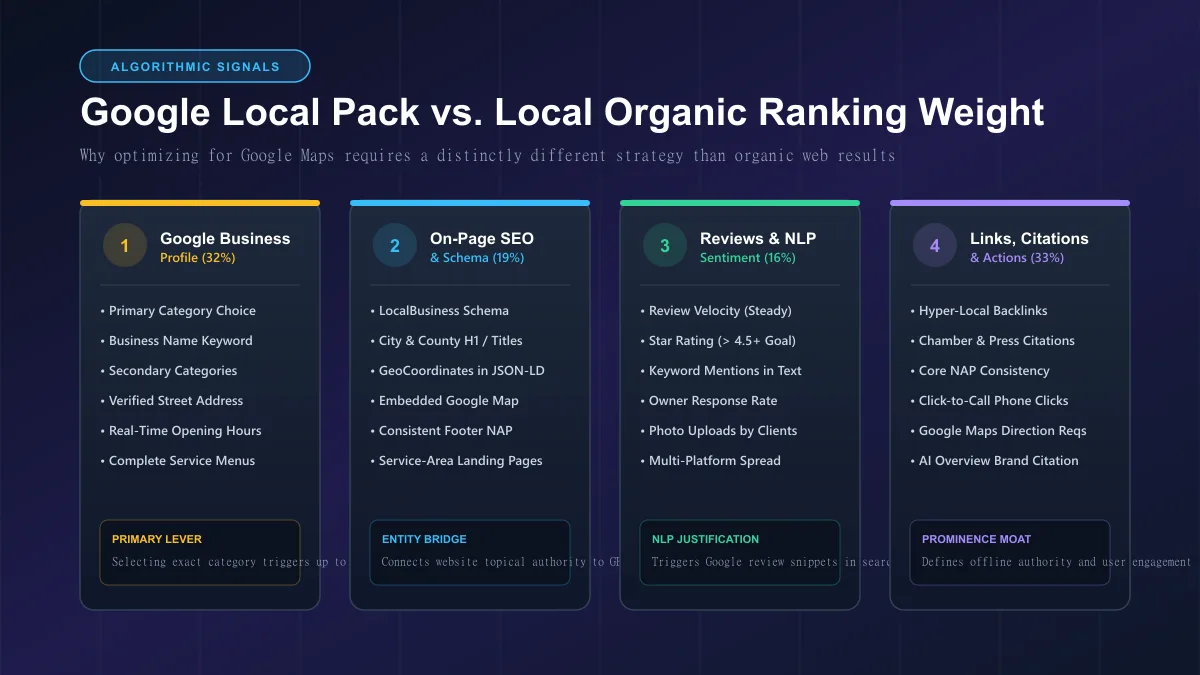
It is critical to distinguish between Google Local 3-Pack factors (which govern who appears in the map box) and Localized Organic factors (which determine the traditional organic links beneath the map). While the two interact symbiotically, they are evaluated by distinct algorithmic pipelines:
As the data confirms, if you optimize your website purely for traditional organic ranking signals—such as backlink volume and long-form content—you may rank in the organic listings below the fold, while failing completely to penetrate the 3-Pack where over 70% of local search clicks concentrate. Let us examine each ranking factor in granular detail.
3. Factor 1: Google Business Profile (GBP) Signals
Your Google Business Profile serves as the direct digital representation of your physical business entity in Google Maps. It contributes over one-third of total ranking weight in local pack retrieval. Within your GBP configuration, several sub-factors govern your visibility:
A. Primary Category Precision
Your primary business category is arguably the single most impactful lever in local SEO. Selecting "Heating Contractor" vs. "Plumber" vs. "HVAC Contractor" tells Google's entity graph your core service specialty. If a business selects an overly broad or misaligned primary category, its ability to rank for high-intent search terms drops instantaneously by up to 80%. When executing our professional local SEO services, our team conducts competitive category reverse-engineering across top-ranking competitors in your exact service coordinates before selecting your primary taxonomy.
B. Business Name & Title Keywords
Algorithmic tests consistently verify that having your primary keyword or geographic city in your official Google Business Profile title produces significant ranking lift. However, this has spurred widespread abusive keyword stuffing (e.g., changing "Smith & Co" to "Smith & Co - Best Emergency Plumber London Cheap 24/7"). While keyword inclusion moves the needle, Google actively penalizes and suspends profiles violating its Name Guidelines. The sustainable competitive edge lies in legally registering a branded DBA (Doing Business As) or ensuring your signage and official documentation reflect your targeted entity structure legitimately.
C. Real-Time Operational Hours (The "Open Now" Factor)
In late 2023 and heavily reinforced throughout 2024 to 2026, Google rolled out a crucial local algorithm update: operational status ranking demotion. When a consumer searches for a service, Google heavily demotes businesses marked as closed at that precise time stamp. For instance, if an emergency drainage contractor has their GBP hours set to 9:00 AM – 5:00 PM, their local pack visibility plummets to near zero at 7:30 PM, ceding the entire local 3-Pack to competitors configured with verified 24/7 emergency availability.
D. Service Menus, Attributes, and High-Resolution Visuals
Google rewards complete profile hygiene. Populating granular service items with explicit pricing, completing business attributes (e.g., "wheelchair accessible," "identifies as veteran-owned," "free estimates"), and routinely uploading geotagged, real-world photography reinforces listing engagement. As verified by Google's consumer behavioral tracking, listings with high-resolution imagery receive 42% more requests for driving directions and 35% more website clicks than bare profiles.
4. Factor 2: Proximity & The Geo-Grid Distance Decay Curve
Distance is the most immutable constraint in local search. Google's algorithm creates a centroid—the exact latitude and longitude of your business—and calculates ranking strength outward in concentric circles. As the physical distance between the searcher's smartphone GPS coordinates and your business address increases, your ranking experiences an exponential proximity decay curve.
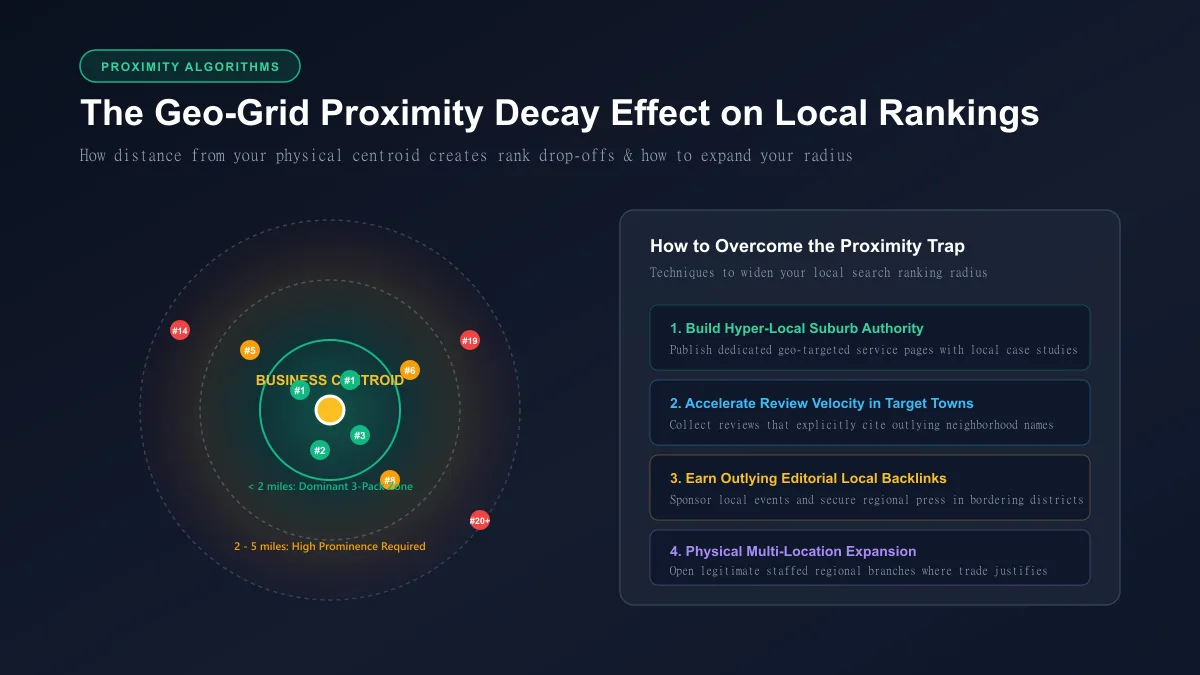
A company may rank in the #1 position when a user stands 300 meters away from the office, drop to #4 at 2.5 miles, and disappear past #20 at 6 miles out. Competitors frequently mistake this drop-off for a penalty, when in reality it is simply Google's proximity bias protecting local convenience for users.
How to Legitimate Expand Your Proximity Radius
While you cannot move your building without changing premises, you can dramatically expand your ranking radius from 2 miles to 8–15 miles by systematically elevating your Prominence signals:
- Suburb & District Landing Pages: Do not rely on a generic homepage. Build robust, dedicated neighborhood service pages that combine hyper-local case studies, client reviews from that specific postcode, and localized driving landmarks. Explore our strategic framework in our guide to multi-location local SEO architecture.
- Localized Review Gathering: Encourage satisfied customers living in bordering towns to mention their neighborhood name in their written review (e.g., "Replaced our boiler in Altrincham quickly and professionally"). Google's neural matching parses these geographic entities to expand your geo-grid ranking boundary.
- Outlying Local Editorial Citations: Secure digital PR and sponsorships in neighbouring borough publications, business networks, and charitable drives.
- Multi-Location Expansion: For scaling enterprises where proximity decay limits commercial capture, the ultimate competitive moat is establishing compliant, fully staffed physical branch locations in high-value territory pockets. Review our real-world transformation in the Local HVAC & Plumbing Case Study.
5. Factor 3: Review Velocity, Sentiment & NLP Justifications
Reviews represent 16% to 18% of the local ranking algorithm, but consumer review optimization has evolved far beyond raw 5-star averages. According to comprehensive market research by BrightLocal's Consumer Review Study, over 87% of consumers evaluate reviews before contacting a local provider, and Google's algorithms now mirror this human scrutiny.
Google utilizes advanced natural language processing (NLP) to parse review content across four vital dimensions:
- Review Velocity (Cadence): A steady, sustained trickle of 4 to 8 authentic reviews per month is exponentially more authoritative than receiving 50 reviews in a single weekend followed by four months of radio silence. Unnatural bursts trigger Google's spam detection algorithms and risk review filter purges.
- Keyword & Entity Mentions: When past clients explicitly write terms like "commercial lease agreement," "underfloor heating installation," or "transparent fixed pricing," Google indexes these phrases. This directly triggers SERP review justifications—bolded callout snippets beneath your map listing stating: "Mentions: underfloor heating installation."
- Numerical Thresholds: Maintaining an aggregate score above 4.5 stars is critical. Listings below 4.0 stars suffer algorithmic suppression and massive drop-offs in organic click-through rate (CTR).
- Owner Response Rate & Response Speed: Google explicitly tracks whether and how quickly business owners respond to reviews. Prompt, thoughtful responses that incorporate natural conversational context reinforce entity activity and consumer trust.
6. Factor 4: On-Page Architecture & Hyper-Local Schema
Your website is the foundational entity that Google Business Profile links to. A poorly structured, slow, or semantically deficient website caps your local pack rankings, regardless of profile completeness. To maximize local organic and 3-pack performance, your website must deploy specialized on-page technical mechanics:
A. LocalBusiness JSON-LD Structured Data
Standard WebSite or Organization schema is insufficient for localized rankings. Implementing nested LocalBusiness schema—or specialized sub-types such as LegalService, HVACBusiness, MedicalBusiness, or PlumbingContractor—explicitly disambiguates your entity in Google's Knowledge Graph according to official Schema.org LocalBusiness standards.
Enterprise LocalBusiness Schema Architecture (JSON-LD)
{
  "@context": "https://schema.org",
  "@type": "PlumbingContractor",
  "@id": "https://www.example.com/#business",
  "name": "Apex Commercial Plumbing Services",
  "url": "https://www.example.com/",
  "telephone": "+44-161-555-0199",
  "priceRange": "$$",
  "address": {
    "@type": "PostalAddress",
    "streetAddress": "45 Deansgate",
    "addressLocality": "Manchester",
    "postalCode": "M3 2AY",
    "addressCountry": "GB"
  },
  "geo": {
    "@type": "GeoCoordinates",
    "latitude": 53.483959,
    "longitude": -2.244644
  },
  "openingHoursSpecification": [
    {
      "@type": "OpeningHoursSpecification",
      "dayOfWeek": ["Monday", "Tuesday", "Wednesday", "Thursday", "Friday"],
      "opens": "08:00",
      "closes": "18:00"
    }
  ],
  "sameAs": [
    "https://www.facebook.com/apexplumbing",
    "https://www.linkedin.com/company/apex-plumbing",
    "https://find-and-update.company-information.service.gov.uk/company/12345678"
  ]
}
B. NAP Uniformity Across Footers and Contact Pages
Your company Name, physical Street Address, and local Telephone Number (NAP) must appear in exact, machine-readable HTML text across your site footer and contact page. Using a dynamic phone number that replaces your local landline with a generic call tracking number can dilute NAP consistency unless integrated with proper DNI (Dynamic Number Insertion) that preserves underlying schema code. For full optimization protocols, utilize our step-by-step On-Page SEO Checklist.
C. Technical Core Web Vitals & Mobile Experience
According to landmark behavioral data published by Think with Google, 76% of mobile users who conduct a local search visit a physical location within 24 hours. If your website takes four seconds to load on mobile, suffers from Cumulative Layout Shift (CLS), or features intrusive modal pop-ups, users immediately bounce back to Google Maps. This behavioral dissatisfaction signals algorithmic unreliability to Google. Maintaining stellar performance requires enterprise technical SEO services and pristine SEO website design architecture.
7. Factor 5: Inbound Local Link Building & Citation Authority
Backlinks in local SEO fulfill a very different function than in global campaigns. While a high-Domain-Rating link from a generic US blog provides minimal geographic relevance, a link from a regional chamber of commerce or a nearby charity website serves as an indisputable geographic endorsement.
The Three Tiers of High-Impact Local Links
- Tier 1: Hyper-Local Editorial & Civic Entities: Links from local town councils (.gov.uk), regional newspapers, educational institutions (.ac.uk), and local business chambers (e.g., Manchester Chamber of Commerce). These pass immense localized prominence.
- Tier 2: Trade & Industry Vertical Links: Authoritative links from national trade federations, licensed contractor registries, and professional associations (e.g., Law Society, Gas Safe Register, Checkatrade). These validate topical expertise.
- Tier 3: Structured Core Citations: Listings on primary data aggregators (Data Axle, Neustar Localeze, Factual/Foursquare) and authoritative foundational directories (Yell, Thomson Local, Scoot, Apple Maps, Bing Places). Ensure 100% NAP parity to prevent entity fragmentation.
To build an authoritative off-page moat without triggering link spam penalties, explore our dedicated off-page SEO services and read our analysis on how to avoid and recover from Google penalties.
8. Factor 6: Behavioral Signals & Zero-Click Conversion Funnels
Google does not rely exclusively on static data; its ranking algorithms incorporate real-world user engagement metrics to evaluate whether a ranked listing satisfies search intent. These behavioral signals include:
- Click-to-Call (CTC) Frequency: The percentage of mobile searchers who tap the primary phone icon to speak directly with your office.
- Driving Direction Requests: How many consumers tap "Directions" in Google Maps and subsequently navigate to your coordinates. Google cross-references physical GPS arrival data to confirm that actual foot traffic occurred.
- Website Click-Through Rate (CTR): The proportion of impressions that result in a visit to your dedicated service page.
- Profile Dwell Time & Interaction Depth: How long users spend reading your reviews, examining photo galleries, browsing product menus, and messaging your profile. High dwell time indicates a high-utility local entity.
Because over 60% of local search queries culminate in zero-click conversions—where the customer takes immediate action directly on the search results page without ever landing on your website—treating your Google Business Profile as an interactive conversion landing page is mandatory.
9. Factor 7: AI Search, Google AI Overviews & Local GEO in 2026
The rise of generative AI search—specifically Google's Gemini-powered AI Overviews and conversational search agents—has introduced a transformative seventh factor to local discovery. When users input conversational local queries like "Find me a reliable, family-run boiler specialist in south Manchester with transparent weekend rates," AI engines do not merely list three nearby addresses.
Instead, Google's AI models synthesize real-time data from multiple sources: GBP attributes, customer review sentiment clusters, schema markup, and third-party mentions across local press. To secure inclusion in AI Overviews, businesses must adopt Generative Engine Optimization (GEO). Learn how our agency engineers AI-ready digital footprints through specialized GEO, LLM & AI SEO services.
10. The 6 Critical Mistakes That Destroy Local SEO Rankings
Achieving top local 3-pack visibility requires knowing what works—and avoiding the common traps that trigger algorithmic demotion or manual suspensions. In our audits of multi-location and regional companies, these six errors consistently destroy local visibility:
- Virtual Office & P.O. Box Spam: Attempting to expand geographic reach by renting unstaffed virtual addresses (such as Regus mailboxes or co-working desks without dedicated physical signage and permanent staff). Google actively suspends profiles caught using unverified virtual offices via mandatory video verification audits.
- Duplicate Google Business Profiles: Creating multiple profiles for the same physical location or overlapping service categories fragments review equity and triggers automated suppression.
- Neglected or Inconsistent NAP Data: Showing one phone number on your website, a second number on Yell, and an outdated former address on Apple Maps confuses Google's entity disambiguation systems.
- Aggressive Keyword Stuffing in Business Name: Appending city names or service keywords not legally registered on your corporate registry invites competitor spam redressal complaints and profile suspension.
- Ignoring Customer Reviews & Negative Feedback: Leaving customer grievances unaddressed signals operational abandonment. Furthermore, failing to systematically ask satisfied clients for feedback causes review velocity to stall, allowing rivals to surpass you.
- Thin, Templated Location Doorway Pages: Creating 50 city pages that duplicate identical content with only the city name swapped out triggers Google's Spam Policies. Every location page must feature unique case studies, localized testimonials, genuine team imagery, and distinct value propositions.
11. Actionable 2026 Local SEO Optimization Checklist
To ensure your local search infrastructure maximizes every ranking signal, implement this prioritized strategic checklist:
The Senior Strategist's Local SEO Execution Framework
- Audit Primary & Secondary Categories: Review top 3 ranking competitors; align your primary category to target your highest-margin commercial service.
- Verify Operational Hours: Set accurate real-time hours, special holiday schedules, and 24/7 service declarations if applicable to avoid off-hours suppression.
- Deploy LocalBusiness Schema: Embed JSON-LD structured data with precise geo-coordinates, telephone, full address, and sameAs social verification links.
- Implement a Systematic Review Flywheel: Send automated SMS/email review requests within 2 hours of job completion; guide clients to mention specific services and suburbs.
- Respond to 100% of Reviews: Reply within 24 hours, integrating natural service references into your gratitude notes.
- Standardize Core Aggregator Citations: Audit Data Axle, Localeze, Yell, Thomson Local, Apple Maps, and Bing Places for absolute NAP consistency.
- Develop Hyper-Local Suburb Hubs: Build unique, high-utility landing pages for key secondary trading postcodes within your operational radius.
- Earn Local Community Backlinks: Sponsor local sports clubs, partner with regional trade schools, and issue local human-interest press releases.