Every single day, hundreds of millions of consumers pull out their smartphones and run high-intent commercial queries: "emergency dental clinic near me," "commercial litigation solicitor in Manchester," or "top-rated HVAC contractor open now." In that split second, search engines do not deliver a generic list of national websites. Instead, Google's algorithms dynamically construct a hyper-localized digital storefront—the Google Local 3-Pack and Google Maps interface—determining which local enterprises win qualified customer phone calls and which vanish into digital obscurity.
If you are a business owner, commercial director, or marketing executive wondering why local SEO matters, the answer boils down to an inescapable reality: local search is the highest-converting digital acquisition channel in modern commerce. Unlike broad informational searches, local intent represents immediate buyer readiness. Customers searching for nearby solutions are not casually browsing; they are holding their payment cards, standing in your trade radius, and actively choosing where to spend their money within hours.
In this comprehensive, research-backed framework, our senior strategists examine the empirical data, algorithmic mechanics, and commercial economics behind local search. We dissect why traditional SEO alone leaves local money on the table, explore how AI search is transforming local discovery, and provide an actionable roadmap to establish an uncontested digital moat in your market.
Executive Summary: The Hard Facts Behind Local Search
- 76% Same-Day Visits: According to empirical research by Think with Google, 76% of consumers who conduct a local search on their mobile device visit a physical business within 24 hours.
- 28% Conversion to Purchase: More than 1 in 4 of those localized searches culminate in an immediate in-store purchase or signed service contract.
- 46% Total Google Volume: Nearly half of the 8.5+ billion daily searches on Google exhibit distinct geographic and localized intent.
- Zero-Click Dominance: Over 60% of local search journeys conclude directly in the SERP via tap-to-call, navigation requests, or booking widgets without ever visiting an external website.
1. The Shift in Consumer Behavior: Why Proximity Dictates Revenue
To understand why local SEO matters, one must first recognize how radically consumer search habits have shifted over the last five years. Mobile computing, geolocation tracking, and real-time navigation have eliminated the friction of local commerce. Consumers no longer search the Yellow Pages, consult local newspapers, or navigate through multiple directory pages. They demand hyper-relevant, immediately actionable solutions at the exact moment their problem arises.
When a homeowner experiences a burst pipe at 9:00 PM on a Tuesday, they do not read an exhaustive 5,000-word historical essay on plumbing architecture. They search "emergency plumber" and immediately evaluate the top three results showcased in Google's Local Map Pack based on three critical heuristics:
- Proximity & Speed: How close is the business to their current geolocation coordinates, and are they open right now?
- Entity Credibility: Does the business have an aggregate star rating of 4.5 or higher with verified recent customer testimonials?
- Frictionless Contact: Can they tap a single button to initiate a phone call or route navigation directly through Google Maps?
Without specialized local SEO services, even companies with exceptional physical services remain algorithmically invisible to consumers standing less than two miles away.
2. Local SEO vs. Traditional Organic SEO: Key Algorithmic Differences
A persistent misconception among corporate marketing executives is assuming that strong national organic search rankings automatically translate into local market dominance. In reality, traditional organic SEO and local search engine optimization operate on two fundamentally distinct algorithmic ecosystems.
This dichotomy creates an unprecedented market opportunity. A regional specialist with a focused, localized strategy can consistently outposition multibillion-pound conglomerate domains because Google's local algorithm prioritizes geographic relevance and physical proximity over sheer domain age or national backlink scale. Combining targeted local optimization with fundamental on-page SEO strategies and robust technical SEO architecture ensures complete search engine alignment.
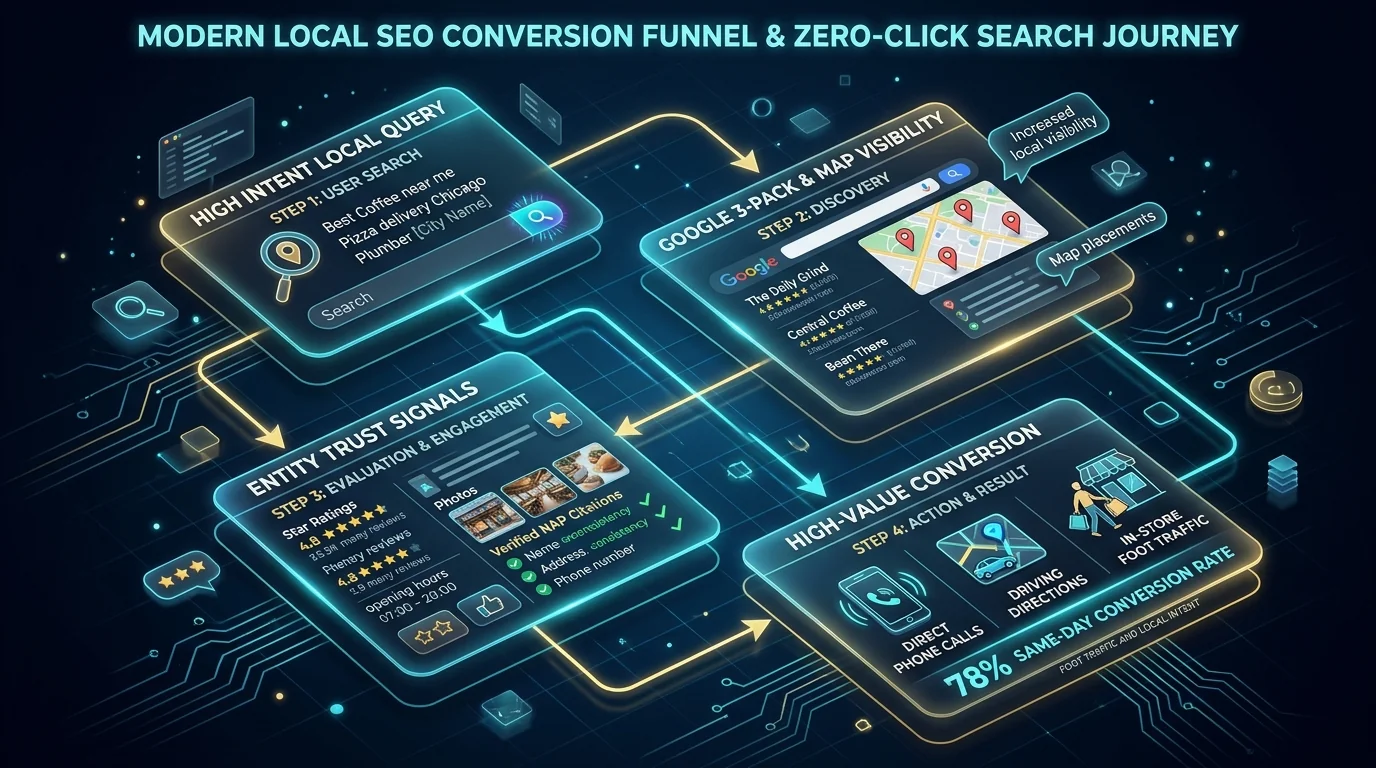
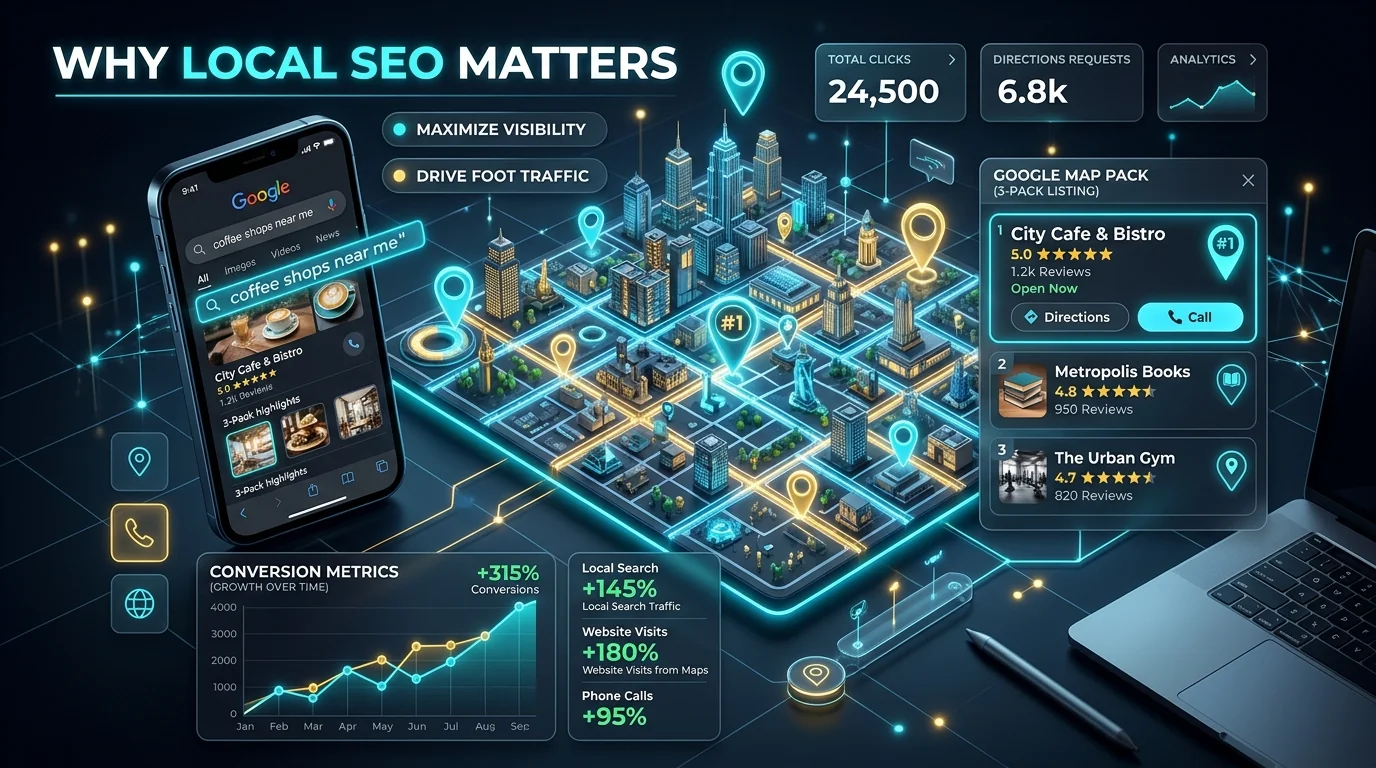
Figure 1: The Modern Local SEO Conversion Funnel illustrating the rapid transition from high-intent local query to direct zero-click offline revenue.
3. The Zero-Click Phenomenon and High-Intent Conversions
One of the most consequential trends reshaping search marketing is the rise of the Zero-Click Search. According to multiple search intelligence studies, more than 60% of mobile searches conclude without the searcher ever navigating away from Google's native interface. In traditional SEO, a zero-click query is often viewed as a lost traffic opportunity. In local SEO, however, a zero-click search is frequently the conversion itself.
Consider how prospects interact with a fully optimized Google Business Profile:
- Direct Click-to-Call: Searchers tap the phone icon on mobile to book an appointment immediately, without navigating to an about page or contact form.
- Driving Directions Requests: Consumers tap "Directions" to populate Apple Maps or Google Maps, initiating a physical visit to your office, clinic, or showroom.
- In-SERP Booking & Menus: Native reservation integrations allow consumers to schedule consultations, reserve tables, or purchase service packages directly within the search ecosystem.
- Instant Trust Validation: Browsing recent customer photo uploads, star ratings, and owner responses provides complete buying confidence in seconds.
When you evaluate local search through the lens of client acquisition cost (CAC), local SEO delivers unmatched capital efficiency. By capturing users at the absolute bottom of the consideration funnel, local optimization generates commercial revenue at a fraction of the cost per lead associated with hyper-competitive Google Ads or pay-per-click bidding wars.
4. How the Google Local 3-Pack Algorithm Actually Works
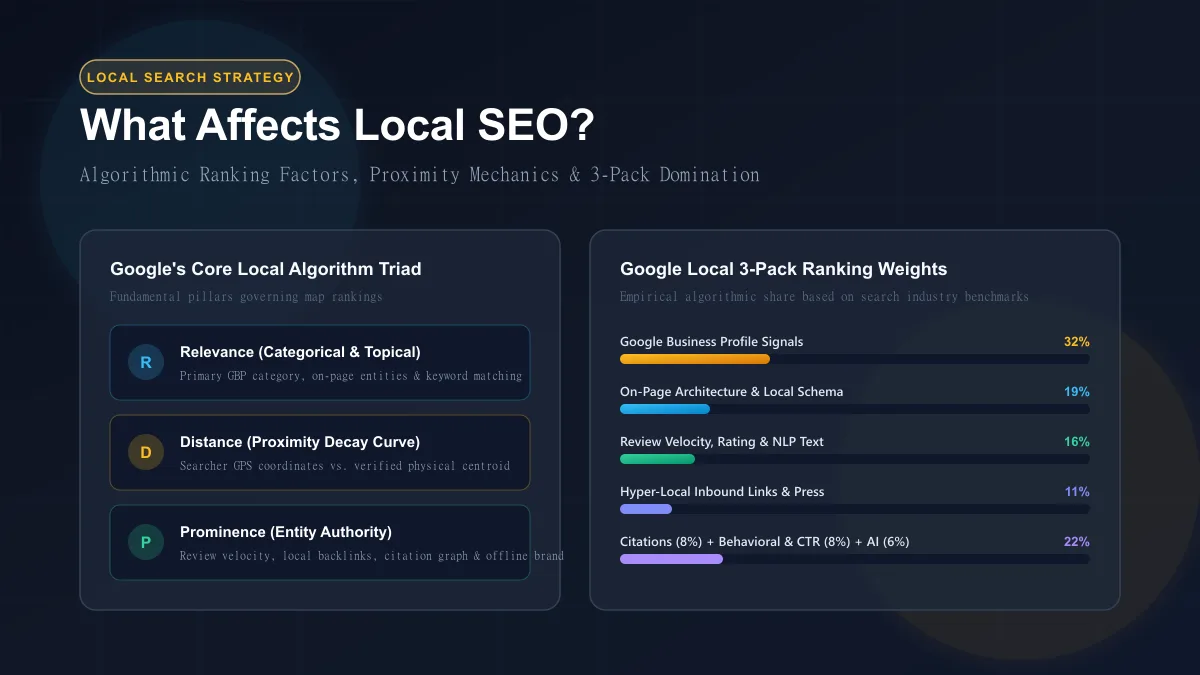
To secure top rankings in the coveted Local 3-Pack, businesses must align with the exact mathematical variables search engines use to calculate local authority. According to the authoritative annual Whitespark Local Search Ranking Factors study, Google's local algorithm evaluates listings across three foundational pillars: Relevance, Distance, and Prominence.
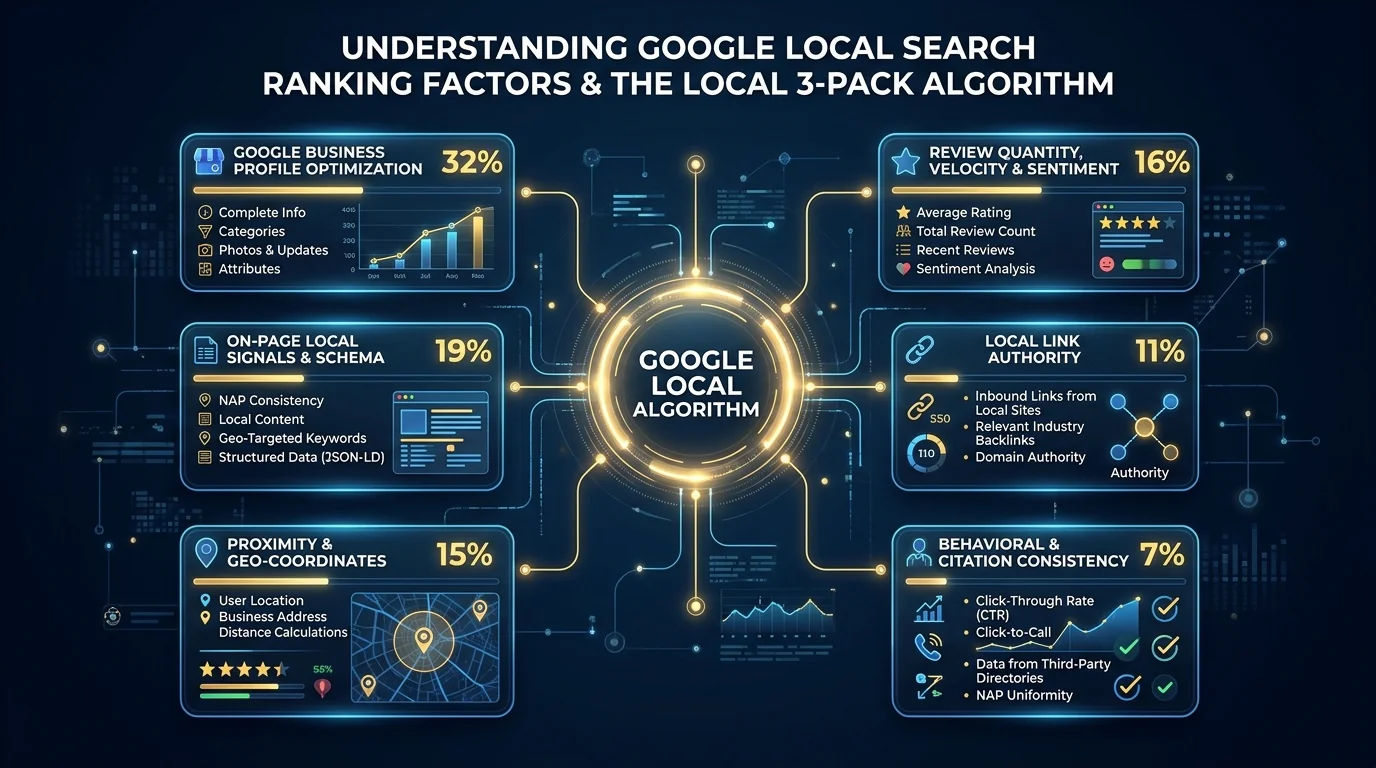
Figure 2: Empirical weighting of Google Local Search Ranking Factors showing the dominance of Google Business Profile signals, on-page schema, and review velocity.
Pillar 1: Relevance (Category Taxonomy & Semantic Entities)
Relevance measures how precisely your business entity matches the searcher's query. The single most heavily weighted factor in Google's entire local algorithm is your Primary Business Category on your Google Business Profile. Selecting an inaccurate or overly generic category handicaps your ranking potential before optimization even begins. Furthermore, secondary categories, service listings, on-page localized content, and structured Schema.org markup reinforce semantic entity relevance to search engines.
Pillar 2: Distance (Algorithmic Proximity & Geo-Coordinates)
Distance calculates the physical space between the user's GPS coordinates (or the geographic term in their query, such as "in Leeds") and the verified address of the business. While you cannot physically relocate your building closer to every prospect, advanced geo-grid optimization, localized landing pages, and regional internal linking networks help extend your ranking radius outward into adjacent suburbs and commercial districts. For businesses expanding across regional markets, our strategic guide to local SEO for multi-location businesses details how to manage regional footprint expansion at scale.
Pillar 3: Prominence (Review Velocity, Citations & Link Authority)
Prominence reflects how established and authoritative your business is within both the physical community and the digital knowledge graph. Search engines calculate prominence through:
- Review Signals: Review count, aggregate star rating, review velocity (the frequency of new reviews), and the presence of natural service terminology within customer review text.
- Citation Consistency: Absolute Name, Address, and Phone Number (NAP) synchronization across authoritative directories (Yelp, Apple Maps, Bing Places, YellowPages, Chamber of Commerce).
- Local Link Ecosystem: Backlinks from regional newspapers, municipal bodies, local business associations, and civic sponsorships that validate geographic presence.
5. The Economic Impact: Real Data on ROI and Customer Acquisition Cost
When evaluating digital marketing investments, chief financial officers and managing partners prioritize unit economics: What does it cost to acquire a client, and what is the lifetime value of that acquisition? When contrasted with paid advertising, local SEO provides durable compounding enterprise value.
Consider the following empirical research benchmarks:
- 87% Consumer Review Reliance: According to the comprehensive BrightLocal Consumer Review Survey, 87% of consumers read online reviews for local businesses before making a purchase decision. Moreover, 79% trust online customer reviews as much as personal recommendations from friends or family members.
- The 4.2-Star Threshold: Research shows that consumers actively filter out local businesses with an aggregate rating below 4.0 stars, with 4.2 stars representing the minimum psychological baseline for high-ticket service transactions.
- PPC Cost Reduction: Businesses that simultaneously rank in the Local 3-Pack and the top organic results can strategically lower their Google Ads bidding budgets on branded and high-intent local keywords, drastically reducing overall blend acquisition costs.
- Compounding Longevity: Paid Google Ads disappear the exact second your daily credit card budget exhausts. A well-optimized local organic footprint, verified citation graph, and pristine review portfolio continue generating high-value inbound calls month after month with zero incremental ad spend.
"Local SEO is not an optional marketing expense; it is a permanent digital asset that establishes geographic monopoly power over your immediate trade territory."
6. The 6-Pillar Framework for Local SEO Dominance
Dominating local search results requires moving beyond haphazard, ad-hoc listing updates. Industry leaders execute an engineered operating framework structured across six core execution disciplines:
Pillar 1: Google Business Profile (GBP) Perfection
Claiming, fully verifying, and rigorously maintaining your Google Business Profile according to official Google Business Profile Guidelines. This includes deploying exact primary categories, filling out 100% of available secondary attributes, adding high-resolution geotagged photographic assets weekly, keeping store hours accurate down to holiday schedules, and utilizing native Google Updates to publish offers and events.
Pillar 2: Hyper-Local Keyword & Intent Architecture
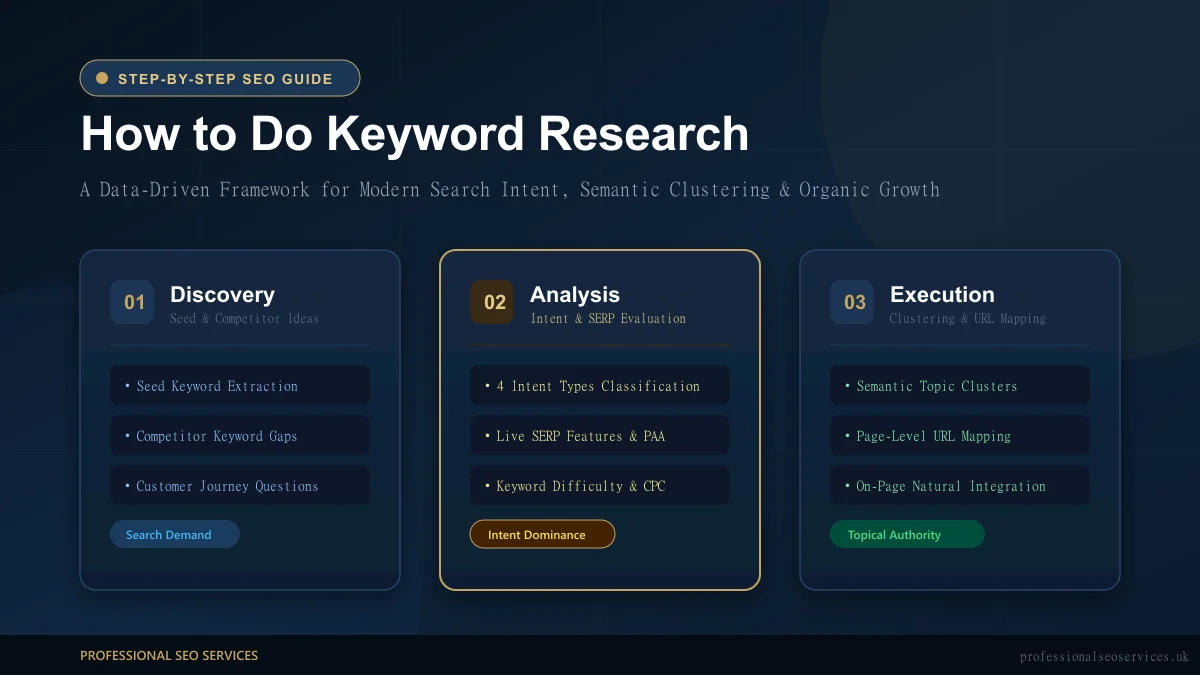
Structuring content around real local conversational search queries. Rather than optimizing exclusively for generic head terms, businesses must conduct granular discovery using modern methodologies. Explore our step-by-step blueprint on how to do keyword research to map hyper-local modifiers, service combinations, and regional vernacular.
Pillar 3: On-Page Local Landing Page Engineering
Developing dedicated, high-converting location landing pages that satisfy search engine algorithms and human visitors alike. Each landing page must feature:
- Embedded interactive Google Maps with driving direction context.
- Localized customer testimonials and neighborhood-specific case studies.
- Comprehensive JSON-LD structured data using specific subtypes (e.g.,
LegalService,MedicalClinic, orHVACBusiness) specifying exact geographic latitude and longitude coordinates. - Consistent NAP details in the footer and main body copy.
Pillar 4: Systematized Review Velocity Workflows
Passive businesses wait for customers to leave reviews; market leaders systematize review acquisition. Implementing automated post-service SMS and email workflows that trigger 2 to 4 hours after service completion directing satisfied customers directly to your GBP short-URL. Furthermore, managing partners must enforce 100% review response rates, replying professionally to both praise and critique within 24 to 48 hours while naturally incorporating service terminology.
Pillar 5: Citation Hygiene & Data Aggregator Cleansing
Enforcing absolute NAP synchronization across core tier-one data aggregators (Data Axle, Neustar Localeze, Foursquare) and premier directories (Apple Business Connect, Bing Places, Yelp). Eliminating orphan duplicate listings and suppressing legacy telephone numbers prevents algorithmic confusion across the local knowledge graph.
Pillar 6: Geo-Grid Heatmap Rank Tracking
Standard rank trackers report a single arbitrary ranking position for an entire city. However, because Google's local algorithm is hypersensitive to physical distance, your business might rank #1 directly outside your front door but drop to #12 just three miles down the road. Deploying geo-grid tracking visualizes rank decay across coordinate heatmaps, enabling precise localized link acquisition and content targeting.
7. The Future of Local Search: AI Overviews, LLMs, and Voice Search
As search engines evolve into conversational generative answer engines, the mechanics of local visibility are undergoing profound transformation. With the rollout of Google's AI Overviews, Gemini integration in Google Maps, and Apple Intelligence, the boundaries between local search and GEO, LLM & AI SEO are dissolving.
When an executive asks an AI voice assistant or conversational agent: "Find the most experienced commercial conveyancing solicitor in Birmingham that can handle a multi-million-pound industrial acquisition this month," the AI does not simply read off web links. It synthesizes entity data, semantic citations, review sentiment analysis, and structured schema to recommend verified authorities. Businesses with ambiguous location data, neglected profiles, or poor sentiment graphs are completely excluded from AI-generated recommendations.
Investing in comprehensive local SEO today is not merely about preserving your current Google Maps rankings; it is about future-proofing your business to remain visible in the era of generative AI discovery.
Frequently Asked Questions About Local SEO
Conclusion: Turning Local Proximity into Compounding Revenue
Why local SEO matters is not a theoretical marketing debate; it is an operational imperative proven by consumer psychology, economic returns, and algorithmic reality. Every day your business remains unoptimized in Google's Local Map Pack, qualified regional customers in your trade radius are seamlessly redirected into the open arms of your direct competitors.
By pairing rigorous Google Business Profile management with structured local schema, systematized review acquisition, and authoritative citation hygiene, your organization can capture bottom-of-funnel commercial demand and establish an unassailable geographic digital moat.
If your enterprise is ready to dominate regional SERPs, eliminate citation fragmentation, and turn local search into your most profitable revenue engine, partner with our senior search consultants. Explore our tailored Professional SEO Services or schedule a comprehensive audit today.