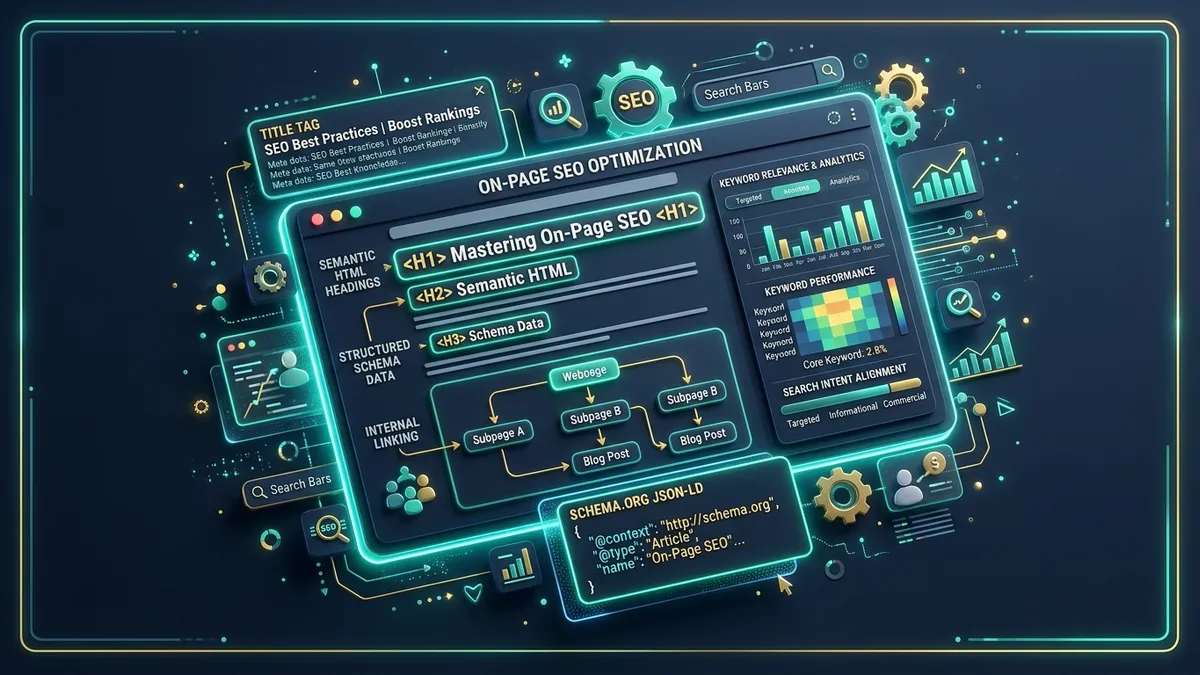
SEO website design is the rigorous engineering discipline of constructing, structuring, and coding a website so that search engine crawlers and generative AI answer engines can frictionlessly discover, render, index, and interpret every page, while simultaneously guiding human visitors through an intuitive, lightning-fast conversion journey.
In the United Kingdom’s fiercely competitive commercial landscape, businesses regularly invest £10,000 to £50,000+ with traditional design agencies for a visually stunning digital presence. Yet months later, the boardroom is bewildered: organic traffic has evaporated, bounce rates are escalating, and lucrative commercial queries are dominated by rivals. The explanation is simple: traditional graphic designers design for visual admiration; SEO website architects design for discoverability, machine comprehension, and commercial transactions.
Building a website without a foundational search strategy is the equivalent of opening a luxury flagship boutique in an underground bunker with no street signs or road access. In this definitive guide, we peel back the curtain on how senior practitioners at Professional SEO Services engineer high-ranking, high-converting digital platforms across London, Manchester, Birmingham, and throughout the UK.
The Costly Disconnect: Graphic Design vs. SEO Architecture
To grasp why so many corporate redesigns suffer traffic collapses of 40% to 70%, one must examine the fundamentally opposing priorities that guide typical web design teams versus senior SEO strategists:
| Design Dimension | Traditional Web Designer Approach | Senior SEO Web Architect Approach |
|---|---|---|
| Primary Goal | Visual aesthetics, motion graphics & brand novelty | Organic visibility, search intent fulfilment & revenue generation |
| Site Architecture | Shallow visual minimalism; hiding pages inside JS drawers | Flat hierarchy (<3 clicks), topical clustering & crawl efficiency |
| HTML & Headings | H1-H4 chosen strictly based on font size or styling aesthetics | Strict semantic DOM hierarchy communicating topical taxonomy |
| JavaScript & Media | Heavy client-side rendering (CSR), 4MB video backgrounds, raw PNGs | Server-Side Rendering (SSR), next-gen WebP <100KB, sub-second LCP |
| URL & Navigation | Arbitrary URL rewrites, fragmented routing, zero redirect planning | 1-to-1 301 migration maps, canonical integrity & breadcrumb trails |
According to research from Ofcom’s UK Online Nation Reports, over 82% of UK adults use smartphones as their primary device for accessing the web, conducting commercial inquiries, and ordering services. When web design decisions overlook mobile rendering efficiency and Google’s strict Mobile-First Indexing standards, brand visibility suffers immediate penalties.
The Semantic Web Framework: Entities, Attributes, Values & Triples
Search in 2026 is no longer governed by archaic keyword density formulas. Modern search engines like Google and Bing, alongside AI Retrieval-Augmented Generation (RAG) engines, perceive your website through Knowledge Graphs and Semantic Web Entities.
When we design an SEO-driven website, we model every page around clear Entity-Attribute-Value (EAV) frameworks and contextual Semantic Triples. This structural discipline ensures search bots understand not merely what words exist on your page, but the precise, disambiguated meaning of your business proposition.
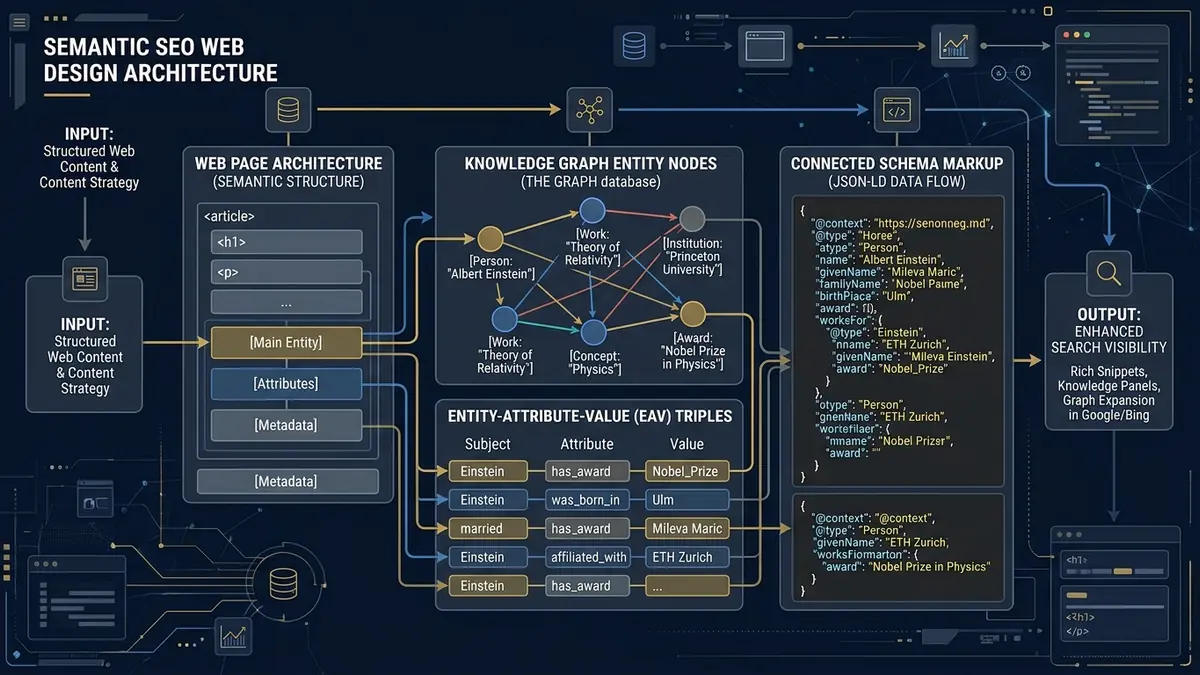
Entity-Attribute-Value (EAV) Modeling in SEO Web Design
In computer science and semantic search, an Entity is a distinct, uniquely identifiable concept, person, organisation, or object (e.g., Professional SEO Services or Core Web Vitals). An Attribute represents a property, feature, or characteristic belonging to that entity. The Value is the specific measurement or data assigned to that attribute.
Here is how senior search architects structure core web design components into explicit EAV models:
| Entity (Subject) | Attribute (Property) | Value (Measurement / Data) | Web Design Context & Implementation |
|---|---|---|---|
| Googlebot | Rendering Engine | Headless Chromium | Requires server-side rendered HTML; critical DOM text cannot hide behind click events. |
| Largest Contentful Paint (LCP) | Target Threshold | ≤ 2.5 seconds | Hero images preloaded with fetchpriority="high"; WebP compression under 100 KB. |
| Interaction to Next Paint (INP) | Interaction Responsiveness | ≤ 200 milliseconds | Eliminating long JavaScript tasks; offloading heavy computation from UI thread. |
| Cumulative Layout Shift (CLS) | Visual Stability Score | ≤ 0.1 | Explicit width and height dimension attributes on all images, iframes, and dynamic banners. |
| Information Architecture | Maximum Click Depth | ≤ 3 clicks from Home | Flat hierarchical directory structure conserving crawl budget and distributing PageRank. |
| Structured Data | Syntax Standard | JSON-LD (Schema.org) | Explicitly declares Organization, LocalBusiness, BreadcrumbList, WebSite, and FAQPage. |
Semantic Triples in SEO Web Design
In semantic graph theory, a Semantic Triple forms the foundational atomic statement of knowledge: [Subject] → [Predicate] → [Object]. Search engines use these triples to build knowledge graph relationships between entities across the global web.
When crafting content and code for an SEO-optimised web design, every key section must reinforce factual semantic triples:
- Triple 1:
[SEO Website Design]→ [accelerates] →[Search Engine Discovery & Crawling Efficiency].
Context: Clean semantic HTML and flat directory paths allow Googlebot to index deeper pages without depleting allocated crawl budgets. For deeper insights on how spiders process URLs, read our complete guide on how Google SEO works. - Triple 2:
[Information Architecture]→ [governs] →[Internal PageRank Distribution].
Context: The logical structuring of categories, silos, and breadcrumbs funnels equity from authoritative top-level pages directly into conversion-focused commercial landing pages. - Triple 3:
[Core Web Vitals Compliance]→ [satisfies] →[Google Page Experience Ranking Signals].
Context: Sub-2.5s LCP, sub-200ms INP, and zero layout shift signal friction-free usability, directly influencing mobile rankings as verified by Web.dev’s Core Web Vitals documentation. - Triple 4:
[JSON-LD Schema Markup]→ [disambiguates] →[Knowledge Graph Entity Association].
Context: Embedding structured data according to Schema.org specifications proves to algorithms whether "Apple" refers to the fruit or the multi-trillion-pound tech corporation. - Triple 5:
[Mobile-Responsive Web Design]→ [converts] →[UK Commercial Organic Search Traffic].
Context: Designing touch-optimised interfaces with minimum 48px touch targets directly boosts transaction rates on UK commercial queries.
The 7 Pillars of High-Performance SEO Website Design
Achieving sustained dominance in Google UK search results demands executing seven interrelated pillars of technical design and structural SEO:
1. Information Architecture (IA) & Logical Topical Siloing
Information Architecture is the structural skeleton of your website. A flawed architecture creates orphan pages, dilutes PageRank, and traps search crawlers in infinite loops.
In professional web design, we establish a flat taxonomy where no key landing page is more than three clicks away from the homepage:
└── /services/ (Depth 1: Category Hub)
│ └── /services/technical-seo/ (Depth 2: Sub-Service Pillar)
│ └── /services/ecommerce-seo/ (Depth 2: Sub-Service Pillar)
└── /blog/ (Depth 1: Editorial Hub)
└── /blog/seo-website-design/ (Depth 2: Comprehensive Cluster Guide)
This layout guarantees that search engines immediately recognise which pages represent top-level topic authorities. Learn more about engineering topic hubs in our comprehensive masterclass on content strategy and topical authority.
2. Core Web Vitals & Technical Speed Engineering
In 2026, page load speed is no longer just a superficial "nice-to-have"—it is a confirmed algorithmic ranking factor across mobile and desktop SERPs. Designing with speed in mind means making performance decisions at the design stage, not retrofitting speed patches onto a sluggish, bloated template.
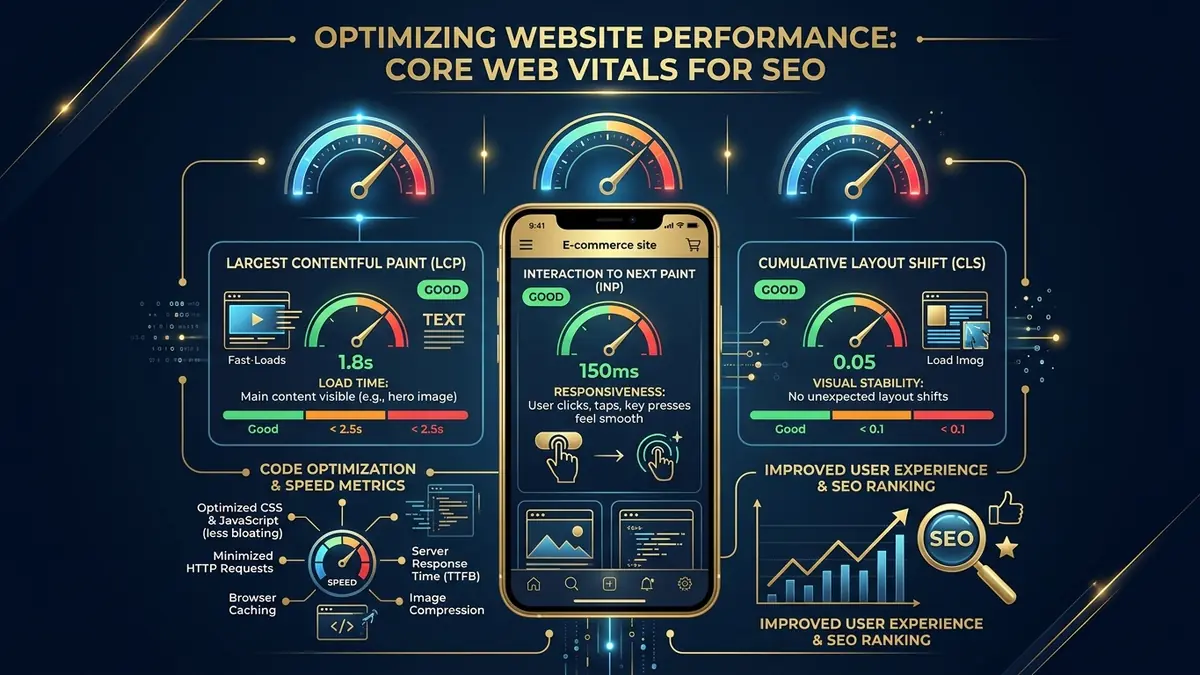
To pass the 75th percentile of real-user Chrome User Experience Report (CrUX) field data in the UK, your design must enforce:
- Largest Contentful Paint (LCP < 2.5s): Never place uncompressed video banners or oversized slider plugins above the fold. Compress hero graphics using modern WebP formats under 100 KB and assign
fetchpriority="high". - Interaction to Next Paint (INP < 200ms): Avoid heavy third-party tracking scripts, bloated slider carousels, or complex DOM recalculations that lock up the browser's main thread when users tap or click.
- Cumulative Layout Shift (CLS < 0.1): Reserve explicit layout dimensions (width and height attributes) on every image, SVG, video player, and ad container so content never shifts abruptly as assets load.
For complete code examples and server-level diagnostics, inspect our in-depth Technical SEO services and our dedicated Technical SEO Guide.
3. Mobile-First Indexing & Fluid Responsive UX
Google indexes the web using a mobile smartphone crawler. If a piece of content, internal link, or navigation element is visible on desktop but concealed or stripped away on mobile, Googlebot effectively ignores it.
Furthermore, adhering to the W3C Web Content Accessibility Guidelines (WCAG 2.2) is not just a legal obligation for UK organisations under the Equality Act 2010—it directly correlates with better crawlability. Screen readers and search bots parse the same underlying semantic DOM. Designing with accessible 48px touch targets, readable font contrasts (minimum 4.5:1 ratio), and keyboard navigation creates an impeccable user experience that reduces bounce rates and lifts organic dwell time.
4. Clean Semantic HTML5 & Hierarchical DOM Structuring
Search crawlers do not read CSS styling; they read raw HTML documents. Many CMS themes wrap headers in generic <div class="header-text"> instead of semantic landmark elements.
True SEO website design deploys semantic HTML5 tags:
<header>and<nav>: Explicitly outlines global and secondary navigation systems.<main>: Isolates unique, primary page content from boilerplate navigation and footers.<article>and<section>: Groups topical themes logically.<aside>: Identifies contextual supplementary data without diluting main page intent.<h1> through <h3>: Implements a single descriptive H1 per page, followed by logical H2 subsections and H3 granular points. Never jump from an H2 directly to an H4.
For a granular walkthrough of on-page HTML tag optimisation, reference our practitioner guide to what is on-page SEO.
5. Schema.org Structured Data & Rich Snippets Integration
Structured data markup acts as a digital translator between your website's content and search engine algorithms. By deploying JSON-LD schema into your design templates, you unlock rich SERP features such as star ratings, breadcrumbs, site-links search boxes, and FAQ drop-downs.
Essential schema types to build directly into website design templates include:
- Organization / LocalBusiness: Defines brand name, logo, address, contact points, and official social media entities (
sameAs). - BreadcrumbList: Renders clean breadcrumb trails directly in Google search snippets instead of ugly raw URLs.
- WebSite & SitelinksSearchBox: Enables users to query your internal catalogue straight from Google’s results.
- Product / AggregateRating: Essential for Ecommerce SEO stores displaying live stock status, prices in GBP (£), and genuine customer reviews.
- BlogPosting / Article: Identifies authors, publishers, release dates, and topical entity nodes for editorial content.
6. Strategic Internal Linking & Contextual Equity Funnels
Internal links are the vascular system of your website. They transport PageRank (link equity) across pages and establish topical relationships between interconnected concepts.
In an SEO-first web design, we never rely solely on standard header navigation menus. We engineer:
- Contextual in-body links: Hyperlinking descriptive, keyword-rich anchor text within primary paragraph copy.
- Contextual sidebar / related modules: Dynamic widgets linking to related guides within the same semantic cluster.
- Faceted category breadcrumbs: Enabling users and spiders to ascend or descend the site hierarchy effortlessly.
7. Conversion Rate Optimisation (CRO) & Search Intent Alignment
High search rankings are pointless if incoming visitors fail to convert into paying clients or qualified leads. Every SEO website design must align with user search intent:
- Informational Pages (Blogs/Guides): Clean reading typography, unobtrusive table of contents, downloadable resources, and soft calls to action.
- Commercial / Transactional Pages (Services/Products): Prominent trust badges, transparent UK client testimonials, clear value propositions above the fold, and high-contrast, frictionless contact forms.
The SEO Website Redesign Process: Migrating Without Losing Traffic
A major website redesign is the single most perilous event in a business's digital lifecycle. Without strict SEO oversight, changing page URLs, altering page templates, and reorganising menus will wipe out years of accumulated search authority overnight.
At Professional SEO Services, we protect UK businesses by executing a battle-tested 5-stage migration framework:
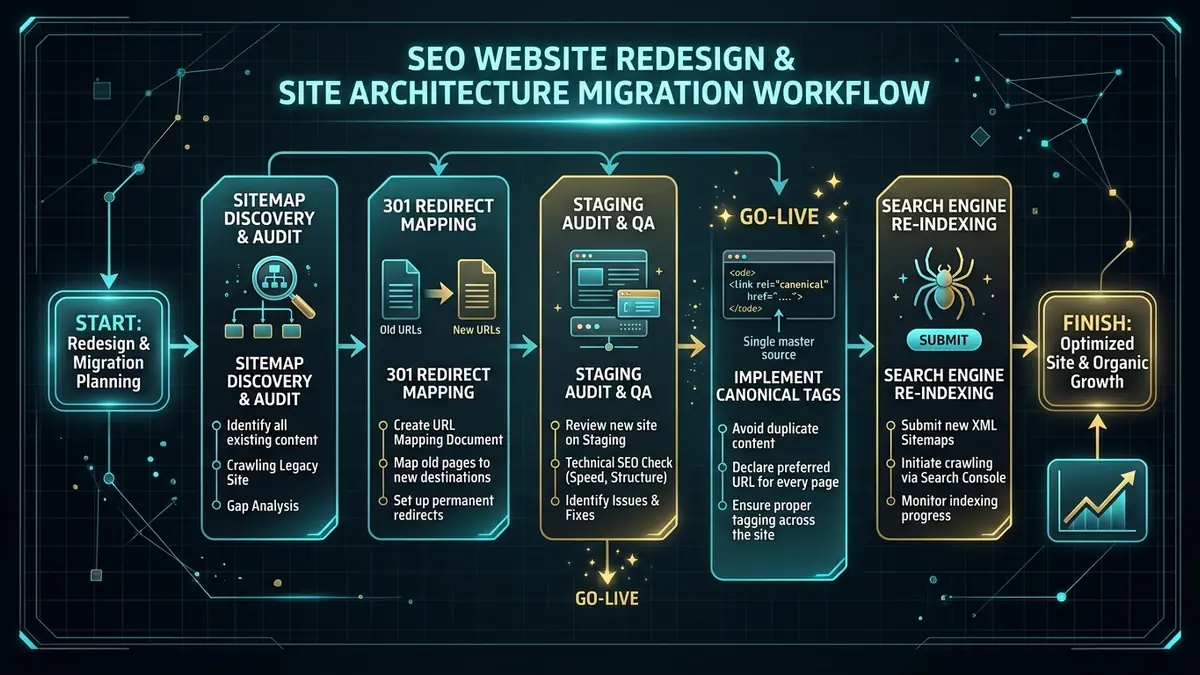
The 5-Stage SEO Redesign Migration Checklist
- Pre-Redesign Crawl & Equity Audit: Crawl the existing live site using Screaming Frog. Catalog all indexed URLs, current ranking keywords, organic traffic volume, and inbound backlinks. Identify legacy top-performing URLs that must be safeguarded at all costs.
- Comprehensive 301 Redirect Mapping: For any URL that changes path (e.g., from
/services/web-design.phpto/services/web-design/), construct a granular 1-to-1 redirect map. Never execute blanket redirects pointing everything to the homepage; Google treats non-relevant redirects as soft 404 errors. - Staging Environment Technical Audit: Password-protect or noindex the staging environment to avoid duplicate content penalties. Audit Core Web Vitals, schema validation, canonical tags, responsive layouts, and internal links before launch.
- Go-Live Day Protocol: Push new design to production, remove noindex directives, verify HTTPS certificates, upload refreshed XML sitemaps to Google Search Console and Bing Webmaster Tools, and test server response codes.
- Post-Launch Telemetry & Log Monitoring: Monitor server log files daily for 404 error spikes, track crawl rate in Search Console, and verify that Googlebot is parsing the new templates smoothly.
SEO Web Design for the UK Market: Regulations & Nuances
Designing for the United Kingdom requires adhering to distinct technical and regulatory considerations:
- UK GDPR & PECR Cookie Compliance: Heavy cookie banner overlays that shift the screen can ruin Cumulative Layout Shift (CLS) scores and irritate mobile users. Use lightweight, asynchronous consent management platforms (CMPs) that load non-intrusively.
- ccTLD vs. gTLD Architecture: A
.co.ukdomain provides automatic geographical geotargeting for UK searchers. If operating on a global.com, implement properhreflang="en-GB"declarations and UK server hosting or CDN edge points (London, Manchester). - British English Localization: Ensure design copy, metadata, and schema reflect British spelling conventions (optimise, customise, specialist) and pricing formatted in GBP (£). Search algorithms evaluate cultural and regional vocabulary when assigning local relevance.
Frequently Asked Questions About SEO Website Design
Here are direct, authoritative answers to the most common queries business owners and marketing directors ask regarding search-optimised web design:
What is SEO website design?
SEO website design is the practice of designing, structuring, and coding a website so that search engines can seamlessly crawl, index, render, and understand its content, while simultaneously delivering an exceptional, high-converting experience for human users.
Why do traditional web design agencies fail at SEO?
Traditional agencies frequently prioritise visual aesthetic novelties—such as heavy client-side JavaScript, uncompressed video backgrounds, and complex navigation menus—over search crawlability, clean semantic HTML5 markup, hierarchical Information Architecture, and Core Web Vitals performance.
How does a website redesign impact existing SEO rankings?
Without an SEO-led migration framework, website redesigns routinely cause catastrophic 30% to 70% drops in organic traffic. This occurs due to unmapped 301 redirects, orphaned URLs, altered URL hierarchies, stripped metadata, modified on-page content, and broken internal linking silos.
What role do semantic entities play in modern web design?
Semantic entities provide machine-readable definitions of real-world concepts, organisations, products, and people. By structuring pages around Entity-Attribute-Value models and implementing JSON-LD schema, search engines and AI generative engines can contextualise your brand without keyword ambiguity.
How much does professional SEO website design cost in the UK?
In the UK, bespoke SEO website design projects typically range from £3,500 to £8,500 for growing SMEs, while comprehensive enterprise or multi-location architectures with custom schema, database migrations, and deep technical audits range between £10,000 and £35,000+.
Which CMS is best for SEO website design?
WordPress (with lightweight builders or headless setups) and Webflow are premier choices for content-driven and B2B websites due to granular control over canonical tags, metadata, clean HTML, and schema. For ecommerce in the UK, Shopify, WooCommerce, and Magento lead when paired with technical speed optimisation.
Conclusion: Building for Search and Conversion
A modern website is your company’s premier commercial asset. Treating SEO as an afterthought to be applied weeks after a site is launched is a recipe for wasted budgets and lost market share. By baking semantic entity models, robust technical architecture, Core Web Vitals speed, and intentional UX conversion funnels into the design blueprint from day one, your website becomes an unstoppable organic revenue engine.
Whether you are architecting a new web platform from scratch or planning a critical website redesign, ensure your digital foundation is guided by seasoned search architects.