Bottom Line Up Front (BLUF): Yes, paying a qualified SEO company is definitively worth the investment for established businesses with demonstrated product-market fit, an average customer lifetime value (LTV) exceeding £1,000, and commercial organic search volume. Across commercial sectors, senior-led SEO partnerships yield an average Return on Investment (ROI) of 275% to 702% over a 12-to-36-month horizon while lowering blended Customer Acquisition Costs (CAC) by 40% to 60%. Conversely, paying an SEO company is a guaranteed financial loss if your organization lacks a 6-month capital runway, engages low-cost "spam" retainers below £1,000 per month, or sells novel commodities devoid of existing search demand.
Every executive board and marketing director eventually confronts the same critical capital-allocation question: is it worth paying a seo company when paid ad networks provide instant traffic, or should internal teams manage search optimization in-house? The dilemma stems from the inherent nature of organic search: SEO requires upfront capital expenditure months before revenue materializes, and the market is crowded with low-cost vendors promising overnight rankings through opaque, outdated tactics.
To answer this question with institutional rigor, business leaders cannot rely on vanity metrics like raw impression volume or arbitrary keyword counts. You must evaluate an SEO agency through corporate finance fundamentals: net present value of organic traffic, payback period velocity, CAC stabilization, and sustainable enterprise equity. Partnering with a premier agency such as Professional SEO Services transforms search optimization from a speculative marketing expense into a predictable, balance-sheet-strengthening customer acquisition channel.
Table of Contents
- 1. The Direct Answer: When Paying an SEO Company Is (and Isn't) Worth It
- 2. The Financial Mathematics: Measuring SEO Agency ROI, CAC, and Payback Velocity
- 3. How Much Does It Cost to Hire an SEO Company in 2026? Pricing Models Explained
- 4. SEO Agency vs. In-House Hire vs. Freelance Consultant: Total Cost of Ownership
- 5. The 7-Step Due Diligence Framework: How to Vet and Select an SEO Company
- 6. What to Expect Month-by-Month: The 12-Month SEO Agency Roadmap
- 7. The Modern Search Landscape: How AI Overviews and LLMs Shift Agency Value
- 8. Frequently Asked Questions About Paying an SEO Company
- 9. Final Verdict: Is Paying an SEO Company Worth the Investment for Your Business?
1. The Direct Answer: When Paying an SEO Company Is (and Isn't) Worth It
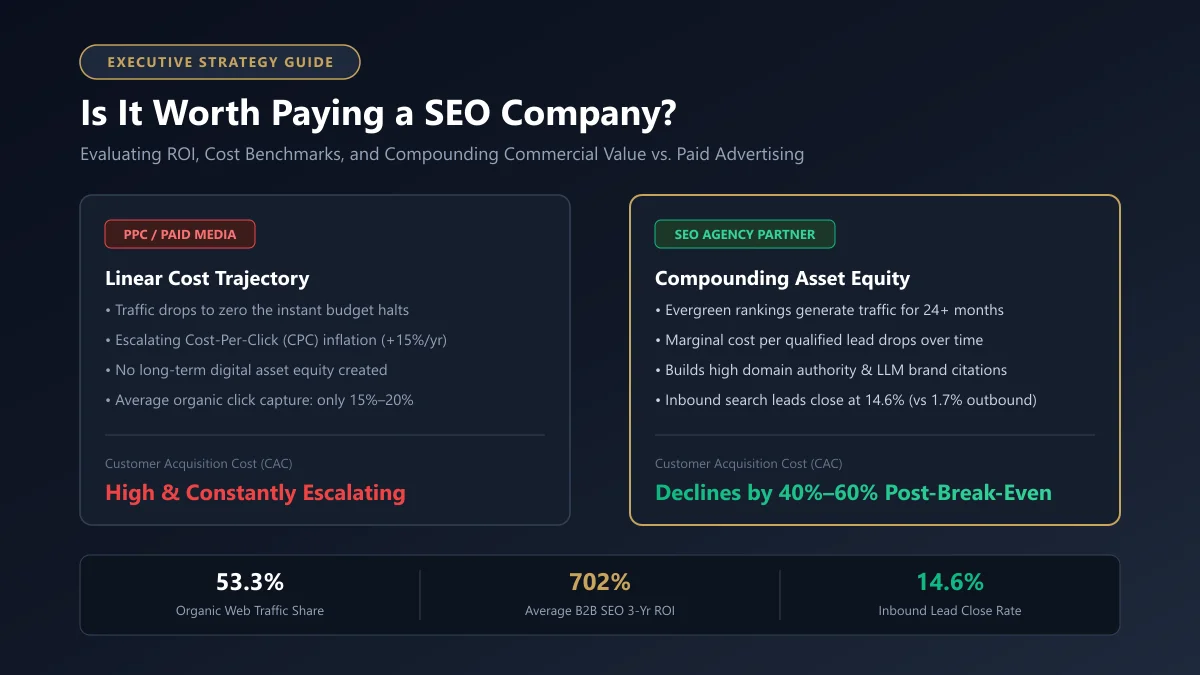
Paying an SEO company is worth it when your business generates at least £300,000 to £500,000 in annual revenue, operates in a sector where prospective clients actively search for solutions online, and maintains sufficient gross margin to absorb a 6-to-12-month compounding growth cycle. Primary market research published by BrightEdge's Organic Search Benchmark Study proves that organic search commands 53.3% of all trackable digital traffic across industries, driving over 40% of total revenue for established B2B and e-commerce enterprises.
The primary reason companies experience disparate outcomes when paying an SEO agency lies in alignment. SEO is not a magic wand that creates market demand from scratch; it is an amplification engine that captures existing search intent with maximum efficiency. Below are the definitive business attributes that dictate whether an agency partnership will generate multimillion-pound pipeline expansion or become a stranded cost.
The Positive Viability Criteria: When the Investment Generates Predictable Returns
An SEO agency investment generates predictable, high-multiple returns when your commercial economics satisfy three structural pillars: high unit economics, demonstrated commercial search volume, and website technical readiness.
- High Customer Lifetime Value (LTV): If an average closed client generates £3,000 to £50,000+ in lifetime contract value (e.g., enterprise SaaS, commercial construction, specialized legal services, medical practices, or bespoke manufacturing), an agency retainer of £2,500/month only needs to generate 1 to 2 incremental closed deals per quarter to produce quadruple-digit net ROI.
- Proven Market Demand & Search Volume: Prospective customers must be actively typing problem-aware, solution-aware, and transactional queries into Google and Bing (e.g., "commercial refrigeration repair London" or "B2B payroll compliance software").
- Scalable Sales Infrastructure: Your organization must possess a functional sales funnel capable of converting inbound leads. If your sales cycle cannot nurture organic prospects, increased search traffic will not translate into balance-sheet revenue.
- Commitment to Long-Term Digital Equity: Unlike paid advertising—where traffic abruptly ceases the microsecond ad spend stops—organic search equity functions as a capital asset. Rankings achieved in year one continue yielding qualified leads throughout years two and three without incremental cost per click.
The Negative Disqualification Scenarios: When Agency SEO Becomes a Sunk Cost
Hiring an SEO company will almost certainly result in negative ROI if your enterprise is an early-stage startup without product-market fit, possesses less than six months of operational capital runway, or operates on razor-thin retail margins with low transactional volume.
- Novel Categories with Zero Search Volume: If you are launching a completely novel invention that no human has ever searched for, SEO cannot capture non-existent search volume. You must first invest in category-creation channels such as PR, influencer partnerships, and targeted social media before SEO becomes viable.
- Undercapitalized Cash Flow: If allocating £1,500 to £3,500 per month threatens your company's payroll or solvency within 90 days, you cannot afford professional SEO. Organic momentum requires a minimum 4-to-6-month ramp-up before traffic and revenue inflection occur.
- Low Transaction Value with Minimal Margin: If you sell £15 consumer trinkets with a £2 margin and lack recurring subscription mechanics, the unit economics cannot support a high-caliber agency retainer. High-volume consumer marketplaces require massive scale that typically demands specialized programmatic automation rather than bespoke strategic consulting.
- Purchasing "Cheap" Budget SEO Packages: Businesses spending £300 to £600 per month on offshore "cheap SEO" packages almost universally lose 100% of their capital. These low-cost packages rely on automated spinning, low-tier link farms, and outdated spam tactics that trigger search engine algorithmic suppressions.
2. The Financial Mathematics: Measuring SEO Agency ROI, CAC, and Payback Velocity
Calculating the true financial return of paying an SEO agency requires modeling the net profit derived from organic search revenue against the total cost of the agency engagement over a rolling 12-to-24-month timeline. According to longitudinal enterprise research by FirstPageSage, the average 3-year ROI of a dedicated B2B SEO campaign sits at 702%, with an average break-even payback period achieved between months 7 and 10.
To understand how this economic engine operates, consider the formal ROI formula utilized by corporate finance teams to benchmark SEO against alternative performance marketing investments:
ROI (%) = [ (Total Net Gross Profit from Organic Leads − Total SEO Agency Spend) ÷ Total SEO Agency Spend ] × 100
For example, suppose a mid-market manufacturing enterprise invests £36,000 per year (£3,000 monthly retainer) with a specialized agency. Over the course of 12 months, the agency's dedicated technical SEO services and content architecture generate 14,000 incremental qualified organic visits. With a standard B2B conversion rate of 2.5%, the site captures 350 sales inquiries. With a modest 10% sales closing rate, the company secures 35 new commercial accounts. If the average lifetime gross margin per account is £6,000, total gross profit equals £210,000.
Applying the formula: [ (£210,000 − £36,000) ÷ £36,000 ] × 100 = 483.3% net ROI in Year 1. Furthermore, in Year 2, because those organic rankings remain intact and continue driving organic inquiries with only maintenance optimization required, the effective ROI frequently surpasses 1,000%.
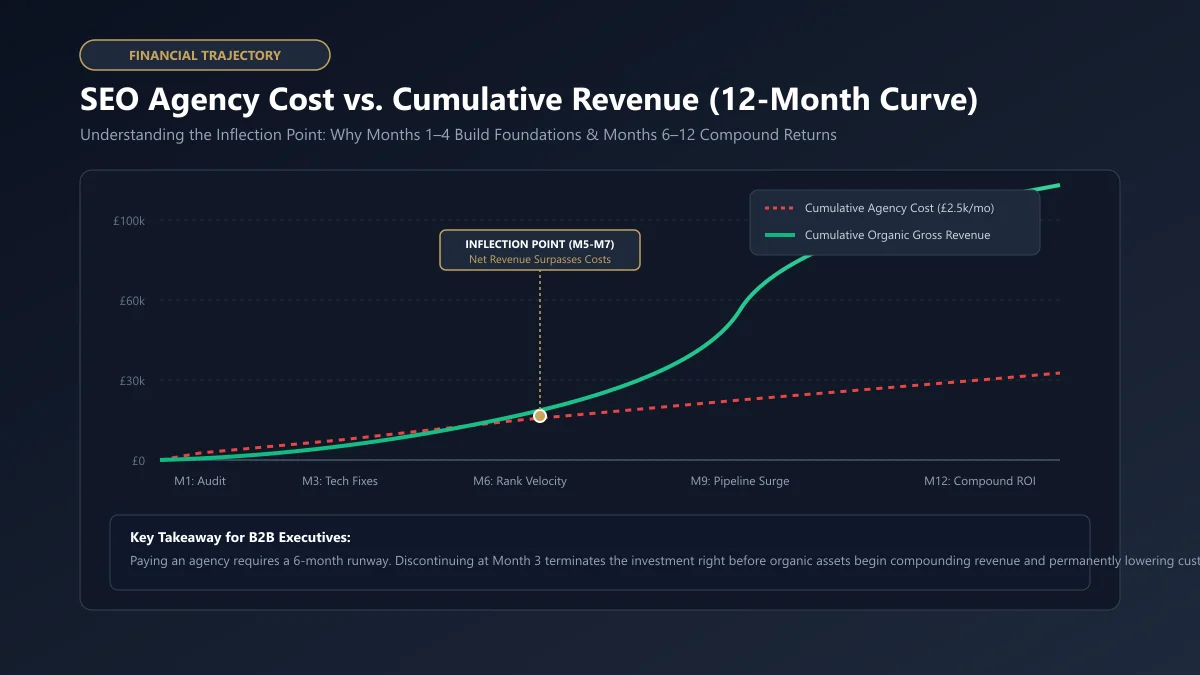
Figure 2: Financial breakdown of average agency retainers (£1,500 to £5,000/month) against cumulative pipeline return and CAC reduction across quarters.
The Compounding Lead Quality Advantage (14.6% vs. 1.7% Close Rates)
Inbound organic search leads close at an average rate of 14.6%, whereas outbound marketing methods (cold outreach, display advertising, interruption marketing) average an anemic 1.7% close rate. This 8.5x closing differential exists because organic search captures prospects experiencing active commercial friction.
When an enterprise buyer searches for a solution on Google, they are actively hunting for a trusted provider to solve an immediate operational pain point. The psychology of search is active problem-solving rather than passive ad tolerance. Consequently, organic prospects spend more time engaging with detailed technical whitepapers, request demos at higher frequencies, and progress through sales qualification pipelines in significantly shorter timeframes.
Organic Traffic Value: Benchmarking Agency Retainers Against PPC Replacement Cost
Organic Traffic Value measures the exact monetary amount your business would have had to pay Google Ads each month to acquire the identical volume of visitors through pay-per-click advertising.
In competitive B2B and professional services sectors—such as commercial law, cyber security, financial services, or industrial logistics—Google Ads Cost-Per-Click (CPC) routinely ranges from £8.00 to £45.00+ per click. If an SEO agency achieves top-3 organic rankings for 50 high-intent transactional keywords that deliver 3,000 targeted clicks per month, acquiring that identical traffic via Google Ads would demand an ongoing advertising budget of £24,000 to £90,000 every single month. An agency retainer of £3,500/month represents an immediate 85% to 95% cash-flow discount relative to paid search equivalent value.
3. How Much Does It Cost to Hire an SEO Company in 2026? Pricing Models Explained
In 2026, reputable professional SEO companies charge between £1,500 and £5,000 ($2,000 to $6,500) per month on a standard retainer model, with specialized enterprise engagements ranging from £6,000 to £15,000+ per month. Comprehensive industry pricing research published in the Ahrefs Global SEO Pricing Survey reveals that 78.2% of reputable agencies operate on monthly retainers, reflecting the continuous, multi-disciplinary nature of modern search optimization.
Understanding where your proposed agency fee falls along the industry pricing spectrum is critical to diagnosing whether you are reviewing a high-impact strategic partner or a low-value commodity vendor:
| Retainer Tier | Monthly Investment | Scope & Deliverables Included | Expected Business Outcome |
|---|---|---|---|
| Budget / Low-End | £300 – £800 / mo | Automated monthly PDF reports, outsourced link directory blasts, generic low-quality AI blog posts. | Zero tangible revenue growth; severe risk of Google algorithm penalties and domain toxicity. |
| Growth / Mid-Market | £1,500 – £3,500 / mo | Full technical audits, code remediation, editorial content strategy, commercial intent landing pages, high-authority digital PR backlinks. | Strong organic traffic expansion, top-3 keyword rankings in regional and national commercial sectors, 3x–6x ROI. |
| Enterprise / High-Competition | £4,000 – £10,000+ / mo | Dedicated squad (Lead Strategist, Technical Architect, Senior Content Writers, PR Outreach Specialists), international SEO, headless CMS architecture, custom LLM vector optimization. | Category dominance across high-competition enterprise queries, millions in trackable pipeline revenue, multi-million organic valuation. |
The Three Common Agency Pricing Models
Agencies deploy three primary contracting structures: ongoing monthly retainers, fixed-scope project audits, and hourly strategic consulting.
- Monthly Retainer (Most Effective for Growth): Retainers align incentives for ongoing compounding progress. Search algorithms update continuously, competitors publish content weekly, and technical debt naturally accumulates as web developers push new code. A continuous retainer ensures agile technical maintenance, steady link acquisition, and proactive content expansion.
- Project-Based Audits (£3,000–£12,000 One-Off): Ideal for enterprise organizations preparing for an upcoming website migration, rebranding, or diagnostic penalty recovery. A comprehensive project audit isolates architectural blockers, canonical errors, and JavaScript rendering bottlenecks for internal engineering teams to execute.
- Hourly Consulting (£125–£350 / hour): Best suited for executive advisory, CMO guidance, in-house team training, or high-level strategic oversight where execution is handled entirely by internal corporate departments.
4. SEO Agency vs. In-House Hire vs. Freelance Consultant: Total Cost of Ownership
Hiring an SEO agency provides approximately three times the specialized competency breadth of an in-house employee at roughly 40% to 50% of the true Total Cost of Ownership (TCO). While business leaders frequently assume an in-house hire offers greater control, financial modeling reveals significant hidden expenses, tool licensing overhead, and high single-point-of-failure risk.
The modern search ecosystem is far too specialized for any single practitioner to master comprehensively. Superior search execution requires five distinct disciplines: technical software engineering, semantic keyword architecture, expert journalistic content creation, high-authority media relations (digital PR), and conversion rate optimization (CRO) analytics.
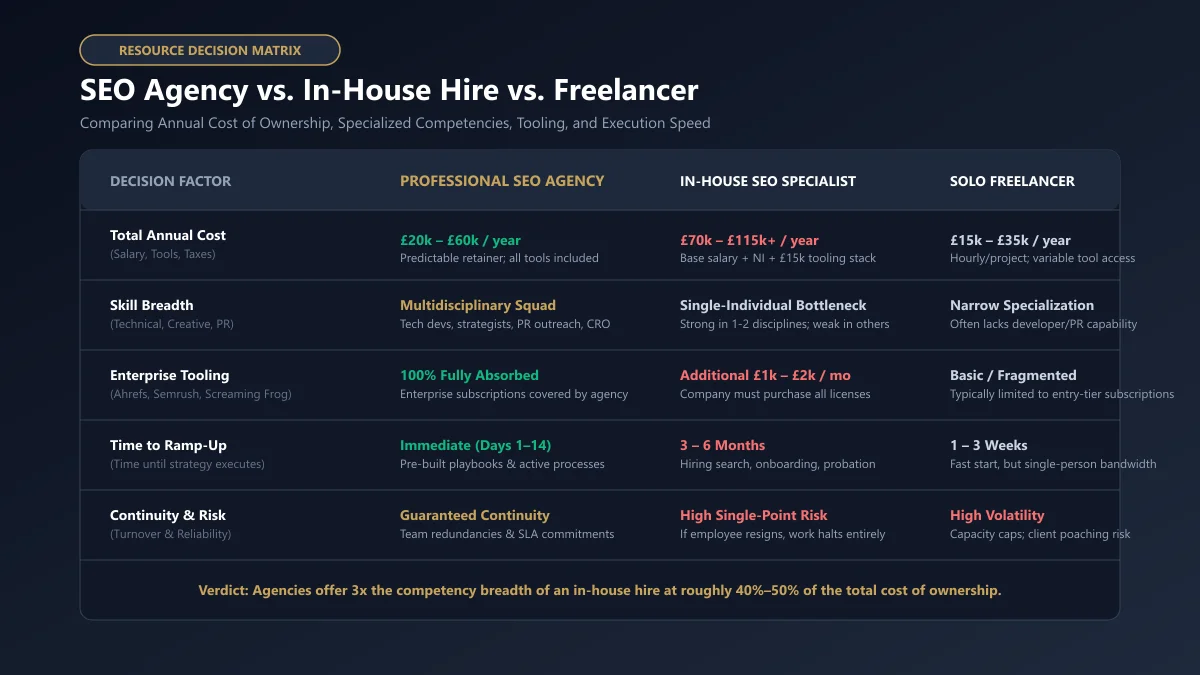
Figure 3: Total Cost of Ownership (TCO) and operational capability matrix: SEO Agency vs In-House Specialist vs Solo Freelance Consultant.
The True Financial Cost of an In-House Specialist
An in-house Senior SEO Manager commands an annual base salary of £55,000 to £80,000 in the UK ($95,000 to $140,000 in the US), resulting in a true fully loaded corporate cost exceeding £85,000 to £115,000+ once mandatory employer taxes, pension contributions, healthcare, and enterprise software licenses are factored in.
Enterprise SEO software is prohibitively expensive for a single company. Professional access to Ahrefs, Semrush, Screaming Frog, Sitebulb, Clearscope, SurferSEO, and enterprise rank trackers easily costs £1,000 to £2,000 every single month (£12,000 to £24,000 annually). Furthermore, if that employee resigns, your corporate search initiatives halt completely during a 3-to-6-month recruitment and onboarding cycle. By contrast, an agency retainer includes all enterprise tool costs, guarantees zero operational downtime, and provides a full squad of senior specialists for £24,000 to £48,000 annually.
The Freelancer Dilemma: Niche Agility vs. Capacity Caps
Freelance SEO consultants offer lower price points (£1,000 to £2,500/month) and direct personal contact, but suffer from strict capacity ceilings and narrow specialization.
A freelancer is typically exceptional at one or two areas—such as keyword research or copywriting—but rarely possesses the full-stack developer capabilities required to resolve complex headless CMS rendering issues, nor do they possess the institutional media relationships required to land high-tier editorial backlinks in publications like Forbes, Reuters, or niche trade journals. Freelancers serve as excellent tactical contributors for small local projects, but medium-to-large enterprises require the cross-functional bandwidth of an agency.
5. The 7-Step Due Diligence Framework: How to Vet and Select an SEO Company
Selecting the wrong SEO agency is the single largest risk factor for business leaders; executing a structured 7-step due diligence process ensures your company partners with a high-integrity, performance-driven firm. Official webmaster documentation from Google Search Central's Guide on Hiring an SEO explicitly warns decision-makers to thoroughly investigate agency track records, reject guarantee-based pitches, and verify technical competencies before signing contractual retainers.
Follow this battle-tested executive vetting scorecard during prospective agency pitch presentations:
- 1. Demand Verifiable, Anonymized Case Studies with Revenue Attribution: Insist on seeing documented proof of ranking growth, organic traffic increases, and revenue generation in competitive niches. Ask the agency to demonstrate how they measured conversion value and navigated major Google core algorithm updates.
- 2. Probe Their Link Acquisition Methodology: Inquire directly: "Exactly how do you acquire backlinks for our website?" If the agency offers vague answers, references "private link networks," or guarantees 50 links per month, walk away immediately. Legitimate agencies acquire links through high-grade digital PR, original research assets, editorial outreach, and thought leadership.
- 3. Evaluate Their Technical Depth and Engineering Fluency: Ask how they diagnose Core Web Vitals, handle JavaScript client-side rendering, configure hreflang for internationalization, and implement complex JSON-LD structured schema. Review our comprehensive breakdown on calculating whether SEO is worth the investment long-term to understand strategic baseline expectations.
- 4. Inspect Contract Flexibility and Break Clauses: High-performing agencies do not need to trap clients in rigid 12-month non-cancelable contracts. Look for 3-to-6-month initial ramp-up agreements followed by rolling monthly retainers with 30-to-60-day notice periods tied to explicit milestone deliverables.
- 5. Clarify Reporting Cadence and KPI Alignment: Confirm that monthly performance reports track business metrics—such as organic pipeline value, assisted conversions, qualified form submissions, and non-brand organic clicks—rather than superficial vanity metrics like gross impression share.
- 6. Audit Seniority of Assigned Account Personnel: Inquire who will actually execute your strategy day-to-day. Many large agencies use senior directors to pitch accounts, then immediately delegate execution to junior interns or offshore contractors. Ensure your account is managed by senior strategists.
- 7. Test Their Perspective on AI Overviews and Modern Search Evolution: Inquire how their search methodology adapts to Google AI Overviews, Large Language Model retrieval, and Generative Engine Optimization (GEO). A modern agency must optimize for entity authority, not just 2015-era keyword density.
🚨 Critical Red Flags That Signal an Unreliable Agency:
• Guaranteed #1 Rankings: Google's search algorithms use over 200 ranking variables; no agency possesses a private relationship with Google or the ability to guarantee specific SERP positions.
• Secret / Proprietary Linking Strategies: Refusal to provide full transparency into published content URLs or earned backlink domains is an immediate indicator of black-hat link farming.
• Ownership Hostage Clauses: Ensure your contract explicitly states that all produced content, technical code, graphics, and analytics data remain 100% property of your business upon termination.
6. What to Expect Month-by-Month: The 12-Month SEO Agency Roadmap
A reputable SEO agency follows a structured 4-phase execution framework spanning 12 months, where technical foundations are cured in Quarter 1, authority accelerates in Quarter 2, and compounding revenue inflection occurs across Quarters 3 and 4. Understanding this chronological trajectory prevents leadership teams from making the fatal mistake of terminating a successful campaign prematurely at Month 3.
Here is what transparent, high-performance agency delivery looks like across each operational milestone:
Months 1–3: Diagnostic Audits, Technical Remediation, and Entity Mapping
The opening 90 days focus on diagnosing architectural roadblocks, fixing indexation bloat, and establishing semantic entity architecture.
Deliverables include comprehensive crawling audits, fixing 404/redirect chains, eliminating keyword cannibalization, optimizing Core Web Vitals (LCP, INP, CLS), and implementing custom JSON-LD schema. Concurrently, the agency conducts exhaustive commercial intent keyword research, mapping target entities to bottom-of-the-funnel commercial landing pages. Review our guide on how to measure SEO performance to track diagnostic progress through Google Search Console indexation health.
Months 4–6: Content Velocity, On-Page Optimization, and Digital PR
During the second quarter, on-page content production scales rapidly, and digital PR campaigns secure authoritative editorial backlinks.
The agency rewrites and optimizes priority commercial pages, develops high-authority topical clusters, and launches targeted PR outreach to industry journalists. Search engines begin recognizing the site's topical authority. Impressions in Google Search Console climb steeply, and target keywords migrate from pages 4–6 onto pages 2–3 of the search results.
Months 7–9: Ranking Velocity, Traffic Inflection, and Lead Acceleration
Months 7 to 9 represent the operational break-even inflection point where target keywords cross into top-3 positions and organic traffic converts into commercial pipeline leads.
High-intent queries achieve Page 1 placement, capturing substantial organic CTRs. Inbound phone calls, demo bookings, and sales requests accelerate. The business begins offsetting monthly agency retainer fees with net-new organic gross profit. The agency shifts focus to conversion rate optimization (CRO) to maximize lead capture from inbound visitors.
Months 10–12+: Compounded Profitability, Moat Building, and Category Dominance
By the conclusion of Year 1, organic search operates as an entrenched competitive moat that produces ongoing, predictable pipeline revenue at drastically reduced CAC.
The campaign achieves full capital payback and enters high-margin compounding territory. The agency expands into long-tail informational clusters, international search targeting, and advanced search experiences, reinforcing brand positioning against competitor counter-attacks.
7. The Modern Search Landscape: How AI Overviews and LLMs Shift Agency Value
The integration of Google AI Overviews and Large Language Models (LLMs) such as ChatGPT and Perplexity increases—rather than diminishes—the necessity of paying a specialized SEO company. AI answer engines do not generate factual knowledge out of thin air; they utilize Retrieval-Augmented Generation (RAG) to scan, extract, and synthesize data from highly authoritative, technically sound, and semantically structured web pages.
Recent data presented in the Search Engine Journal State of SEO Report highlights that businesses investing in Generative Engine Optimization (GEO) earn 3.4x more AI citation references than unoptimized competitor sites. Partnering with a forward-thinking agency that specializes in AI search engine optimization ensures your brand is explicitly cited as the primary recommendation when prospective buyers consult conversational AI tools.
The Three Pillars of AI & Generative Engine Visibility:
- Information Gain & First-Party Research: Google's Helpful Content systems heavily reward original data, proprietary client benchmarks, and unique expert commentary that cannot be synthesized from existing web archives. Agencies produce original thought-leadership assets that establish undeniable E-E-A-T (Experience, Expertise, Authoritativeness, and Trustworthiness).
- Semantic Entity Graph Optimization: Search engines understand concepts as entities (nodes) connected by contextual relationships (edges). Expert agencies structure your digital assets using nested JSON-LD schema, Wikipedia-aligned Wikidata entity definitions, and precise topical maps that make your brand easily interpretable by search crawlers.
- Digital PR & Unlinked Brand Mentions: LLMs determine brand trustworthiness based on consensus across the broader web. High-tier agency digital PR secures authoritative brand citations in leading industry trade publications, validating your authority within training and retrieval corpora.
8. Frequently Asked Questions About Paying an SEO Company
Below are authoritative, direct answers to the most common questions executives and business owners ask when evaluating whether to pay for professional SEO services:
Q: Is it worth paying an SEO company for a small or local business?
Yes, absolutely. For local service companies (such as plumbers, electricians, dental clinics, or accountants), local SEO produces extraordinary ROI. Over 76% of consumers who search for a local service on a smartphone visit a physical business within 24 hours. Ranking in Google's Local Map 3-Pack generates immediate, high-intent local customer phone calls at a fraction of the cost of local print or social ads.
Q: What happens to our rankings if we stop paying an SEO company?
Unlike PPC advertising—where traffic immediately collapses to zero the minute ad spend stops—organic rankings degrade slowly over time. Well-optimized, authoritative evergreen content can maintain top rankings for 6 to 18 months after active agency work ceases. However, competitors continuously publish new content and acquire fresh links; without ongoing maintenance, your positions will gradually erode over subsequent quarters.
Q: Can I do SEO myself instead of paying an agency?
Yes, for basic fundamentals (such as setting up Google Search Console, optimizing title tags, and creating standard business listings). However, scaling organic search requires hundreds of hours of monthly execution across JavaScript auditing, technical server optimization, content architecture, and digital PR link building. For business leaders, diverting executive time away from core operations to learn complex search engineering rarely makes financial sense.
Q: How can I tell if our current SEO company is doing actual work?
Request a transparent monthly deliverables log detailing exact URLs published, code changes deployed, redirects implemented, and specific live backlinks earned. Cross-reference their claims with independent data in your own Google Search Console (checking non-brand organic clicks and indexed pages) rather than relying exclusively on agency-generated PDF summaries.
Q: Is SEO better than paid search (Google Ads / PPC)?
Neither channel is strictly "better"—they perform distinct commercial functions. PPC provides immediate traffic and rapid message testing, but requires continuous cash injection with escalating CPCs. SEO requires upfront ramp-up time, but creates compounding long-term equity with declining marginal acquisition costs. The most profitable enterprises run an integrated strategy: using PPC for immediate cash flow while building organic SEO assets to lower long-term blended CAC.
9. Final Verdict: Is Paying an SEO Company Worth the Investment for Your Business?
The final verdict is clear: paying an SEO company is one of the highest-ROI capital allocation decisions a business can make—provided you select a proven, transparent agency and maintain the operational runway required to let organic momentum compound.
If your enterprise sells high-value solutions, operates in an established market, and aims to break free from the escalating hamster wheel of pay-per-click ad inflation, professional search optimization provides an unbeatable competitive advantage. It systematically positions your brand directly in front of buyers at the precise psychological moment of commercial intent, builds permanent digital asset equity, and drives down client acquisition costs year after year.
The key is due diligence. Avoid cheap budget packages, demand complete deliverable transparency, align KPIs with commercial revenue rather than vanity metrics, and partner with a senior-led agency dedicated to engineering measurable organic growth.