
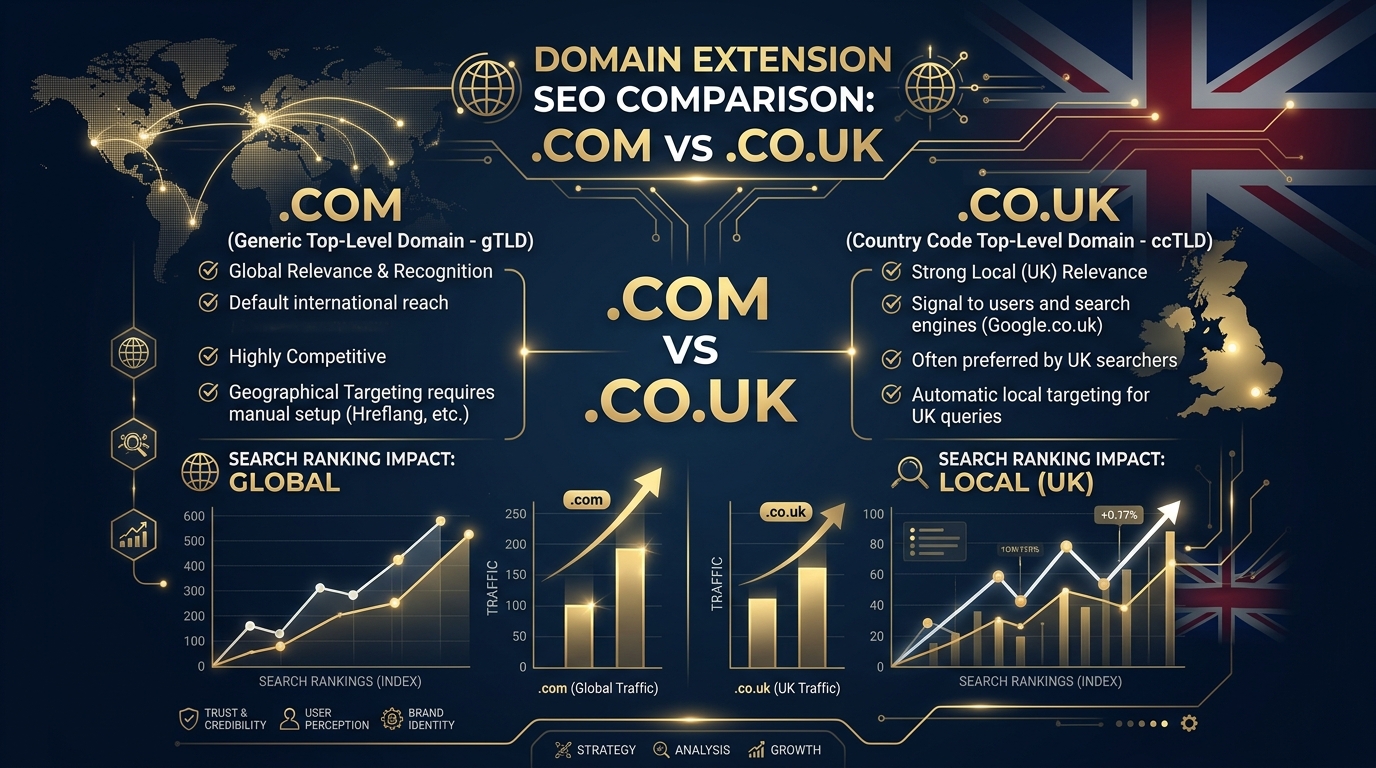
Deciding whether a .com or .co.uk domain is better for SEO depends on your primary geographic target market, customer search intent, and long-term business scalability. Domain extensions function by signaling geographical relevance and administrative ownership to search engines such as Google and Bing, which helps search algorithms determine where your website fits in localized search results.
The main benefits of choosing the right domain extension include capturing higher localized click-through rates within the United Kingdom, avoiding international content duplication issues, and establishing immediate trust with your target buyers. You protect your digital marketing investment when you align your web address with your commercial geographic footprint.
The primary uses and applications of domain selection span local service businesses, domestic retailers, international e-commerce platforms, and multinational software enterprises. Marketers evaluate Top-Level Domain (TLD) options to ensure their technical setup supports scalable content delivery and regional geotargeting.
The main components of evaluating .com versus .co.uk include understanding Generic Top-Level Domains (gTLDs), Country Code Top-Level Domains (ccTLDs), Google search localization signals, and backlink authority building. You can learn more about general ranking fundamentals in our detailed SEO Guide.
.com vs .co.uk: What's the Difference?
The primary difference between .com and .co.uk lies in their geographical scope, administrative governance, and search engine targeting parameters. While .com serves as an open international standard for commercial websites globally, .co.uk functions specifically as the official country code extension for the United Kingdom.
What Is a .com Domain?
A .com domain is a Generic Top-Level Domain (gTLD) originally created for commercial organizations and managed globally by Verisign under the oversight of the Internet Corporation for Assigned Names and Numbers (ICANN). It is the most popular domain extension in the world, with over 160 million active registrations across various industries.
Search engines treat a .com domain as geographically neutral. This neutral status allows a website to rank across multiple countries, including the United States, Australia, Canada, and the United Kingdom, provided you configure regional content and language tags properly.
What Is a .co.uk Domain?
A .co.uk domain is a Country Code Top-Level Domain (ccTLD) dedicated to businesses operating within the United Kingdom and managed by Nominet. Nominet oversees more than 11 million .uk and .co.uk domains, maintaining high trust among British consumers.
Search engines automatically associate a .co.uk domain with the United Kingdom. This automatic connection gives British businesses an advantage on Google.co.uk for localized queries, signaling to users that prices appear in British pounds (£), shipping originates domestically, and customer support operates during UK business hours.
com vs .co.uk at a Glance
Comparing .com and .co.uk across key factors highlights how each extension supports different operational priorities:
| Feature | .com Domain | .co.uk Domain |
|---|---|---|
| TLD Classification | Generic Top-Level Domain (gTLD) | Country Code Top-Level Domain (ccTLD) |
| Geographical Target | Global (Neutral worldwide reach) | United Kingdom (Strict domestic focus) |
| Local UK Trust Signals | Moderate (Requires local NAP & schema) | High (Immediate British credibility) |
| International Ranking Ease | High (Can target any country or market) | Restricted (Biased heavily toward the UK) |
| Governing Registry | Verisign / ICANN | Nominet UK |
Is .com or .co.uk Better for SEO?
Neither .com nor .co.uk is universally superior for SEO because their ranking effectiveness depends entirely on your target audience location. A .co.uk domain is better for businesses targeting customers strictly within the UK, whereas a .com domain is better for businesses targeting a global audience across multiple countries.
Google algorithms evaluate domain extensions to determine search intent and regional relevance. If a searcher in Manchester queries "commercial plumbing repairs", Google prioritizes websites with UK-specific signals, including .co.uk domains, UK hosting IP addresses, and local structured data. If a searcher enters a broad query like "how to calculate customer lifetime value", Google ranks high-authority .com and .co.uk websites equally based on content depth. You can explore tracking methodologies in our guide on how to measure SEO.
Is .com Better Than .co.uk for International SEO?
Yes, a .com domain is significantly better than a .co.uk domain for international SEO because search engines treat .com as a generic top-level domain with no geographic limitations. Using a .com allows you to structure subdirectories (such as example.com/uk/ and example.com/us/) to target multiple countries under a single unified domain authority.
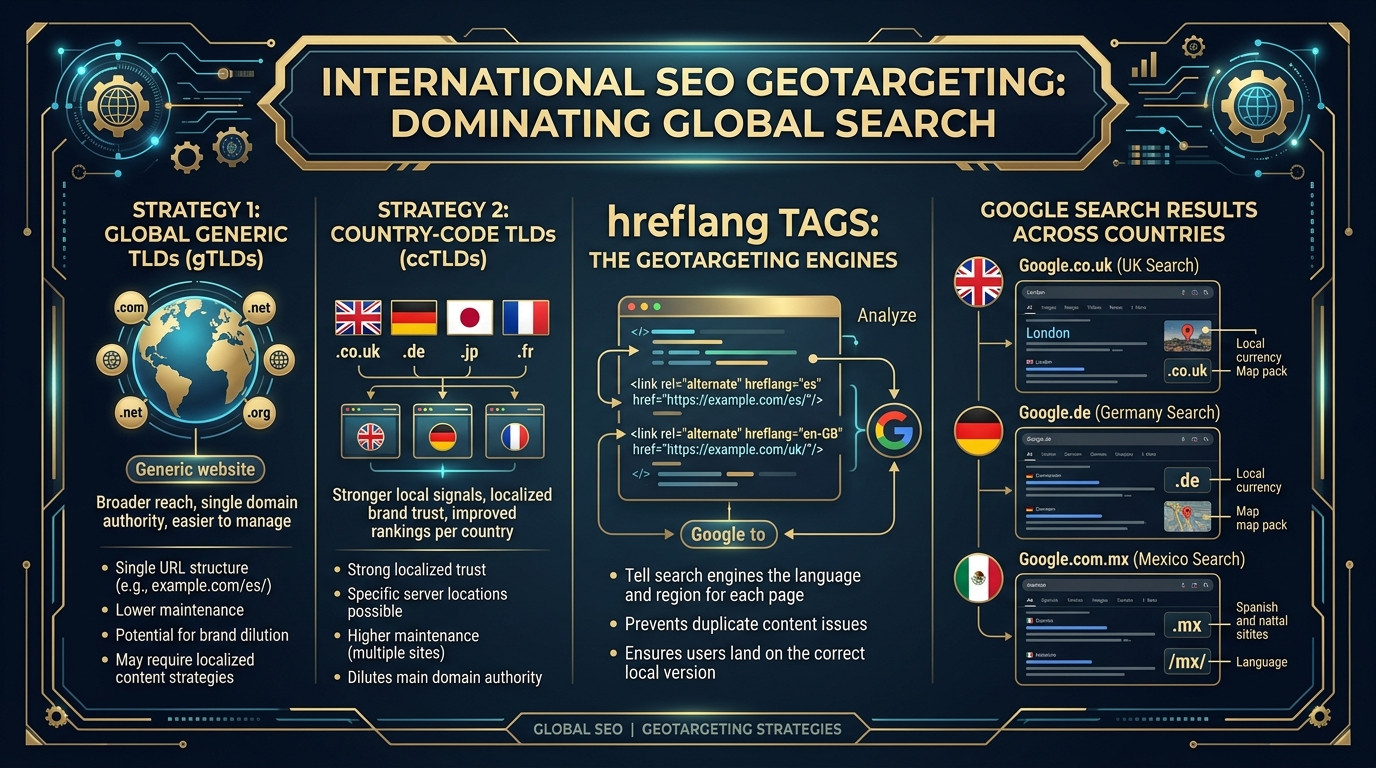
When you attempt to rank a .co.uk website in foreign search markets like the US or Germany, Google treats the ccTLD as a strong indicator that the website caters only to the UK. This geographical limitation makes it difficult to earn high ranking positions in international Search Engine Results Pages (SERPs).
How Does Your Domain Extension Affect SEO?
Your domain extension affects SEO by influencing search engine geotargeting parameters, user click-through rates, backlink acquisition, and perceived site authority. While the TLD itself is not a direct PageRank calculation factor, it influences several critical search performance signals.
Geographic Targeting
Geographic targeting tells search engines where your primary audience resides based on domain structure, server location, and hreflang annotations. When you register a .co.uk domain, search engines automatically restrict your primary geotargeting to the United Kingdom without requiring manual settings in Google Search Console (GSC).
User Trust and Click-Through Rate
User trust and Click-Through Rate (CTR) measure how likely searchers are to click your website link when it appears on the SERP. British consumers often display higher confidence when clicking .co.uk links for transactional searches because they know shipping rates, taxes, and return policies comply with UK regulations.
For global informational topics, international users often prefer .com links, associating them with established worldwide brands. Higher user trust leads to improved organic CTR, which signals strong search satisfaction to Google algorithms.
Backlinks and Domain Authority
Backlinks and Domain Authority reflect the quality and quantity of external websites linking to your web address. Local UK websites (such as regional news outlets, universities, and industry trade directories) naturally link to authoritative .co.uk websites.
Conversely, international publications and global blogs link more readily to .com domains. Aligning your domain extension with the geographic location of your outreach targets improves link building campaign efficiency.
Content and Relevance Matter More Than the TLD
Content quality, topical depth, and search intent satisfaction matter far more for SEO rankings than the domain extension alone. A poorly optimized .com website with thin content will be outranked by a comprehensive .co.uk website that thoroughly answers user questions.
Search engines reward websites that provide fast page speeds, clean technical architectures, and helpful information regardless of whether the URL ends in .com, .co.uk, or another extension. You can review infrastructure optimization in our Technical SEO Guide.
.com vs .co.uk for Different Types of Businesses
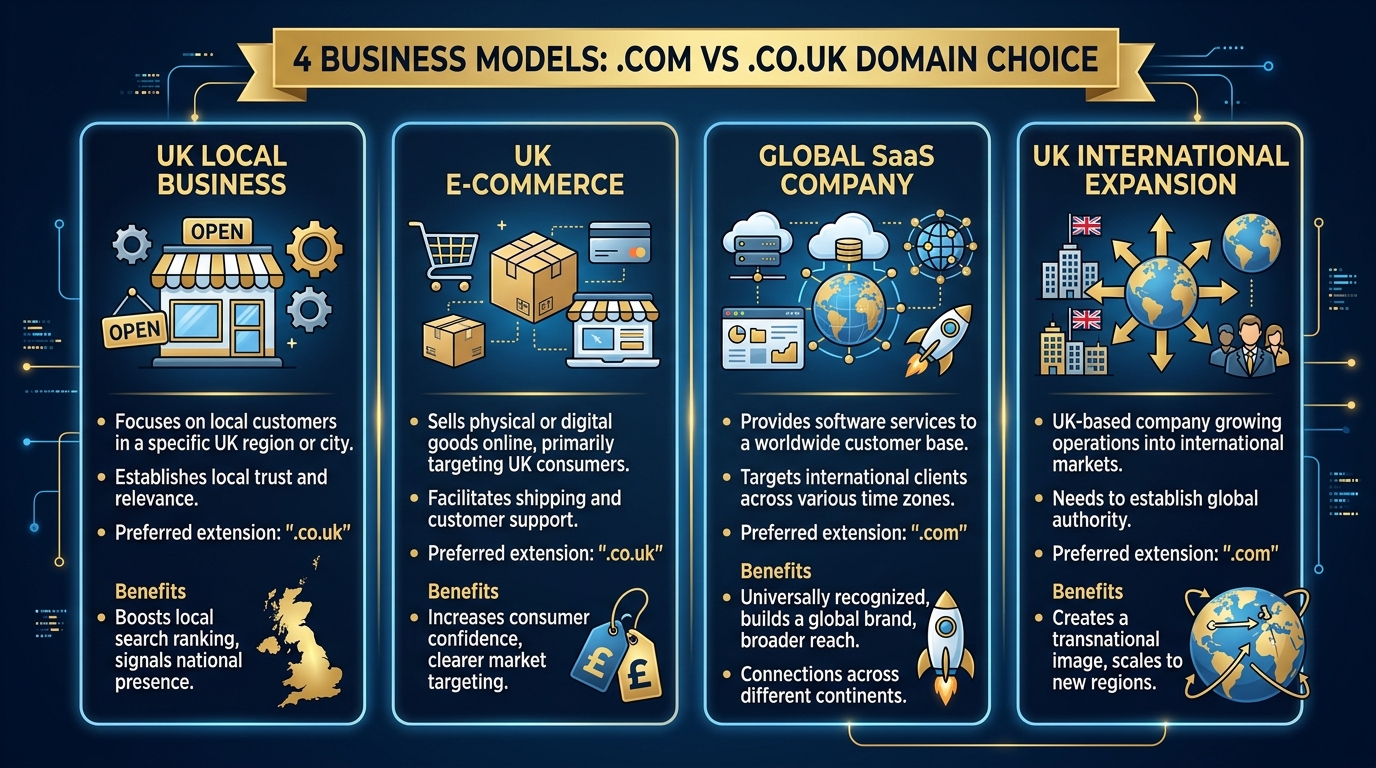
Selecting between .com and .co.uk requires evaluating your specific business model, customer base, and five-year growth strategy. Different commercial setups benefit from different domain extension choices.
UK Local Business
For a UK local business, choose a .co.uk domain because it reinforces your local presence in geographic search queries and Google Maps Local Packs. Local trades, law practices, dental clinics, and regional accounting firms gain instant recognition among nearby residents.
UK E-commerce Business
For a UK e-commerce business selling exclusively within the British market, a .co.uk domain is the ideal choice because it reassures buyers about domestic delivery times, UK currency pricing, and local VAT compliance. If you intend to ship products across Europe or North America, select a .com domain to avoid rebranding down the line.
International Business
For an international business operating across multiple continents, select a .com domain to establish an open global presence. A Global E-commerce Platform or multinational corporation benefits from a universal .com web address that supports localized subdirectories.
UK Business Planning to Expand Globally
For a UK business planning future international expansion, launch on a .com domain from day one while securing the matching .co.uk to redirect locally. Starting on .com prevents complex URL migrations, link equity loss, and brand confusion when entering overseas markets later.
SaaS or Technology Company
For a software or technology company, a .com domain is the industry gold standard for attracting enterprise clients, international investors, and global subscribers. Software products have no physical borders, making a globally recognized .com domain the preferred option.
Should You Buy Both .com and .co.uk?
Yes, you should buy both .com and .co.uk domains if both variations are available at regular registration prices. Registering both extensions costs approximately £10 to £25 per year and protects your brand from competitors, impersonators, and traffic leakage.
Select one version as your primary canonical domain (for example, your main live website on .co.uk or .com), and set up a permanent 301 redirect from the secondary version. This setup ensures that visitors who mistype your extension still arrive on your primary web address.
What If Your .com or .co.uk Domain Is Already Taken?
If your preferred domain name is already taken, evaluate alternative extensions, consider minor brand name modifications, or research country-specific TLD options. You have several practical options before committing to an expensive aftermarket domain purchase.
Should You Choose the Other Extension?
You can choose the alternative extension if the existing website on the taken domain operates in an unrelated industry and does not hold a conflicting trademark. For instance, if the .com is registered by an inactive overseas portfolio, a UK consultancy firm can safely register the .co.uk version to serve British clients.
What is the difference between tld & cctld?
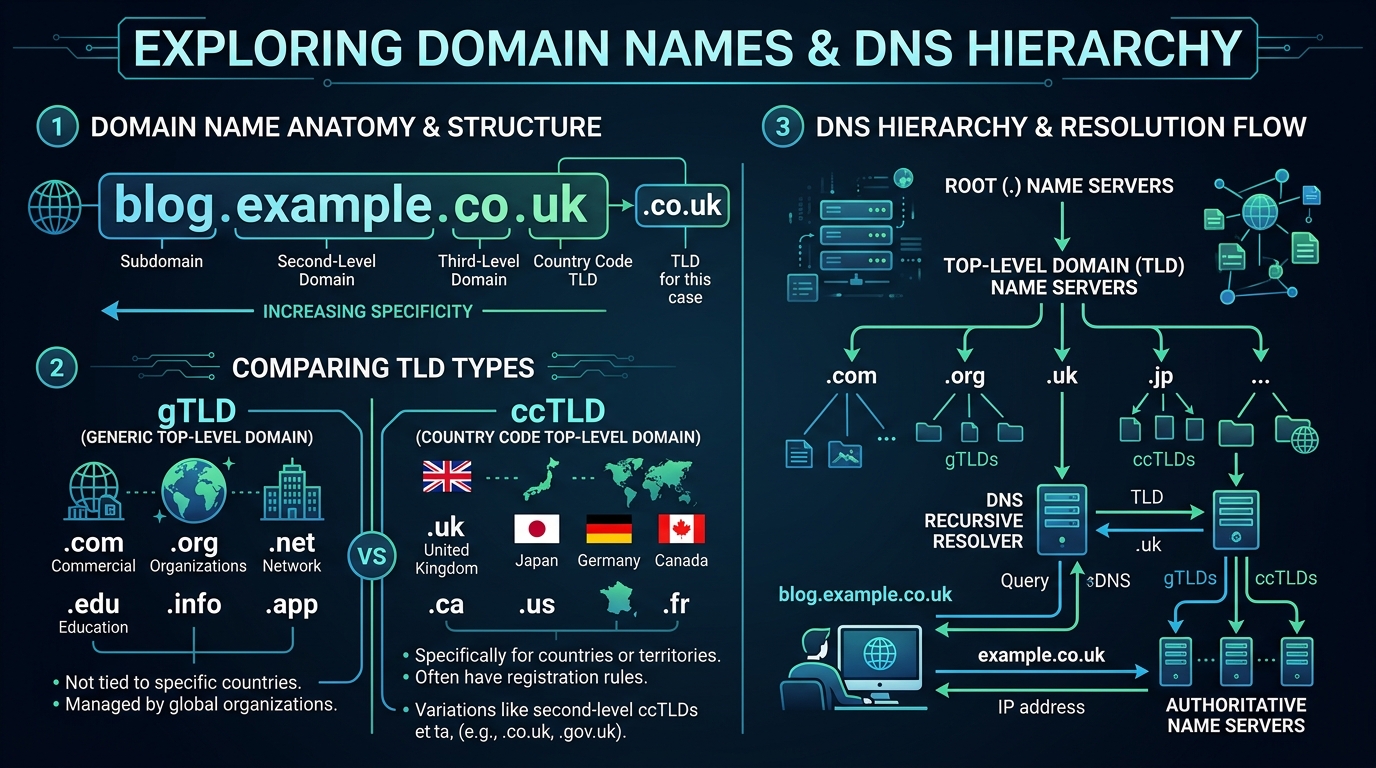
The difference between a Top-Level Domain (TLD) and a Country Code Top-Level Domain (ccTLD) is their geographic targeting scope. A generic TLD (gTLD) such as .com, .org, or .net has no inherent geographic association, whereas a ccTLD such as .co.uk (United Kingdom), .de (Germany), or .fr (France) explicitly signals a specific country to search algorithms.
Should You Change Your Brand Name?
Consider modifying your brand name slightly if both the .com and .co.uk versions are owned by direct commercial competitors in your niche. Adding a descriptive keyword (such as "Consulting", "Group", or "HQ") allows you to secure clean, unencumbered .com and .co.uk domains without trademark risks.
Should You Use a Different TLD?
You can use modern industry-specific domain extensions like .tech, .shop, or .london if traditional extensions are unavailable. These new extensions are recognized by Google as generic TLDs and rank effectively when supported by quality content and authoritative backlinks.
Does WWW vs Non-WWW Affect SEO?
No, choosing between WWW and non-WWW does not give you an inherent SEO ranking advantage, as Google treats both formats equally. However, you must pick one canonical version and implement a 301 permanent redirect from the other to prevent duplicate content indexing.
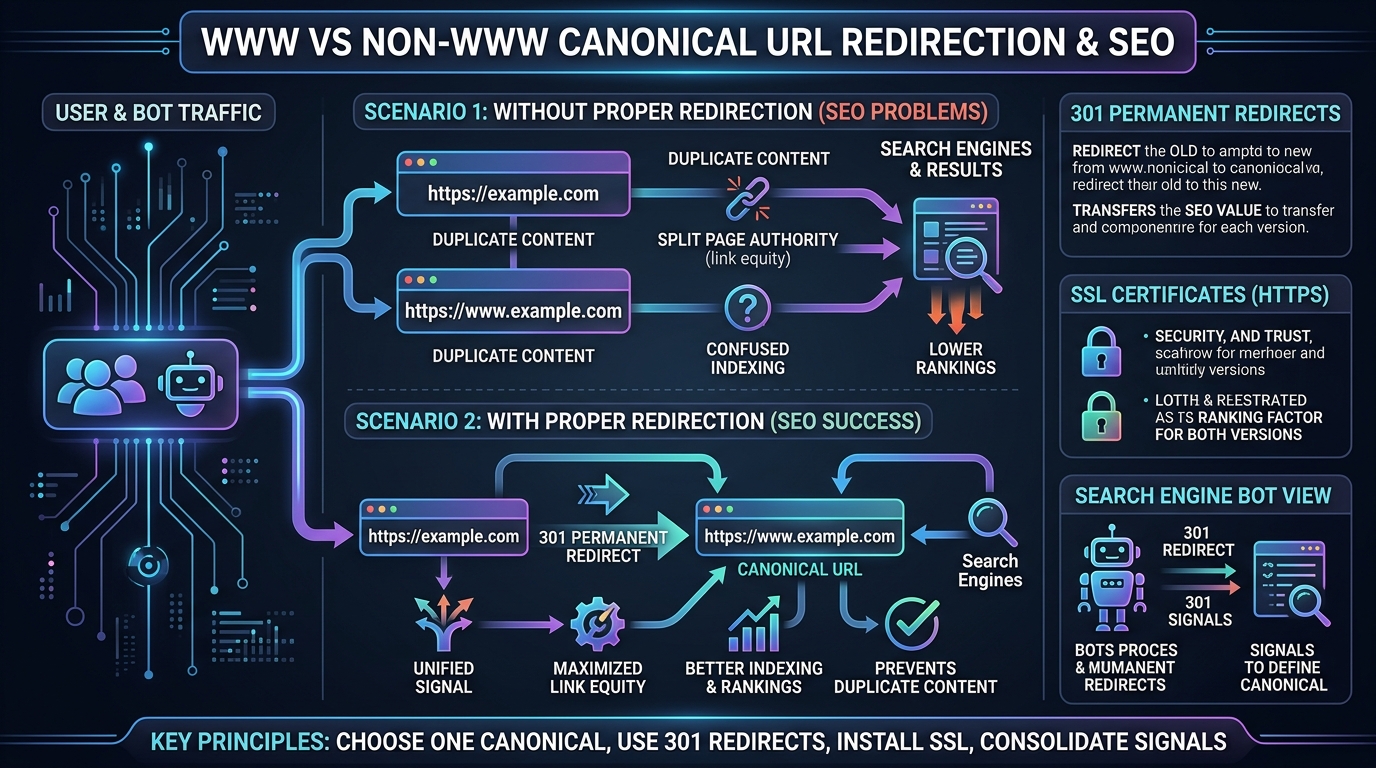
For example, if your preferred format is https://example.co.uk, configure your web server or DNS provider (such as Cloudflare) to redirect all https://www.example.co.uk requests to the non-WWW version. This consolidates all backlink equity and PageRank into a single canonical URL.
Does Domain Age Matter More Than .com vs .co.uk?
No, domain age itself is not a significant Google ranking factor, but the accumulated backlink profile, topical authority, and historical trust of an established domain matter far more than its extension. An established .co.uk domain with ten years of earned links will consistently outrank a brand-new .com domain with zero authority.
Common Mistakes When Choosing Between .com and .co.uk
Avoid 4 common domain selection mistakes that can hinder your long-term organic search growth:
- Targeting global markets with a .co.uk domain: Attempting to rank in the US or Asia on a UK ccTLD limits your international visibility.
- Neglecting local UK trust signals on a .com domain: Failing to add UK contact details, schema markup, and regional business profiles when operating locally on a .com.
- Failing to secure both versions: Leaving the alternative extension available for competitors or domain squatters to purchase.
- Executing unmanaged domain migrations: Switching from .co.uk to .com without proper 301 redirect mapping, which risks losing accumulated search rankings.
Conclusion
Deciding whether a .com or .co.uk domain is better for SEO comes down to knowing your target audience, geographical market, and future growth plans. A .co.uk domain provides immediate local trust and automatic geotargeting within the United Kingdom, while a .com domain offers unrestricted global reach for businesses expanding internationally.
Whenever possible, purchase both .com and .co.uk extensions to safeguard your brand identity. Set your primary focus on creating helpful content, building authoritative backlinks, and maintaining technical site health to achieve lasting search engine visibility.
Frequently Asked Questions

Rehan Saeed
Lead SEO Specialist with over 10 years of experience helping UK and international businesses scale organic search visibility, domain authority, and revenue.
Connect on LinkedIn