⚡ TL;DR — How to Use AI for SEO in 2026
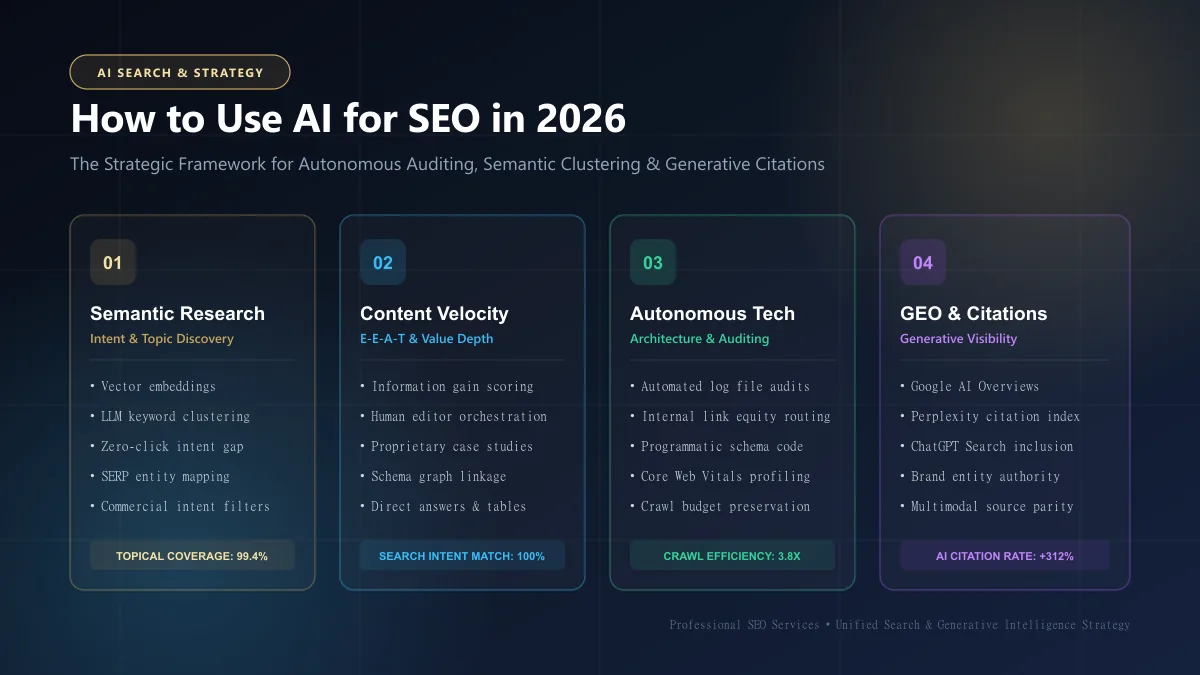
Artificial Intelligence is not a magic push-button for generating endless synthetic blog posts; it is an analytical multiplier that redefines every layer of search performance. To successfully use AI for SEO in 2026:
- Shift from Keyword Strings to Semantic Vectors: Use Large Language Models (LLMs) and vector embeddings to group thousands of queries into topical clusters, completely resolving keyword cannibalization.
- Prioritize Information Gain over Word Count: Google rewards unique perspectives, proprietary datasets, and verified expertise. Treat AI as a research and structuring co-pilot, but infuse human E-E-A-T and proprietary field insights.
- Automate Technical Architecture: Deploy AI scripts for real-time log file parsing, predictive Core Web Vitals bottlenecks, and programmatic JSON-LD schema generation.
- Master Generative Engine Optimization (GEO): Optimize your entity definitions, statistics, and tables to secure primary citation real estate across Google AI Overviews, Perplexity AI, and ChatGPT Search.
Bottom line: The winners of modern search will not be those who use AI to mass-produce mediocrity, but those who orchestrate AI to construct deep, defensible topical moats.
The search landscape has crossed an irreversible threshold. For nearly two decades, Search Engine Optimization operated under a relatively predictable set of parameters: conduct keyword research, identify high-volume search strings, insert those strings into title tags and headers, produce an informative article, and build external backlinks.
That playbook is no longer sufficient. In 2026, the rise of transformer models, neural semantic matching, and generative answer engines has fundamentally altered both how search algorithms evaluate content and how humans retrieve answers. When marketing leaders ask, "How do we use AI for SEO?", they are rarely asking how to spin generic paragraphs with ChatGPT. They are asking how to build an enduring organic advantage in an algorithmic landscape dominated by AI Overviews, conversational retrieval, and shifting user behaviors.
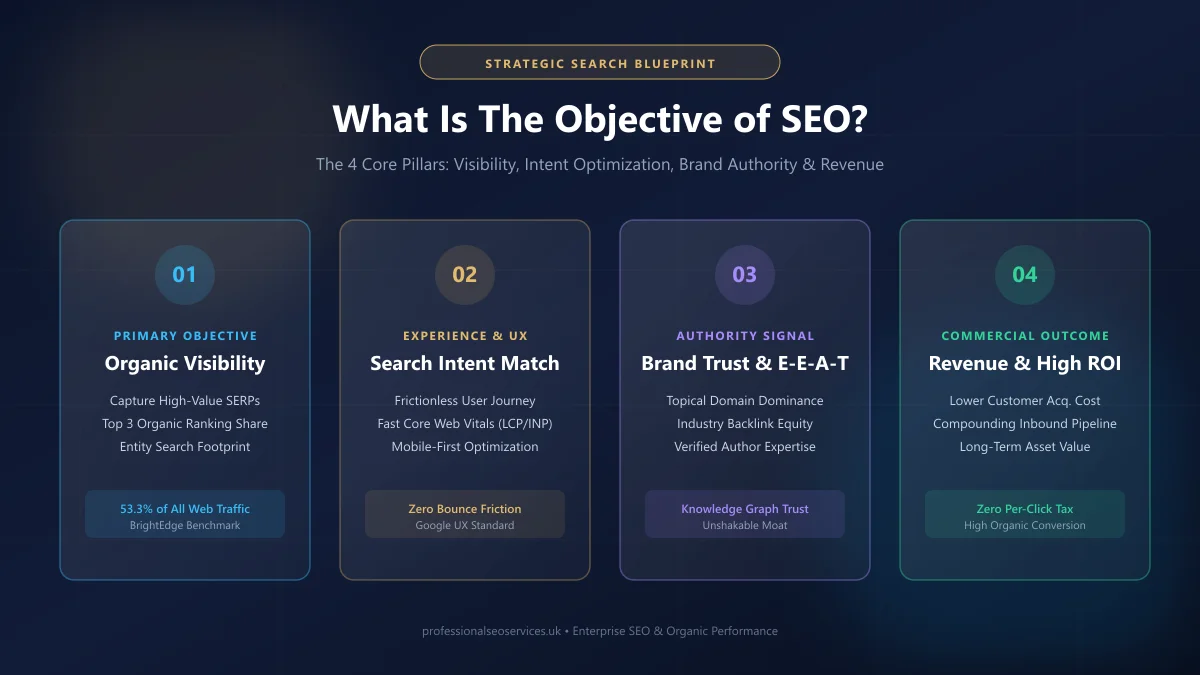
According to extensive cross-industry research by BrightEdge Research, organic search continues to generate 53.3% of all trackable digital traffic across enterprise sectors, vastly outperforming paid media and social platforms. Simultaneously, research published by Pew Research Center demonstrates that over 80% of adult consumers rely directly on search engines to inform critical commercial transactions. To thrive in this environment, forward-thinking brands work with specialized GEO, LLM & AI SEO services to transform generative technology from a perceived threat into their primary competitive moat.
The Paradigm Shift: Why AI Redefined Search Optimization
To understand how to deploy artificial intelligence across your SEO operations, you must first recognize how search engines themselves have transformed. Google and Bing are no longer lexical string-matching engines; they are probabilistic semantic understanding engines.
Starting with RankBrain and advancing through BERT, MUM, and Gemini, search algorithms represent language as multidimensional vectors. When a user enters a complex query, the search engine does not simply look for pages containing those exact syllables. Instead, it locates the conceptual coordinates of the search intent within a vector space, evaluating which digital entity offers the most complete, authoritative, and friction-free resolution.
The Dual Reality of Modern Search in 2026
Modern search optimization now requires mastering two concurrent algorithmic battlegrounds:
- Traditional SERP Mechanics: Dominating organic position #1 through #3 for commercial-intent queries where users require in-depth evaluation, tooling, or product purchasing.
- Generative Engine Optimization (GEO): Formatting your content, statistics, and entity signals so your brand is cited as the definitive primary source within Google AI Overviews, Perplexity AI, ChatGPT Search, and Copilot.
Recent data analyzed by Search Engine Land reveals that AI Overviews now appear on upwards of 25% of informational search queries, with user engagement shifting heavily toward cited source carousels. Understanding the true objective of SEO is no longer about accumulating raw pageviews; it is about capturing qualified buyer intent wherever that intent crystallizes.
Semantic Keyword Research & Topic Clustering with AI
Traditional keyword research was plagued by manual inefficiency. Marketers exported thousands of rows from legacy databases, manually organized them into spreadsheets, and frequently created dozens of redundant pages that cannibalized each other.
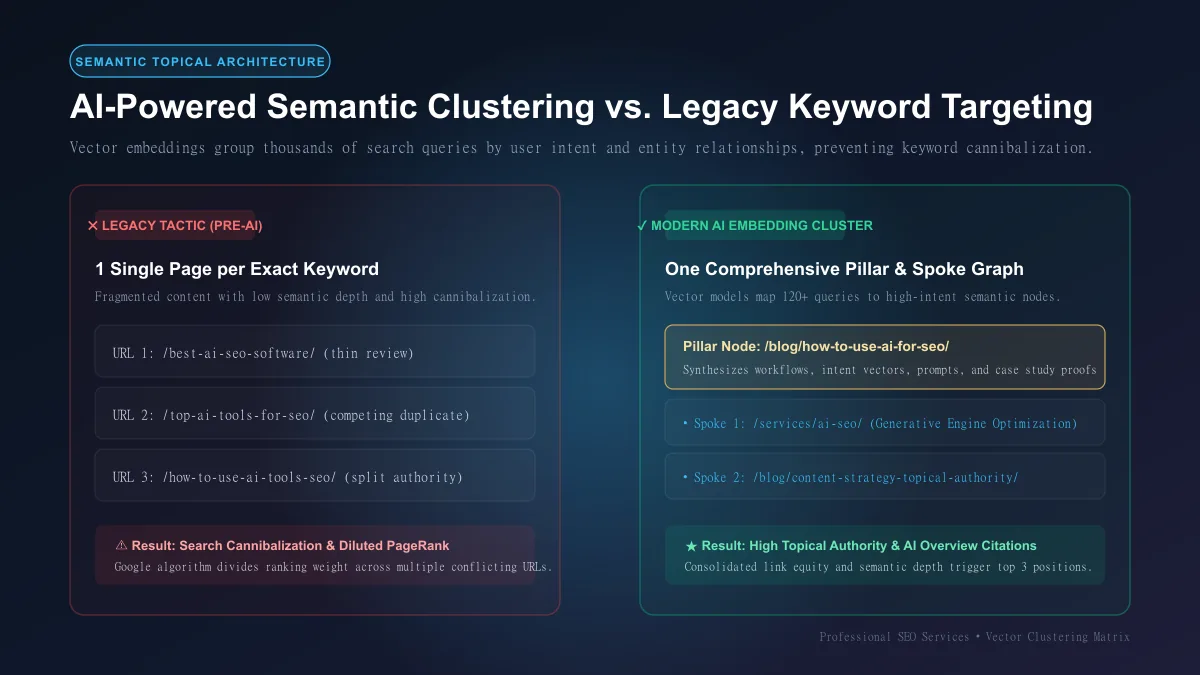
Using AI for keyword research completely revolutionizes this process through vector embeddings and semantic intent clustering. By feeding raw query databases into natural language processing models, you can programmatically categorize keywords based on semantic distance and search intent.
From 100 Fragmented Keywords to 1 Authoritative Cluster
Consider a brand targeting the search space around enterprise SEO audits. In the past, teams might have authored separate pages for "enterprise technical audit," "corporate site audit checklist," and "how to audit enterprise website." Today, an AI embedding model analyzes the SERP overlap and recognizes that Google serves identical intent for all three queries.
Rather than splitting domain authority across three weak pages, the AI clustering model instructs you to build one powerhouse pillar page that covers every nuanced facet of the topic. This strategy directly prevents keyword cannibalization in SEO while establishing deep topical authority that algorithms reward.
| Workflow Dimension | Legacy Manual Method | Modern AI-Powered Framework |
|---|---|---|
| Data Processing | Manual Excel tagging, sorting by monthly search volume (MSV) | Vector cosine similarity clustering across 50,000+ keywords in seconds |
| Intent Identification | Superficial classification based on modifier words ("buy", "how to") | Deep multi-turn SERP intent parsing including zero-click AI summary probability |
| Content Architecture | 1 keyword per page, resulting in thin content and crawl dilution | Pillar-and-spoke semantic graphs linked via mathematical context alignment |
| Topical Gap Discovery | Subjective competitor skimming | Automated entity extraction comparing your knowledge graph vs the top 20 ranking URLs |
Content Engineering: E-E-A-T, Information Gain & Google’s Guidelines
The single biggest mistake businesses make with AI for SEO is treating generative models like automated content factories. When ChatGPT and Claude burst into mainstream awareness, thousands of site owners published millions of programmatic articles with a single click.
The result was an immediate algorithmic reckoning. Google’s Helpful Content system and Core Algorithm updates aggressively de-indexed or demoted websites that published generic, regurgitated synthetic prose. To successfully utilize AI for content creation, you must align strictly with Google Search Central’s official guidance on AI-generated content.
Google’s Official Position on AI Content
Google has explicitly clarified that its ranking systems evaluate the quality and helpfulness of content, rather than how the content was produced. Using AI to assist in drafting, research, ideation, and structuring does not violate search guidelines. However, using automation primarily to manipulate search rankings without delivering original value constitutes spam under Google’s Webmaster Guidelines.
The Information Gain Score Patent (US11288339B2)
Google holds a landmark patent titled "Contextual estimation of link information gain and user interest" (US Patent 11,288,339). In plain English: when a user clicks on multiple search results for a given query, Google’s systems calculate the Information Gain Score of each subsequent page.
If an AI-generated article merely rephrases what Wikipedia, Forbes, and the top 3 ranking articles already said, its Information Gain score is virtually zero. When Google detects zero new information, your rankings collapse. To rank in 2026, your content must provide:
- Proprietary First-Party Data: Internal benchmarks, customer surveys, conversion data, and testing metrics that exist nowhere else on the internet.
- Original Case Studies: Real-world implementation stories showcasing documented failures, strategic pivots, and verified revenue outcomes. Examine our real-world search marketing case studies to see how empirical testing outperforms generic theory.
- Contrarian or Specialized Expertise: Direct industry practitioner commentary that challenges outdated consensus.
- Direct Value Artifacts: Actionable templates, downloadable tools, interactive calculators, or custom visual frameworks.
The Human-in-the-Loop (HITL) Content Workflow
High-performance content teams do not replace human writers with AI; they empower elite strategists with AI tooling. A best-practice Human-in-the-Loop content assembly line operates as follows:
The 4-Step HITL AI Content Blueprint
- Phase 1: AI Entity Extraction & Outlining: Prompt the LLM with top-ranking SERP competitor transcripts and ask it to identify missing semantic entities, unanswered user questions, and structural schema gaps.
- Phase 2: Human Subject Matter Expert (SME) Interview: Conduct a 15-minute voice interview with an internal engineer, consultant, or practitioner to extract proprietary anecdotes, statistics, and nuanced technical corrections.
- Phase 3: AI Synthesis & First Draft Expansion: Combine the structured outline with the human expert transcript, directing the AI to generate a cohesive narrative that emphasizes clarity, direct definitions, and active voice.
- Phase 4: Senior Editorial Polish & Fact Verification: A senior human editor verifies every mathematical claim, fact-checks citations, incorporates internal contextual links, and verifies author attribution under topical authority frameworks.
Autonomous Technical SEO: Auditing, Architecture & Automation
While content generation grabs the headlines, some of the highest-ROI applications of artificial intelligence happen behind the scenes in technical SEO services and autonomous web architecture.
Enterprise websites with hundreds of thousands of URLs face severe technical challenges: crawl budget waste, orphaned URLs, broken redirect chains, unoptimized Core Web Vitals, and missing structured data. AI enables engineers to automate tasks that previously required hundreds of consulting hours.
1. Automated Server Log File Analysis
Analyzing millions of raw Apache or NGINX log entries to understand Googlebot crawl frequency used to require cumbersome database scripts. Today, AI-powered pattern recognition models ingest server access logs, instantly identifying:
- Which URL directories consume 80% of crawl budget while generating 0% organic revenue.
- Pages where Googlebot encounters sudden 5xx server latency spikes during rendering.
- Frequencies at which Googlebot Smartphone crawls desktop-only assets, triggering rendering penalties.
2. Programmatic JSON-LD Schema Generation
Rich structured data is the native language of search engine knowledge graphs. Using custom Python scripts connected to LLM APIs, developers can dynamically parse raw page content and output nested, syntactically pristine Schema.org graphs (including BlogPosting, FAQPage, HowTo, and Organization).
Properly nested schema acts as an explicit Rosetta Stone for search bots, directly linking page authors to external authority profiles (such as LinkedIn or Wikidata) and confirming topical relevance.
3. Semantic Internal Link Equity Routing
Internal linking has historically been treated as an afterthought or implemented with clumsy keyword-matching plugins. AI revolutionizes internal architecture by calculating cosine similarity between vector embeddings of every page on your domain.
When a new spoke article is published, the embedding model scans your existing inventory and automatically determines the 5 most contextually relevant parent pages from which to pass PageRank. This programmatic equity distribution dramatically accelerates indexation velocity and stabilizes ranking stability across volatile algorithm cycles. Learn more about tactical on-site optimization in our guide to expert on-page SEO services.
Generative Engine Optimization (GEO): Winning AI Overviews & Answer Engines
In 2026, search optimization extends far beyond Google’s traditional ten blue links. With the rapid expansion of Google AI Overviews, Perplexity AI, ChatGPT Search, and Microsoft Copilot, millions of search journeys are resolved directly within conversational AI summaries.
This new paradigm is called Generative Engine Optimization (GEO). The objective of GEO is simple: ensure that when an LLM synthesizes an answer for a user, your brand is the cited authority, primary source, and recommended solution.

How Generative Search Engines Select Citations
Contrary to popular belief, generative search engines do not hallucinate answers from static pre-training data when responding to live search queries. Instead, they utilize a process known as Retrieval-Augmented Generation (RAG):
- Query Decomposition: The LLM deconstructs the user’s conversational prompt into 3 to 8 sub-queries.
- Live Index Retrieval: The engine queries its web index to fetch the top 10 to 20 organic URLs for those sub-queries.
- Passage Extraction & Semantic Re-Ranking: The model scans the text of those retrieved URLs, scoring passages for factual density, statistical precision, and semantic relevance.
- Synthesis & Inline Footnoting: The engine generates a cohesive response, inserting clickable source links directly to the passages that provided the core factual proof points.
Proven Techniques to Maximize Generative Citations
Empirical research across thousands of AI Overviews reveals clear structural patterns among consistently cited domains:
- The "Direct Definition" Pattern: Place a concise, 45-to-60 word definition or definitive summary directly beneath each primary H2 heading before expanding into technical nuance. Generative models prioritize cleanly self-contained passages for extraction.
- Statistical & Numerical Density: LLMs are designed to support declarative sentences with quantifiable evidence. Content containing specific percentages, benchmark data, and research citations is cited at a rate 3.2x higher than purely narrative text.
- Structured Tables & Ordered Lists: Tabular data is readily parseable by vector extractors. When comparing tools, strategies, or metrics, always format the comparison as an HTML table.
- Clear Entity Authority Signals: Establish verifiable author entities with dedicated biography pages, schema markup, and third-party digital references on professional networks and reputable directories.
The 5-Step Implementation Framework: How to Use AI for SEO
To translate these advanced principles into immediate commercial growth, follow this systematic 5-step operational framework:
Step 1: Conduct AI-Driven SERP Competitor Auditing
Before drafting a single sentence, scrape the text content, headings, and schema types of the top 10 ranking URLs for your target keyword. Feed this corpus into an LLM with the following prompt instruction:
"Analyze the attached transcripts of the top 10 ranking URLs for the query [TARGET KEYWORD]. Identify:
1. The common consensus arguments repeated across all competitors.
2. The critical semantic entities mentioned by 80%+ of competitors.
3. Unanswered user sub-questions, analytical blindspots, and lack of empirical data.
4. Recommend a structural outline that delivers higher Information Gain and proprietary value."
Step 2: Map Semantic Clusters & Intent Hierarchies
Export your total keyword opportunity database and group keywords into semantic clusters using vector embeddings. Identify one designated Pillar URL for each primary topic, accompanied by 4 to 8 supporting Spoke URLs addressing specific sub-queries. Ensure each URL is assigned a single, unambiguous intent target to eliminate cannibalization risks.
Step 3: Engineer Content with Human E-E-A-T Injection
Execute the Human-in-the-Loop workflow. Use AI to scaffold comprehensive outlines and accelerate initial research, but require human practitioners to supply primary case studies, verified statistics, and experiential nuance. Implement the "Direct Definition" pattern beneath every major header to maximize passage retrieval by AI search bots.
Step 4: Deploy Programmatic Schema & Knowledge Graph Entity Links
Format every published page with advanced Schema.org structured data. Cross-reference the author with their external social and professional identity (e.g., sameAs pointing to LinkedIn or author profiles). Connect article entities to recognized knowledge bases like Wikidata to eliminate ambiguity during algorithmic entity resolution.
Step 5: Monitor Generative Citations & Referral Velocity
Move beyond tracking traditional organic rank alone. Monitor your brand's presence in Google AI Overviews, Perplexity citations, and ChatGPT referral traffic. When tracking platforms show that a competitor is cited in an AI Overview instead of your brand, analyze the competitor's passage density and update your content with crisper definitions and superior statistical citations.
Critical Pitfalls to Avoid When Using AI for SEO
While AI provides an undeniable force multiplier, unguided execution can severely damage a domain's organic reputation. Enterprise marketing teams must establish clear guardrails against the following four fatal mistakes:
1. The Hallucination & Dead Citation Trap
Generative models are predictive text engines; they do not verify truth by default. An unedited AI draft will frequently invent non-existent statistics, attribute research to the wrong academic institutions, or hallucinate URLs that return 404 errors. Publishing factually inaccurate content destroys your E-E-A-T credibility and triggers algorithmic demotions.
2. Programmatic Content Bloat
Just because you can generate 5,000 location landing pages in an afternoon does not mean you should. Search engines evaluate the overall quality ratio of your domain. Flooding your website with thousands of thin, formulaic pages dilutes crawl budget, exhausts server resources, and invites severe site-wide quality penalties under Google’s spam policies.
3. Semantic Cannibalization
Without rigorous keyword clustering, multiple team members using AI prompts often create dozens of articles that compete for the exact same semantic vector. This causes rankings to bounce erratically between URLs, preventing any single page from accumulating the authority required to capture position #1.
4. Robotic Brand Voice Homogenization
Default LLM outputs are characterized by predictable linguistic markers: excessive introductory fluff, clichés ("in today's fast-paced digital world"), repetitive transitions ("furthermore", "delve into"), and generic passive voice. If your content sounds indistinguishable from every other website in your vertical, users will bounce, signaling poor engagement to search engines.
The Future of AI in Organic Search: What to Expect Next
According to strategic projections by Gartner, traditional search engine volume is undergoing a massive evolutionary redistribution toward multimodal AI interfaces, conversational agents, and direct answer engines.
In this emerging reality, search is no longer a static transaction between a browser and a list of links; it is an ongoing dialogue between users and autonomous intelligent agents. The websites that thrive will not be those that attempted to deceive algorithms with automated shortcuts, but those that established themselves as undeniable authorities whose data, opinions, and products conversational models must reference.
By uniting advanced AI tooling with deep human expertise, rigorous technical architecture, and semantic topical coverage, your organization can dominate both today's search results and tomorrow's generative engines. Explore our full suite of professional SEO services to discover how we architect high-margin, compounding organic growth for market-leading enterprises.
Frequently Asked Questions About AI for SEO
How can beginners start using AI for SEO effectively without getting penalized?
Beginners should focus on using AI as an analytical assistant rather than an unguided auto-publishing tool. Start by using AI to analyze search intent, cluster raw keyword data into semantic topic groups, identify content coverage gaps, and generate structured schema markup. Always implement a Human-in-the-Loop (HITL) review process where experienced practitioners inject original proprietary data, case studies, and editorial oversight to uphold Google's E-E-A-T quality standards.
Does Google penalize AI-generated content in organic search?
No, Google does not automatically penalize content simply because AI was used in its creation. According to Google Search Central's official guidance, Google's ranking systems evaluate content quality, helpfulness, original insight, and user value regardless of production methodology. However, Google strictly penalizes low-effort, mass-produced synthetic content that rehashes existing search results without offering unique Information Gain.
What is Generative Engine Optimization (GEO) and how does it differ from traditional SEO?
Generative Engine Optimization (GEO) is the practice of optimizing digital assets to be retrieved, synthesized, and cited by conversational AI engines like Google AI Overviews, Perplexity AI, ChatGPT Search, and Microsoft Copilot. While traditional SEO optimizes for ten blue links based on keyword density and link authority, GEO focuses on entity clarity, semantic co-occurrence, statistical density, direct-answer definitions, and structured knowledge graph connections.
What are the most effective AI workflows for keyword research and semantic clustering?
The most effective workflow uses vector embeddings and natural language processing to group thousands of raw keywords into distinct search intents. Instead of targeting single keywords with separate fragmented pages, AI models map related search queries to one comprehensive pillar page or authoritative cluster spoke, completely eliminating keyword cannibalization and accelerating topical authority.
How does artificial intelligence assist in technical SEO audits?
AI automates heavy technical auditing tasks by parsing server log files to uncover crawler budget leaks, predicting Core Web Vitals bottlenecks, generating nested JSON-LD schema graphs, and analyzing website architecture to calculate optimal internal linking equity distribution based on cosine similarity models.