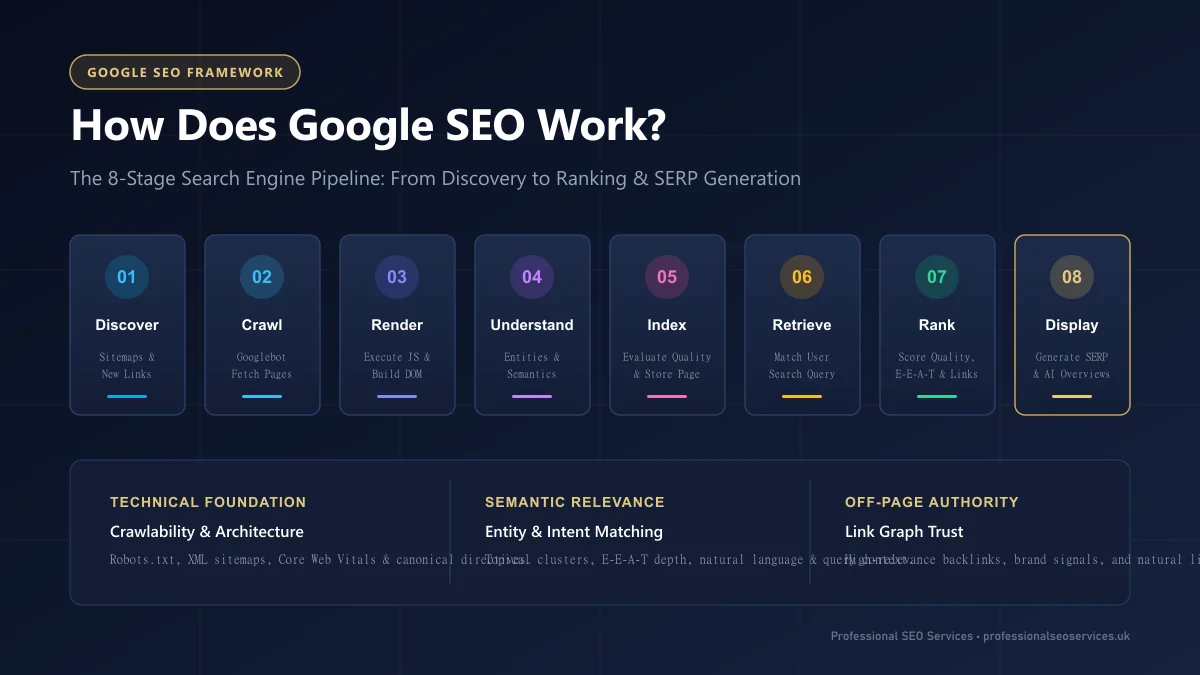
SEO takes so long because search engines like Google do not operate on an instant publishing switch; instead, they run an asynchronous, multi-stage pipeline of URL discovery, Googlebot crawling, JavaScript rendering, semantic indexing, and continuous algorithmic quality reassessment. When you publish a new page or rewrite an existing title tag, you are not simply inserting data into a live public directory. You are asking a global distributed index of over 50 billion web documents to recalculate its ranking equations against entrenched competitors who have spent years building authority, backlinks, and user satisfaction signals.
This structural reality makes Search Engine Optimization fundamentally different from paid advertising platforms like Google Ads or Meta Ads. Paid media operates as a financial lease: the moment you fund a campaign, ad auctions display your sponsored links at the top of the Search Engine Results Page (SERP), but the exact second your budget stops, your visibility drops to zero. SEO, by contrast, functions as digital real estate development. You are building an enduring organic asset where every technical fix, content cluster, and acquired backlink strengthens your site's cumulative equity over time.
The Quick Answer: Why Does SEO Take So Long?
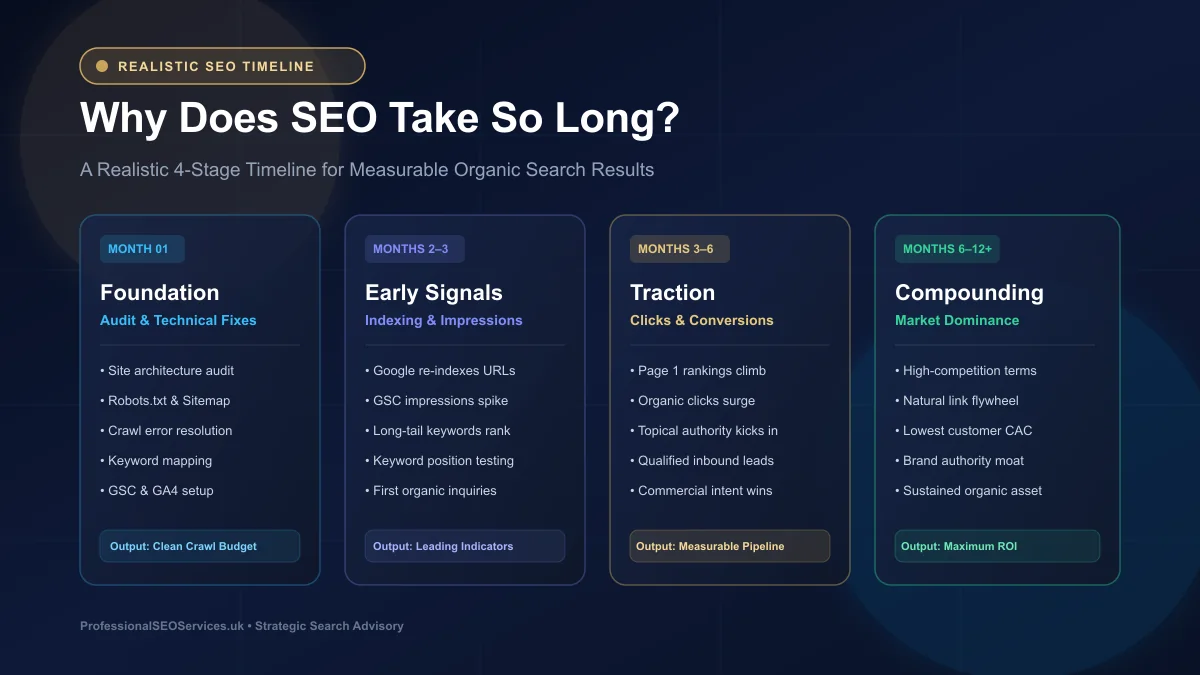
If you are looking for an executive summary of realistic SEO expectations, search performance progresses along four distinct chronological tiers:
-
•
Some technical changes produce effects relatively quickly: Resolving indexation blocks (e.g., removing accidental
noindextags or fixing broken robots.txt rules) can trigger page re-indexing within a few days to 2 weeks. - • New pages take days to weeks to be crawled and indexed: Googlebot allocates crawl budget based on domain authority; newly launched URLs must queue before Google discovers, parses, and validates their eligibility.
- • Meaningful organic growth commonly takes 3 to 6 months: Accumulating topical relevance, ranking for long-tail query variations, and climbing onto Page 2 or the bottom of Page 1 requires several months of algorithmic observation.
- • Competitive industries and new websites require 6 to 12+ months: Unseating high-authority market incumbents for high-commercial head terms demands extensive topical coverage, digital PR, and sustained historical trust.
Crucially, businesses must understand that there is no universal SEO timeline. SEO does not run on a single monolithic stopwatch. Instead, every website operates across multiple overlapping timelines simultaneously: an urgent technical fix may register within 72 hours, a localized practice-area page might capture qualified leads in 90 days, while a national commercial head term could take a full 14 months of compounding topical execution. Understanding these distinct gears is what separates successful digital executives from frustrated search investors. Partnering with a dedicated agency like Professional SEO Services ensures your search roadmap establishes realistic milestones while systematically accelerating every controllable variable.
How Long Does SEO Take to Work?
The short answer: SEO typically takes 3 to 6 months to begin generating measurable organic traffic and conversion momentum, with substantial commercial returns, competitive market dominance, and revenue compounding occurring between months 6 and 12+.
To understand how long does it take for SEO to work, you must break down the progression into empirical performance phases:
An Important Industry Nuance: You should never accept “3 to 6 months” as a contractual Google guarantee. While leading industry studies from Ahrefs, Semrush, and SEO.co commonly cite 3 to 6 months as an empirical benchmark for when SEO starts showing results, Google's search advocate John Mueller and official Search Central documentation repeatedly emphasize that Google provides no fixed guarantees or statutory deadlines for crawling, indexing, or ranking. The search engine is a dynamic, competitive market; a site's velocity depends entirely on its competitive environment and execution rigor.
Whether you are asking how long does SEO take to see results, how long does it take for SEO to show results, how long does SEO take to start working, how long before SEO works, or how long does SEO take to kick in, the timeline is governed by the structural mechanics of search engines. Let us examine the exact architectural reasons why this lag exists.
Why Does SEO Take So Long? The Core Architectural Reasons
To non-technical stakeholders, SEO often feels agonizingly slow compared to running digital ad campaigns. However, once you unpack the algorithmic pipeline that Google must execute for every URL on your website, the timeline becomes entirely logical. Let us dissect the six primary reasons why SEO requires time to mature.
1. Google Has to Crawl and Index Your Changes
Every SEO improvement must progress through a mandatory physical and algorithmic pipeline before any user can see it in a search result:
Google must first discover that your content has changed. If your site has low crawl priority, Googlebot may not revisit your updated URLs for days, weeks, or even months. Furthermore:
- Crawling does not automatically mean ranking: Googlebot downloading your HTML is merely an ingestion event; it does not assign any search position.
- Indexing does not guarantee visibility: Google may store your document in its inverted index but determine that other competing pages answer user intent more comprehensively, placing your URL on Page 4 or 5.
- Requesting indexing in Search Console does not grant instant inclusion: While the "Request Indexing" tool in Google Search Console prompts the queue, Google's documentation explicitly clarifies that it guarantees neither instant crawling nor priority evaluation.
For teams asking how long does Google take to update SEO or how long for Google to update SEO, the crawl-to-index lag represents the first mandatory waiting period.
2. Google Needs to Reevaluate Your Website Over Time
Indexing a page is merely acknowledging its existence; deciding where it belongs among 10 million potential results is an entirely separate, compute-intensive calculation. When evaluating search position, Google's systems assess:
- Semantic Search Intent Alignment: Does the document directly satisfy what searchers seek (transactional, informational, or navigational)?
- Information Gain & Content Depth: Does your page provide original insights, unique data, or first-hand experience beyond what already exists on the web?
- Internal Link Architecture: How does the page relate to your surrounding topic clusters and sitewide hierarchy?
- Site-Wide Quality Patterns: Google's search algorithms do not evaluate pages in complete isolation; overall domain trust, topical focus, and Core Web Vitals heavily influence individual URL performance.
Google's search engineers have publicly confirmed that after substantial website quality improvements, their automated scoring systems can require several months to learn, observe, and verify that the quality upgrade is permanent rather than a temporary anomaly. This is why webmasters asking how long does SEO take to effect or how long does SEO take to work on Google must account for this algorithmic learning window.
3. You Are Competing Against Websites That Already Have Established Authority
One of the biggest misconceptions among business leaders is assuming that optimizing their own website in isolation should immediately produce top rankings. In organic search, you are not operating in a vacuum. You are actively competing against incumbents who may have spent five to ten years accumulating digital authority.
Consider what your competitor might already have:
- Thousands of high-tier, naturally acquired editorial backlinks from industry publications.
- Dozens of interlinked supporting guides demonstrating encyclopedic topical authority.
- Extensive brand recognition and historical click-through rates that signal immense trust to Google's ranking systems.
- Millions of internal PageRank equity connections flowing seamlessly through a refined site architecture.
Publishing a single, high-quality blog post or updating five meta tags does not instantly erase a competitor's eight-year head start. Your site must systematically accumulate equivalent or superior trust signals before search algorithms justify shuffling the top organic positions.
4. Building Topical Authority Takes Time
In modern semantic SEO, Google evaluates websites through topical maps, entity relationships, and Knowledge Graph associations. Search algorithms no longer rank standalone pages based on keyword density; they favor websites that demonstrate topical completeness.
Building genuine topical authority requires:
- Pillar Pages & Topic Clusters: Designing a centralized hub page supported by 15 to 30 comprehensive subtopic guides.
- Semantic Entity Coverage: Thoroughly covering primary entities, parent concepts, child subtopics, and related industry vocabulary.
- Contextual Internal Linking: Passing PageRank and semantic context between related guides with descriptive, non-spammy anchor text.
Publishing one solitary article about a service does not establish you as an authority. Planning, writing, editing, linking, and indexing a comprehensive 25-article topical cluster realistically requires two to four months of concentrated production. This answers why how long does it take to build SEO and how long does SEO take to mature cannot be condensed into a two-week sprint.
5. Quality Backlinks Don't Appear Overnight
Backlinks remain one of Google's most fundamental off-page ranking signals. However, the days of buying 500 directory links on freelance marketplaces to jump into Position #1 within 48 hours are long gone; such manipulative tactics trigger Google's automated spam algorithms or manual penalties.
Legitimate, sustainable link acquisition demands:
- Digital PR campaigns that earn editorial mentions in tier-one media outlets.
- Original industry research, survey reports, and proprietary data studies that content creators cite naturally.
- Targeted relationship outreach to niche-relevant publishers and trade associations.
- Natural link velocity: backlinks must accumulate gradually over months to appear organic to search algorithms.
Furthermore, when a high-authority publication links to your website, Google must first recrawl that external third-party page before discovering the hyperlink. Only after Googlebot processes the link, calculates the source page's PageRank equity, and updates its link graph will your target page receive the algorithmic benefit. This explains how long does it take for backlinks to affect SEO: typically 6 to 12 weeks after link publication.
6. SEO Changes Need Time to Compound
The true power of search engine optimization lies in its compounding momentum. Unlike paid advertising where every click costs money and stops the moment ad spend ceases, SEO operates as a positive feedback loop:
The Compounding Organic Flywheel
Technical Enhancements accelerate crawl efficiency → Better Crawling leads to faster discovery of new topical content → Deeper Content expands the site's semantic entity footprint → Higher Impressions reveal early ranking opportunities → Rising Page 1 Rankings drive qualified organic clicks → Greater Market Visibility attracts organic citations and natural backlinks → Accumulated Authority accelerates the ranking speed of every subsequent page published.
Each incremental improvement becomes more valuable as overall site authority grows. A technical fix deployed on a high-authority domain can trigger ranking jumps in 7 days, whereas that exact same fix on a brand-new website might take 90 days to register.
How Long Does SEO Take to Show Results? A Month-by-Month Timeline
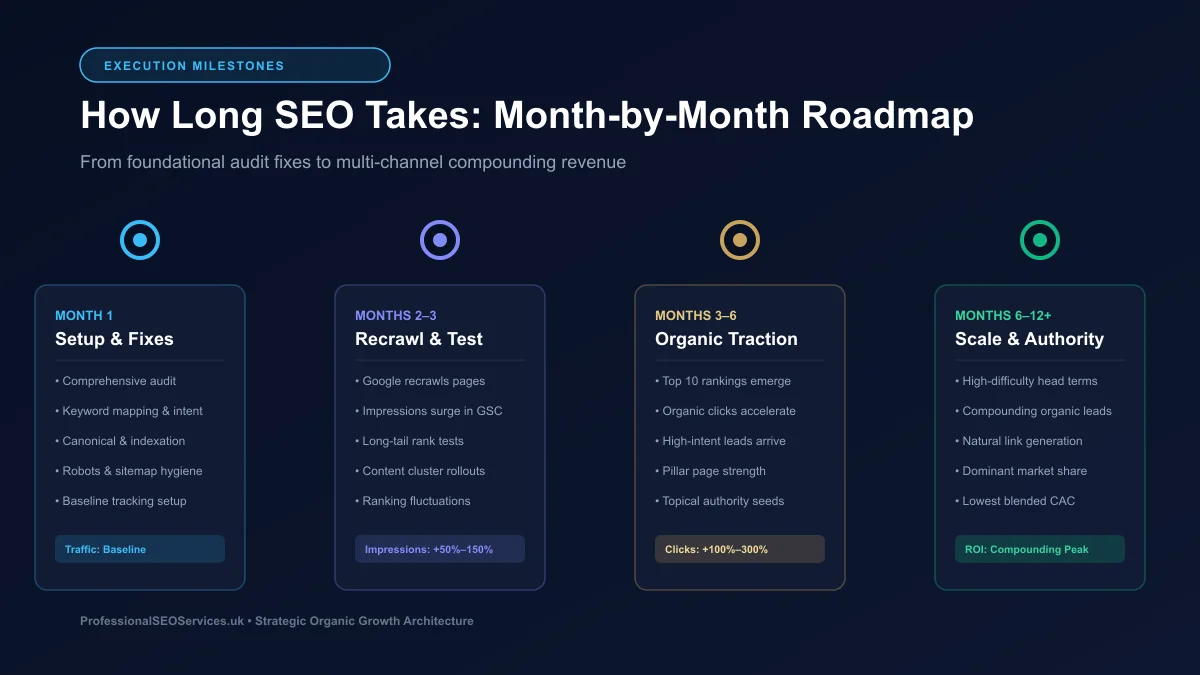
To provide an actionable, realistic operational roadmap, let us examine what a senior SEO agency executes across a standard 12-month campaign and what performance milestones you should expect at each stage.
Month 1: Technical Audit, Strategy, and Foundation Setup
Month 1 is dedicated to discovery, diagnosis, and infrastructure hygiene. No seasoned professional promises massive traffic spikes in the first 30 days because optimizing without a comprehensive audit is like building a skyscraper on swamp water.
Key Month 1 deliverables include:
- Comprehensive Technical SEO Audit: Uncovering crawl errors, broken redirect loops, 404 dead ends, JavaScript rendering traps, and server latency bottlenecks.
- Crawl Budget & Indexation Hygiene: Streamlining
robots.txt, submitting clean XML sitemaps, configuring self-referencing canonical tags, and eliminating duplicate parameters. - Deep Keyword & Competitor Gap Analysis: Mapping commercial intent, search volume, keyword difficulty, and competitor topic clusters across your sales funnel.
- Analytics & Tracking Configuration: Calibrating Google Analytics 4 (GA4), Google Search Console (GSC), Bing Webmaster Tools, and conversion event tagging to guarantee data accuracy.
- Topical Architecture Roadmapping: Designing pillar-and-cluster content frameworks that dictate your editorial schedule for the next two quarters.
For teams asking how long does SEO take to set up or how long does it take to implement SEO, foundational technical remediation typically spans 3 to 6 weeks. At this stage, your traffic metrics will remain flat at your baseline, which is completely expected.
Months 2–3: Crawling, Indexation, and Initial Ranking Movement
During months two and three, your technical fixes take effect, on-page optimizations are deployed, and your first batch of topic cluster content goes live. Googlebot begins recrawling your site with greater frequency.
What you will observe in Months 2–3:
- Google Search Console Impressions Surge: Total impressions often double or triple before organic clicks begin climbing. This proves Google is testing your pages for thousands of newly recognized search terms.
- Long-Tail Keywords Rank First: Specific, low-competition 4-to-6 word queries (e.g., “how to optimize internal links for ecommerce sites”) enter positions 10 to 30.
- Keyword Ranking Fluctuations: Pages often bounce between positions 18 and 50 as Google's algorithmic systems test user satisfaction and recalculate relevance signals.
- Leading Indicators, Not Conversion Peaks: While commercial revenue has not exploded yet, these early indicators confirm that search engines have accepted your technical baseline and begun scoring your content.
Months 3–6: SEO Starts Gaining Tangible Traction
Months 3 to 6 represent the inflection point where organic efforts transform into tangible business momentum. By this time, Google has re-evaluated your site's quality patterns, several content clusters are fully indexed, and internal link equity flows effectively.
Key milestones in Months 3–6:
- Striking Distance Migration: Target commercial keywords steadily climb from Page 3 and 2 into striking distance (positions 8 to 15).
- Organic Clicks Accelerate: As long-tail keywords penetrate the top 5 positions, qualified organic visits increase by 50% to 200% over baseline.
- Early Qualified Leads & Sales: Inbound phone inquiries, demo requests, and product transactions begin arriving consistently through organic search.
- Topical Relevance Reinforcement: Google associates your domain with core industry entities, accelerating the indexation velocity of newly published pieces.
This answers why queries like how long does SEO take to work 3–6 months and how long does SEO take to see results 3–6 months are standard industry milestones.
Months 6–12: Compounding Organic Growth and Market Expansion
Between months 6 and 12, the compounding organic flywheel operates at full power. Your website possesses established indexation history, multiple mature topical clusters, and an expanding network of naturally acquired editorial backlinks.
What happens in Months 6–12:
- Competitive Head Terms Reach Top 5: High-volume, commercially lucrative keywords climb onto the upper half of Page 1.
- Organic Traffic Multiplication: Total organic sessions frequently increase by 200% to 500%+ compared to pre-campaign baselines.
- Customer Acquisition Cost (CAC) Plummets: Because organic clicks carry no marginal media spend, your blended cost per lead drops substantially.
- Content Refresh Opportunities: Early articles published in Months 1 and 2 are refreshed and expanded based on real Search Console query data, unlocking instant ranking gains.
12+ Months: Scaling, Moat Building, and Category Dominance
After 12 months, your SEO program transitions from initial customer acquisition into defending and expanding your market share. SEO has no finish line. Search algorithms undergo thousands of updates every year, and competitors continuously invest in overtaking your top listings.
Ongoing focus areas at 12+ months include:
- Dominating Ultra-Competitive Industry Head Terms: Challenging category leaders for high-intent head terms.
- Digital PR & Thought Leadership: Securing mainstream press coverage, podcast appearances, and authoritative brand citations.
- International & Programmatic SEO: Expanding into new geographic territories via hreflang architectures or deploying programmatic landing pages to capture long-tail demand at scale.
- Conversion Rate Optimization (CRO): Continually optimizing high-ranking pages to maximize lead capture and transaction conversion rates.
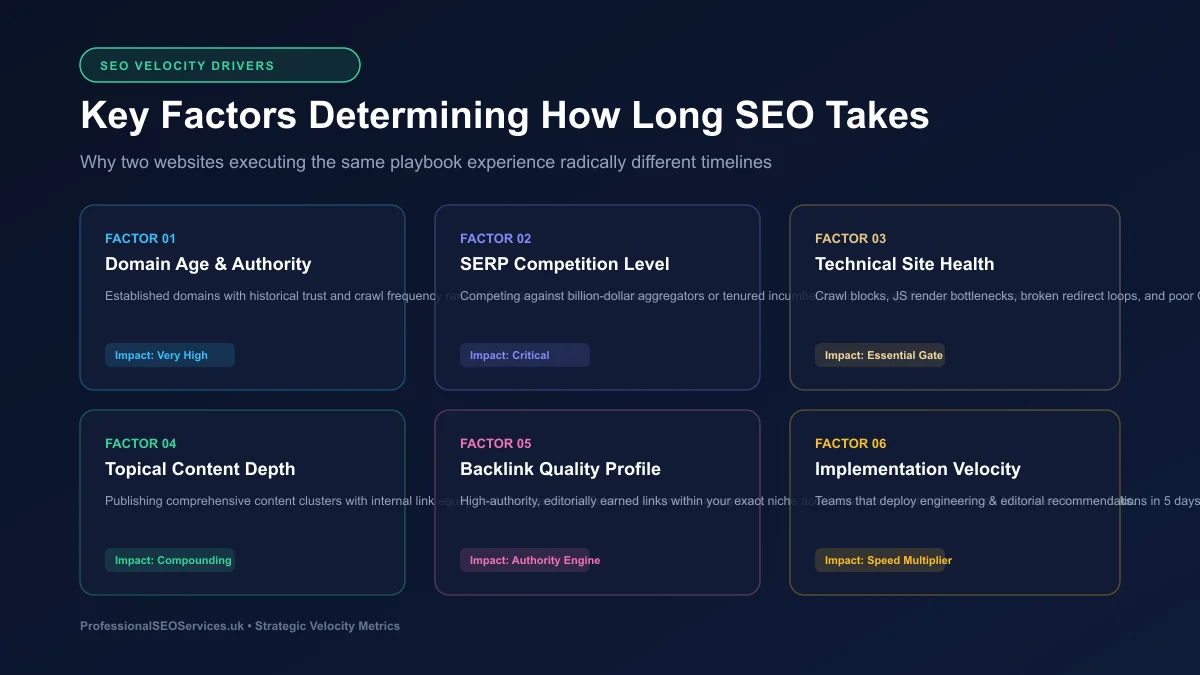
What Factors Determine How Long SEO Takes?
Why can two businesses in different sectors deploy identical SEO budgets yet experience radically different timelines? The speed of your organic progress is governed by seven distinct variables.
1. Website Age and Existing Historical Authority
An established domain registered eight years ago with hundreds of clean editorial backlinks and existing Page 2 rankings provides an immense launchpad. When you fix technical bottlenecks or add fresh content to an authoritative domain, Googlebot crawls and rewards those pages in weeks. Conversely, a brand-new domain with zero trust signals must spend months earning baseline credibility before algorithms permit Page 1 exposure.
2. SERP Keyword Competition and Search Intent
Ranking for a hyper-niche query like “commercial HVAC acoustic vibration dampeners Manchester” might take 6 to 10 weeks because only three other local websites discuss the topic. By contrast, ranking for “CRM software for enterprise sales” requires unseating multi-billion-dollar corporations like Salesforce, HubSpot, and Forbes who spend millions monthly on content and links.
3. Website Technical Health and Architecture
If your web server suffers from frequent 5xx timeout errors, slow server response times (TTFB > 1.8s), unrendered client-side JavaScript, or recursive redirect chains, Googlebot's crawler burns through its allocated crawl budget without ever discovering your primary money pages. Technical bottlenecks act as hard gatekeepers that delay every other organic initiative.
4. Content Quality and Semantic Topical Depth
Superficial, 500-word articles that regurgitate generic talking points will never outrank content that delivers genuine Information Gain, proprietary case data, custom diagrams, and complete semantic coverage of related entities. The more comprehensive and original your content, the faster search engines recognize your topical authority.
5. Quality and Relevance of Your Backlink Profile
Raw link quantity is meaningless; what matters to modern search engines is contextual relevance, editorial authority, and link acquisition velocity. Ten contextual backlinks from respected trade publications in your specific vertical will move organic rankings faster than 1,000 low-quality forum or directory links.
6. SEO Implementation Speed: The Silent Timeline Gap
This is one of the most critical yet frequently ignored factors in search performance. Two companies can hire the same agency and receive identical technical audits and content recommendations.
Company A has an agile development team that pushes technical fixes, schema markup, and meta tag changes to staging within five business days. Company B requires five rounds of executive committee approval, passing recommendations between internal departments for three months before publishing a single change. Company A sees ranking improvements by Month 2; Company B complains by Month 4 that “SEO isn't working,” when in reality, the strategy was never actually deployed.
7. Industry and Vertical Market Dynamics
Timelines vary drastically across different industry verticals due to competitive density, regulatory scrutiny (such as Your Money Your Life / YMYL guidelines), and search volumes:
- Local Service Businesses (Roofing, Plumbers, HVAC): Often achieve Page 1 local pack and map visibility within 2 to 4 months.
- Managed Service Providers (MSPs) & B2B SaaS: Typically require 4 to 8 months due to longer research cycles and technical buyer personas.
- Ecommerce Storefronts: Depend heavily on catalog crawlability, faceted navigation indexing, and product schema, usually requiring 4 to 9 months.
- Law Firms & Financial Institutions: Face hyper-competitive, high-CPC queries subject to rigorous E-E-A-T standards, commonly requiring 8 to 14+ months.
How Long Does SEO Take for a New Website?
For owners of brand-new domains, the wait can feel particularly excruciating. Let us compare realistic expectations across different domain starting points:
It is important to clarify that domain age itself is not a direct algorithmic ranking factor. Google does not give a domain preference simply because its WHOIS registration date is from 2012. What matters is the accumulated history of signals associated with that age: continuous crawl records, historical user engagement, established entity connections, and an earned backlink profile. A brand-new website lacks this accumulated digital footprint, requiring Google's machine learning models extended observation time to confirm that the business is legitimate, reliable, and trustworthy.
How Long Does It Take for SEO Changes to Take Effect?
Many business owners asking about SEO timelines are not launching an entire annual campaign—they have already made a specific technical or on-page modification and want to know when Google will reflect it. Here is an empirical breakdown of how long specific SEO modifications take to process:
How Long Does It Take for an SEO Description to Update?
A common operational question among digital marketing managers is: how long does it take for an SEO description to update?
How Long Does It Take for a Meta Description to Update on Google?
When you write and publish a new meta description, Google typically updates the search snippet within 3 to 14 days, provided Googlebot revisits the page. However, you must keep three crucial caveats in mind:
- Google must recrawl the page first: If your website has low crawl priority, the outdated description will remain in search snippets until Googlebot re-fetches the HTML. You can submit the URL through the Google Search Console "URL Inspection" tool to accelerate crawl discovery.
- Google does not guarantee your meta description will appear: Empirical research reveals that Google rewrites meta descriptions in roughly 60% to 70% of search queries. If Google's algorithms determine that an on-page paragraph matches the user's specific query better than your meta description, it will dynamically generate its own snippet.
- Changing a meta description does not directly improve rankings: Meta descriptions have not been a direct Google ranking factor since 2009. While an enticing meta description improves your Organic Click-Through Rate (CTR)—which drives more traffic—it will not mechanically push a page from Position #8 to Position #1.
Best Practice Guidelines: How Long Should an SEO Description Be?
To prevent Google from truncating your search snippet on mobile or desktop devices:
- Keep meta descriptions between 150 and 160 characters (or roughly 920–960 pixels).
- Always integrate your primary focus keyword naturally within the first 100 characters so search engines can bold the matching terms when users query them.
- Include a clear value proposition and an actionable call to action (e.g., “Explore our realistic month-by-month roadmap”).
How Long Does It Take Google to Update SEO Changes?
To understand why search updates do not happen instantaneously, every digital strategist should understand the core featured-snippet framework:
The Fundamental Rule: Crawling ≠ Indexing ≠ Ranking
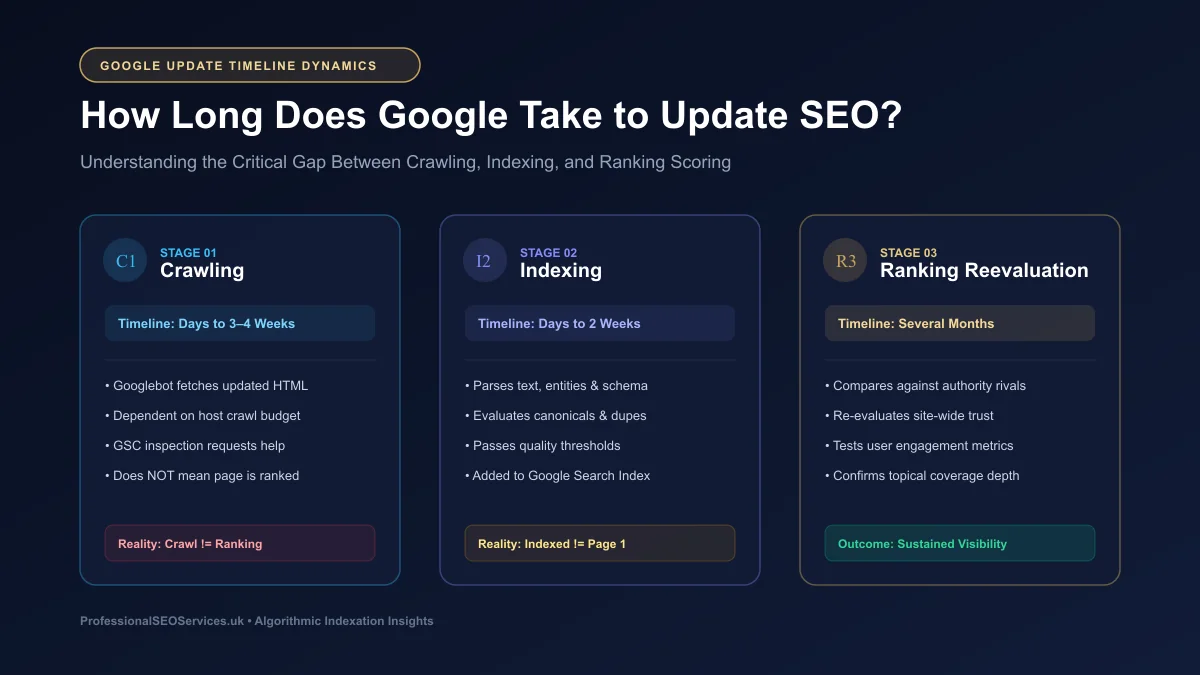
A search engine does not execute optimization updates in a single step. Google operates three entirely distinct automated systems: Crawling discovers the code, Indexing analyzes and stores the document, and Ranking scores the page against competitive alternatives. An update is not visible on the SERP until all three systems complete their work.
Stage 1: Crawling
Googlebot Smartphone visits your web server, downloads the HTML document, requests accompanying stylesheets and scripts, and queues the URL for processing. Crawling can take anywhere from a few hours for high-authority media hubs to 3 to 4 weeks for smaller, infrequently updated websites.
Stage 2: Indexing
Google's Web Rendering Service (WRS) compiles client-side JavaScript, extracts textual entities, parses structured data schema, checks for duplication against existing web pages, and determines whether the content satisfies basic quality thresholds for storage in the primary Search Index.
Stage 3: Ranking Scoring
When a user enters a search query, Google's candidate retrieval systems pull potentially relevant indexed pages. Hundreds of algorithmic scoring systems (including BERT, RankBrain, MUM, helpful content systems, and PageRank) score each candidate document to determine its exact numerical position.
Stage 4: Search Result SERP Display
Finally, Google's layout generator constructs the public SERP, rendering standard blue links, featured snippet cards, People Also Ask dropdowns, and AI Overviews.
Why Does SEO Take Longer for Some Websites Than Others?
If you find your organic campaign progressing slower than expected, your site likely falls into one of eight distinct structural scenarios:
- Brand-New Websites: Possess zero historical trust, low crawl frequency, and no earned backlink equity.
- Low-Authority Domains: Struggle to outrank legacy competitors due to a low volume of external referring domains.
- Highly Competitive Commercial Industries: Competing in finance, legal, SaaS, or insurance requires displacing incumbents with million-pound monthly budgets.
- Targeting Ultra-Competitive Head Terms: Broad 1-word or 2-word keywords require encyclopedic topical authority that takes 12+ months to construct.
- Websites with Deep Technical Debt: Severe indexing errors, slow page speed (failing Core Web Vitals), or rendering traps silently throttle ranking potential.
- Sites with Thin or Unoriginal Content: Regurgitating generic content without unique data or expert perspectives fails Google's quality criteria.
- Weak or Toxic Backlink Profiles: Sites suffering from historical spam links or algorithmic demotions require months of cleanup before new optimizations register.
- Inconsistent Publishing & Execution: Publishing sporadic articles every three months prevents search crawlers from establishing a consistent recrawl frequency.
How Long Does SEO Take for Small Businesses?
For local service enterprises—such as dental clinics, accounting practices, plumbing contractors, and regional retail outlets—the timeline is generally much more accelerated than national ecommerce or enterprise software campaigns.
Local SEO for small businesses commonly produces measurable inbound inquiries within 2 to 4 months. This faster timeline is possible because local search algorithms rely heavily on localized relevance and proximity rather than massive national backlink profiles.
A comprehensive small business SEO campaign focuses on:
- Google Business Profile (GBP) Optimization: Completing primary and secondary categories, uploading geotagged imagery, verifying business hours, and systematically collecting customer reviews.
- Local Map Pack Domination: Optimizing local NAP consistency (Name, Address, Phone) across high-tier UK and regional citation directories.
- Dedicated Location & Service Pages: Crafting localized landing pages targeting high-intent queries such as “commercial electrical contractor Birmingham” or “roof repair Southampton.”
- Hyper-Local Backlinks: Sponsoring local charity events, collaborating with regional chambers of commerce, and securing local press mentions.
In moderately sized regional markets, small businesses can achieve dominant Google Maps 3-Pack rankings and consistent phone calls within 90 to 120 days. In dense metropolitan centers (such as Central London or Manchester), competition may extend the window to 6 to 9 months.
How Long Does SEO Take for Law Firms?
Legal SEO represents one of the most competitive, high-stakes arenas in organic search. Google Ads pay-per-click costs for terms like “personal injury solicitor” or “commercial litigation lawyer London” frequently exceed £50 to £120+ per single click. Because the commercial value of a single client can reach tens of thousands of pounds, legal SERPs are fiercely contested.
SEO for law firms typically takes 6 to 12+ months to achieve dominant Page 1 rankings for competitive practice areas. Legal websites fall strictly under Google's Your Money or Your Life (YMYL) content classification, meaning Google demands the highest standards of Experience, Expertise, Authoritativeness, and Trustworthiness (E-E-A-T).
To win in legal SEO, firms must execute:
- Exhaustive Practice-Area Clusters: Publishing deep, legally verified answers addressing every nuance of statute, procedural timeline, and case settlement considerations.
- Verified Legal Author Credentials: Incorporating comprehensive author biographies detailing bar admissions, legal accreditations, and verified judicial experience.
- High-Tier Legal Digital PR: Earning commentary citations in mainstream news publications, legal journals, and judicial commentary blogs.
- Localized Practice Hubs: Dominating Local Service Ads (LSAs) and Google Maps 3-Packs alongside traditional organic blue links.
How Long Does SEO Take to Pay Off? Shifting from Vanity Rankings to Revenue
A foundational mistake many marketing executives make is measuring SEO success purely by vanity metrics: keyword counts and Position #1 badges. SEO does not pay off when a keyword moves to position #1; SEO pays off when qualified organic traffic converts into paying customers and bottom-line revenue.
When evaluating organic ROI, modern organizations look at full-funnel business outcomes:
- Qualified Organic Visits: Traffic filtering for commercial intent rather than accidental informational clicks.
- Inbound Leads & Phone Inquiries: Tracked phone calls, form completions, and consultation requests originating from search.
- Direct Ecommerce Revenue: Organic search transactions, average order value (AOV), and customer lifetime value (LTV).
- CAC Reduction: Decreasing your blended customer acquisition cost by shifting reliance away from paid PPC auctions.
For most B2B enterprises and ecommerce storefronts, SEO officially reaches a break-even ROI between months 6 and 9. By months 12 to 18, organic search routinely produces the highest return on investment of any digital marketing channel, continuing to generate revenue long after the initial development investment was made.
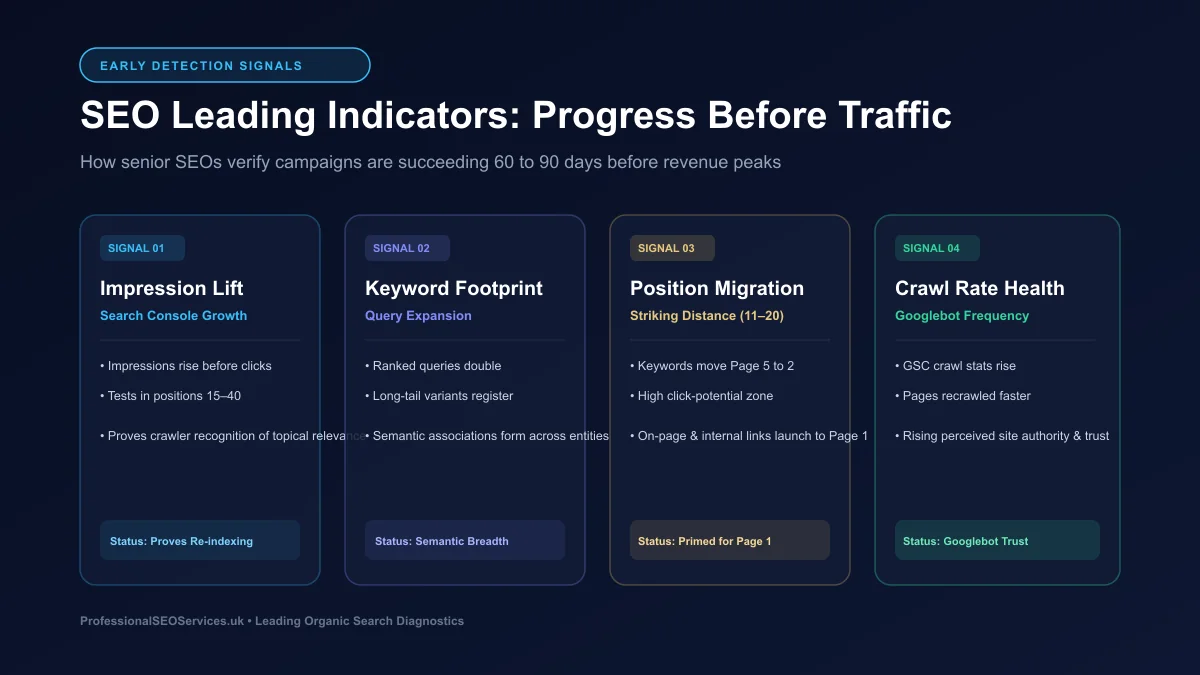
How Do You Know If Your SEO Is Working Before Traffic Increases?
One of the most dangerous moments in any SEO campaign occurs between months 2 and 3, when stakeholders look at overall website sessions, see modest growth, and prematurely assume the campaign is failing.
Senior search strategists do not evaluate early-stage campaigns through traffic alone; they monitor leading indicators. Leading indicators are early algorithmic signals that prove search engines are responding positively to your optimizations long before traffic explodes:
1. Impressions Are Multiplying
Total impressions in Google Search Console spike weeks before clicks materialize. This confirms Google has indexed your pages and is testing them for relevant queries.
2. Total Ranked Keywords Double
Third-party tools (Ahrefs, Semrush) show your keyword footprint expanding from 200 queries to 1,200 queries across positions 20–80.
3. Keywords Move Page 5 to Page 2
Climbing from position 48 to position 14 generates virtually zero new clicks, but algorithmically, it represents massive progress into striking distance.
4. Indexed Page Ratio Improves
In GSC Page Indexing reports, previously "Discovered - currently not indexed" URLs systematically transition to "Indexed" status.
5. Long-Tail Queries Surface
Highly specific query variants begin registering organic clicks, demonstrating that Google's semantic models understand your contextual depth.
6. Googlebot Crawl Frequency Rises
Crawl stats reports show search bots visiting your domain more frequently and with lower download latency, proving growing domain trust.
How Can You Make SEO Work Faster?
Let us be completely transparent: there are no secret shortcuts or backdoor cheat codes to manipulate Google's algorithms. Anyone promising instant Page 1 rankings within 14 days is using black-hat tactics that risk complete domain de-indexing.
However, you can dramatically compress avoidable delays by eliminating the operational frictions that slow campaigns down:
- Eliminate Technical Roadblocks First: Ensure your website is effortlessly crawlable, passes Core Web Vitals, and has clean, self-referencing canonical structures.
- Target Low-Competition, High-Intent Keywords First: Do not start by trying to rank for broad 1-word terms. Capture 3-word and 4-word long-tail queries to generate early traffic and revenue.
- Publish Complete Topical Clusters: Avoid publishing isolated one-off articles. Release complete topic hubs of 10 to 15 interlinked guides to establish topical authority rapidly.
- Refine Internal Linking Architecture: Connect your informational cluster articles to primary commercial landing pages to pass PageRank equity efficiently.
- Earn Quality Backlinks Through Digital PR: Focus on editorially earned links from respected industry publications that transfer real domain authority.
- Deploy Recommendations Rapidly: Accelerate your internal engineering and content approval cycles; companies that deploy changes in days see results months faster.
What SEO Tactics Should You Avoid If You Want Faster Results?
When business owners get impatient, they often fall prey to outdated or manipulative tactics that cause irreparable harm. If you want sustainable, fast organic growth, avoid these critical traps:
- Buying Bulk Spammy Backlinks: Purchasing link packages from freelance marketplaces or private blog networks (PBNs) triggers automated spam filters or manual penalties.
- Keyword Stuffing: Artificially forcing exact-match keywords into every heading ruins readability and violates Google's spam guidelines.
- Publishing Low-Quality AI Content at Scale: Auto-generating hundreds of thin, unedited AI articles lacking unique data or first-hand experience results in Google's quality algorithms ignoring your entire domain.
- Constantly Changing URL Structures: Renaming URLs or constantly altering folder structures resets Google's crawl and indexing evaluations, creating massive ranking volatility.
- Expecting One Article to Transform Business Revenue: SEO is a systematic sitewide engine, not a lottery ticket. Sustainable growth requires a holistic strategy.
How Long Does It Take to Learn SEO?
While our primary focus is understanding campaign timelines, many practitioners ask: how long does it take to learn SEO?
Mastering organic search follows a tiered progression:
- SEO Fundamentals (Weeks to 2 Months): Understanding keyword research, title tag optimization, crawling basics, and Search Console navigation.
- Practical Working Proficiency (4 to 8 Months): Executing hands-on site audits, technical fixes, schema implementation, and topic cluster architecture across live websites.
- Advanced Enterprise Mastery (Ongoing / Multi-Year): Navigating complex JavaScript rendering, international hreflang architectures, algorithmic core update recovery, and data science integration. Search algorithms evolve continuously, making SEO an ongoing discipline of continuous learning.
How Long Should an SEO Blog or Article Be?
Another common question is: how long should a blog be for SEO or how long should an SEO article be?
Google does not have any algorithmic word count requirement. There is no magical number—whether 800 words, 1,500 words, or 3,000 words—that automatically guarantees a ranking.
Search engines reward content that completely satisfies the searcher's intent with maximum efficiency. If a user queries “what time does the London Stock Exchange open,” an answer requiring 50 words is superior to a 2,000-word essay on financial history. However, for complex, multi-layered queries (such as “how long does SEO take to work”), delivering an authoritative, comprehensive breakdown naturally requires 3,000 to 4,500+ words to cover every technical facet, scenario, and timeline detail.
How Long Has SEO Been Around?
Search Engine Optimization has been around for over three decades, originating in the mid-1990s alongside early search directories like Archie, Lycos, AltaVista, and Yahoo!. The term “Search Engine Optimization” was coined around 1997.
The industry has transitioned through distinct technological eras:
- The Early Directory Era (1995–1998): Simple keyword density and alphabetical cataloging.
- The PageRank Revolution (1998–2010): Google introduced link equity mathematics, transforming links into votes of web authority.
- The Quality & Semantic Era (2011–2022): Algorithmic filters like Panda, Penguin, Hummingbird, and BERT penalized web spam and introduced Natural Language Processing.
- The AI & Generative Search Era (Present): Search engines evaluate deep entity graphs, multi-modal search intent, and synthesize answers through AI Overviews and LLM retrieval.
How Long Does SEO Last? Is It a One-Time Campaign?
SEO is an enduring digital asset, but it does not have an indefinite shelf life without ongoing maintenance. If you stop investing in SEO after achieving top rankings, your positions will not disappear overnight—in fact, high-authority pages often maintain top rankings for months or years.
However, gradual organic decay occurs because:
- Competitors actively invest in creating newer, more comprehensive content to surpass you.
- Search engine algorithms release regular Core Updates, shifting intent weighting and quality criteria.
- Backlinks naturally decay over time as external websites redesign, delete pages, or go offline.
- Industry statistics, software interfaces, and factual references become outdated.
Treat SEO like maintaining a commercial property: building the foundation and framing requires the most intensive upfront investment, but routine maintenance, content refreshes, and technical upkeep are essential to preserve its market value.
Frequently Asked Questions About How Long SEO Takes
Here are direct, evidence-based answers to the fifteen most common questions regarding search engine optimization timelines:
How long does SEO take to work?
SEO typically takes between 3 to 6 months to generate measurable organic search traffic and ranking improvements. Initial technical and crawl signals appear within weeks, while substantial revenue and competitive top-3 keyword positions generally require 6 to 12+ months of consistent optimization.
How long does SEO take to show results?
SEO starts showing early leading indicators (such as impression spikes in Google Search Console and keyword indexing) in 30 to 90 days. Meaningful commercial traffic and qualified inbound leads commonly manifest between months 3 and 6 as topical authority accumulates.
How long does it take for SEO to start working?
SEO starts working from the moment search crawlers detect and parse your technical fixes or newly published content, often within days to a few weeks. However, algorithmic re-evaluation, entity scoring, and PageRank recalculations require several weeks before reflecting on the public SERP.
How long before I see SEO results?
Most businesses observe initial organic impressions within 4 to 8 weeks. Noticeable organic traffic growth and keyword ranking climbs usually become evident between months 3 and 6, with high-intent lead conversions accelerating in months 6 through 12.
How long does it take to get SEO results?
Getting substantial business results from SEO requires a 3 to 12 month timeframe, depending on your domain age, technical site baseline, competitor authority, backlink profile, and implementation velocity.
How long does Google take to update SEO?
Google can recrawl a modified page in a few hours to several weeks. However, processing changes, indexing updates, and algorithmically re-evaluating ranking positions across competing websites typically takes several weeks to a few months.
How long do SEO changes take to kick in?
Simple on-page edits (like title tags) may reflect in search snippets within 3 to 14 days after Googlebot recrawls the URL. Broader structural, semantic content, and backlink changes typically take 6 to 12 weeks to influence overall keyword rankings.
How long does organic SEO take?
Organic SEO is an ongoing compounding process. Foundational technical changes take 1 to 3 months, topical authority clusters require 3 to 6 months to mature, and dominating head commercial terms often takes 9 to 12 months or longer.
How long does SEO take for a new website?
A brand-new website with zero historical authority generally takes 6 to 12 months to gain meaningful search traction. New domains lack accumulated trust, backlinks, and indexation history, requiring Google systems extended observation time to confirm quality.
How long does SEO take for a small business?
Local SEO for small businesses can produce ranking and inbound call improvements in 2 to 4 months through Google Business Profile optimization, local citations, and localized service pages. Competitive metro markets may take 6 to 9 months.
Can SEO produce results in 30 days?
In 30 days, SEO produces leading indicators—such as resolving severe crawl errors, indexing previously blocked URLs, and registering impression spikes. Full business-level revenue and competitive keyword rankings rarely occur within 30 days.
Can SEO results happen in 3 months?
Yes, 3 months is a common threshold for early organic momentum, especially for established domains targeting low-to-moderate competition long-tail keywords or fixing critical technical bottlenecks.
Why does SEO take a year?
SEO takes up to a year for highly competitive keywords because search engines must observe long-term user satisfaction, backlinks must be naturally earned, topical coverage must be demonstrated across dozens of subtopics, and established competitors must be systematically overtaken.
Does SEO take time?
Yes, SEO fundamentally requires time because Google operates an asynchronous crawling, rendering, indexing, and multi-layered algorithmic scoring pipeline designed to reward enduring trust rather than temporary shortcuts.
Can you guarantee how long SEO will take?
No legitimate agency can guarantee a fixed date for SEO results because search engine algorithms, crawling queues, and competitor counter-actions are third-party variables outside any individual's direct control. Google explicitly warns against any firm guaranteeing instant rankings.
Final Answer: Why Does SEO Take So Long?
At its foundation, SEO takes so long because search engine algorithms are mathematically designed to measure and reward accumulated trust, not temporary activity.
When you invest in search engine optimization:
- Google must discover, crawl, render, index, and continuously re-evaluate your technical updates across distributed global data centers.
- You are actively competing against entrenched industry rivals who have spent years earning backlinks, topical authority, and brand recognition.
- Topical relevance and link authority accumulate gradually; search algorithms require sustained observation to confirm that your website delivers enduring value to searchers.
While the wait requires patience and executive discipline, the reward is unmatched: an appreciating digital asset that captures high-intent customers around the clock, lowers customer acquisition costs, and builds an enduring competitive moat around your business. If you are ready to construct a data-driven, senior-led organic growth roadmap, partner with Professional SEO Services today to build a search strategy that scales your revenue predictably.